Last updated: March 25, 2026
Quick Answer
Yes, having a doctor remove a skin tag is the safest and most effective option. A trained physician can confirm the growth is benign, choose the right removal method, and complete the procedure in a single short visit — with minimal risk of infection, scarring, or complications. Most procedures take under 15 minutes.
Key Takeaways
- Skin tags are benign, soft growths — but a doctor should confirm that before removal.
- A doctor can remove a skin tag using excision, cryotherapy, or cauterization, depending on size and location.
- Professional removal reduces the risk of infection, scarring, and incomplete removal.
- DIY removal carries real risks: bleeding, infection, and potential scarring from improper technique or unapproved products.
- Skin tag removal is usually considered cosmetic and not covered by insurance unless medically necessary (e.g., bleeding, irritation, or diagnostic uncertainty).
- Multiple skin tags can often be removed in a single visit.
- Some growths that look like skin tags may need a biopsy — another reason professional assessment matters.
- At The Minor Surgery Center, patients across Toronto and the GTA receive expert outpatient care with a comfort-first approach.
What Is a Skin Tag and Why Do People Get Them?
A skin tag (medically called an acrochordon) is a small, soft flap of skin connected to the body by a thin stalk. They are completely benign and very common — affecting a large portion of adults at some point in their lives.
They tend to appear in areas where skin rubs against skin or clothing:
- Neck
- Armpits (axilla)
- Groin and inner thighs
- Eyelids
- Under the breasts
Skin tags are more common in people with obesity, diabetes, or a family history of them. Hormonal changes during pregnancy can also trigger new ones. Want to understand what causes them in more detail? Read our guide on why skin tags form.
The growth itself is harmless. But it can catch on clothing, jewellery, or a razor — causing irritation, bleeding, or just plain annoyance. That's usually when people start looking for removal options.
Important: Not every small skin-coloured growth is a skin tag. Some lesions that look similar — including certain warts, moles, or in rare cases, malignant growths — require a professional eye to distinguish. See our complete guide to 25+ types of skin lesions to understand the differences.
Why Have a Doctor Remove a Skin Tag Instead of Doing It Yourself?
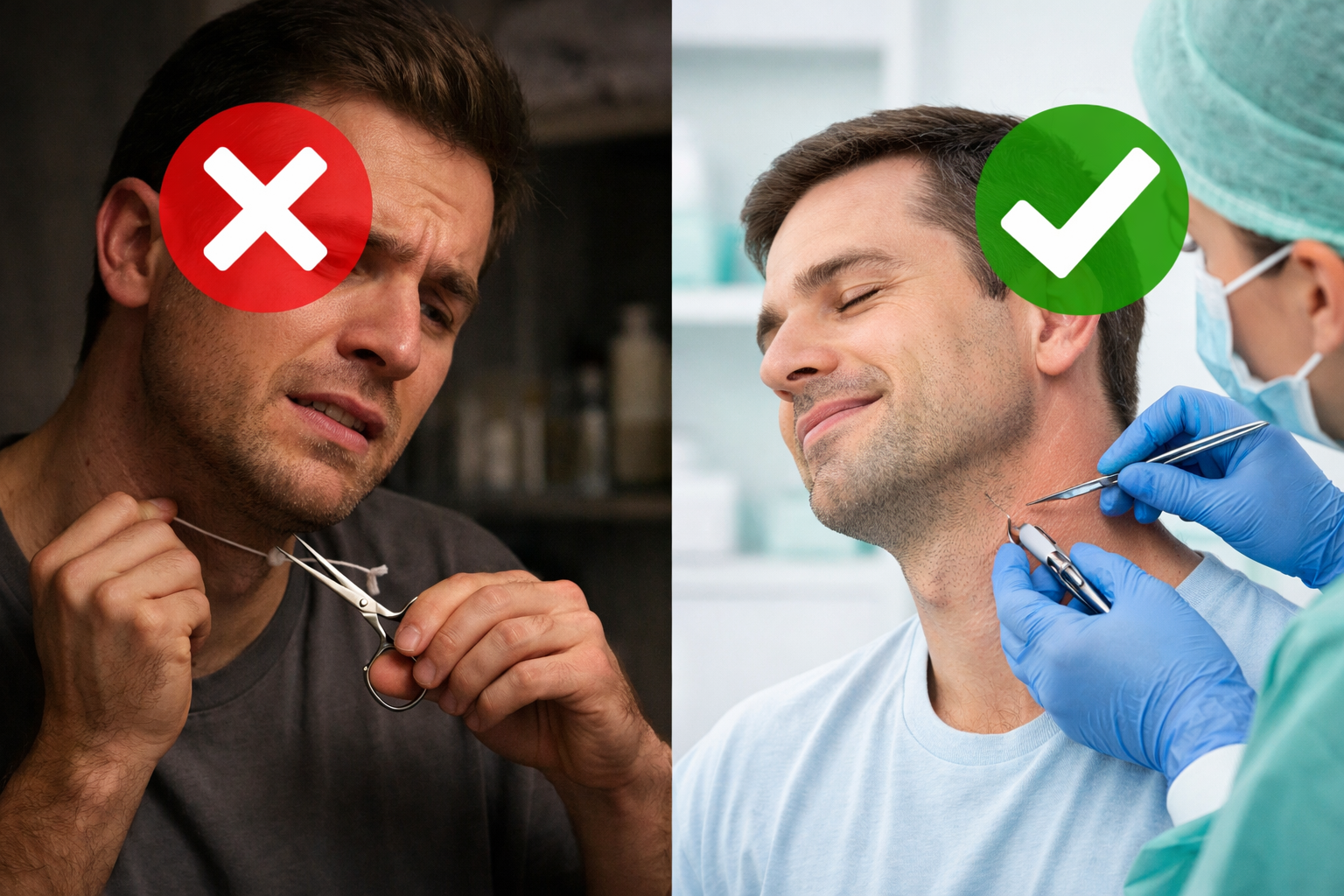
Having a doctor remove a skin tag is safer than DIY methods because a physician can confirm the diagnosis, use sterile technique, and manage any complications on the spot.
DIY removal might seem tempting — there are plenty of at-home kits, freeze sprays, and internet tutorials. But the risks are real.
What can go wrong with DIY removal:
- Infection from non-sterile scissors, string, or nail clippers
- Excessive bleeding, especially on the face or near the eyelid
- Incomplete removal, causing the tag to grow back or leave a raw wound
- Scarring from improper technique or caustic products
- Misdiagnosis — removing something that actually needed a biopsy
The FDA has flagged unapproved over-the-counter skin tag removers containing concentrated salicylic acid or Sanguinaria canadensis as associated with serious burns, ulceration, permanent scarring, and disfigurement — including 14 reported facial injuries [1]. That's not a minor risk.
A doctor brings sterile instruments, local anaesthesia, and clinical judgment. That combination makes a significant difference — especially for tags near the eyes, genitals, or any area prone to irritation.
How Does a Doctor Remove a Skin Tag? The Main Methods
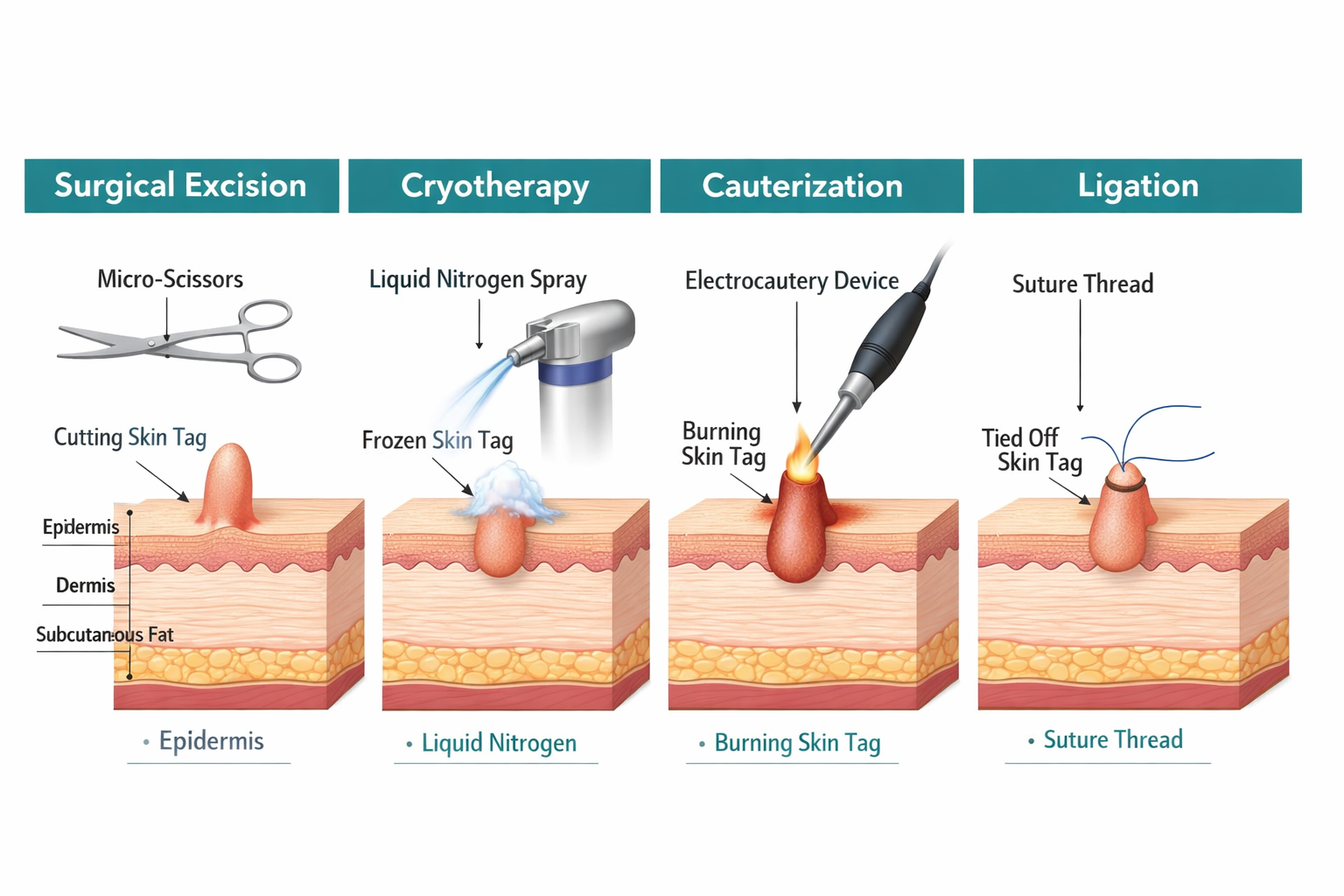
A doctor removes a skin tag using one of three main techniques: surgical excision, cryotherapy, or cauterization. The best method depends on the tag's size, location, and the patient's skin type.
Here's a breakdown:
| Method | How It Works | Best For | Recovery |
|---|---|---|---|
| Surgical Excision | Surgeon cuts the tag off with sterile scissors or a scalpel after local anaesthetic | Most sizes; precise removal | Heals in 1–2 weeks |
| Cryotherapy | Liquid nitrogen freezes the tag; it falls off within days | Smaller tags; multiple at once | Mild redness, 1–2 weeks |
| Cauterization (Electrocautery) | Electrical current burns the tag off and seals the wound | Bleeding-prone areas | Heals in 1–2 weeks |
| Ligation | Suture tied around the stalk cuts off blood supply | Larger, pedunculated tags | Tag falls off in days |
At The Minor Surgery Center, our experienced surgical team often uses ethyl chloride spray for comfortable, quick anaesthesia before micro-scissor excision — a method that's both precise and well-tolerated [1].
Choose excision if: the tag is large, located in a sensitive area, or needs to be sent for pathology.
Choose cryotherapy if: you have multiple small tags and want a fast, no-needle option.
Choose cauterization if: the site has a history of bleeding or the tag is in a vascular area.
Most procedures are completed in under 15 minutes. Patients are in and out the same day — no hospital stay, no general anaesthesia, no lengthy recovery. That's the beauty of expert outpatient care.
When Should You See a Doctor to Remove a Skin Tag?
You should see a doctor to remove a skin tag when it causes pain, bleeding, or irritation — or when you're not certain the growth is actually a skin tag.
See a doctor if:
- The tag bleeds regularly or catches on clothing
- It's growing, changing colour, or changing shape
- You have multiple new tags appearing quickly
- The growth is near your eye, genitals, or anus
- You're unsure whether it's a skin tag, mole, or wart
- You want it removed cleanly with minimal scarring
You can wait (or monitor) if:
- The tag is small, stable, and causes zero symptoms
- It's in a location where it never gets irritated
- You're not bothered by its appearance
One thing worth knowing: skin tags don't become cancerous. But some lesions that look like skin tags — including certain types of basal cell carcinoma — can be mistaken for them. Learn more about potentially cancerous skin tags and what to look for.
If there's any doubt, a doctor can assess the growth and, if needed, send it for a biopsy. That peace of mind is worth the visit.
Does Insurance Cover Doctor-Performed Skin Tag Removal?
Skin tag removal is typically considered cosmetic and not covered by insurance unless there is documented medical necessity [1].
Coverage is more likely when:
- The tag causes documented pain, bleeding, or recurrent irritation
- It interferes with daily activities or hygiene
- There is diagnostic uncertainty requiring a biopsy
- The site shows signs of infection or inflammation [1]
Coverage is typically denied when:
- Removal is purely cosmetic (no symptoms)
- Multiple tags are removed in one session without individual medical justification
- The goal is preventive removal for future cosmetic concerns [1]
In Canada, OHIP generally does not cover cosmetic skin tag removal. Private insurance plans vary — some cover removal if a physician documents medical necessity.
For billing purposes, CPT code 11200 covers removal of up to 15 skin tags in a single session, while CPT code 11201 covers each additional 10 tags beyond the first 15 [2]. ICD-10 code L91.8 (Other Hypertrophic Disorders of the Skin) applies when tags cause irritation, inflammation, or bleeding [2].
The practical takeaway: if your skin tags are symptomatic, document that clearly with your physician. It improves your chances of coverage — and it's accurate.
For patients paying privately, the cost of professional removal at a clinic like The Minor Surgery Center is typically straightforward and transparent. A personalised treatment plan and clear pricing are part of the process.
What to Expect During and After a Doctor's Skin Tag Removal
The procedure is quick, low-risk, and well-tolerated by most patients. Here's what a typical visit looks like:
Before the procedure:
- A brief consultation to assess the tag(s) and confirm the diagnosis
- Discussion of removal method and aftercare
- Consent and documentation of size, location, and symptoms [2]
During the procedure:
- Local anaesthetic applied (spray or injection) to numb the area
- Tag removed using the chosen method (excision, cryo, or cautery)
- Wound cleaned and dressed; bleeding controlled if needed
- Total time: 10–20 minutes for most cases
After the procedure:
- Mild redness, tenderness, or a small scab is normal
- Keep the area clean and dry for the first 24–48 hours
- Avoid picking at the site — let it heal naturally
- Most sites heal fully within 1–2 weeks
- Follow-up is rarely needed unless there are complications
Common mistakes to avoid post-removal:
- Applying makeup or irritants to the healing site too soon
- Exposing the area to sun without protection
- Scratching or rubbing the scab
If the tag was sent for pathology, results typically come back within 1–2 weeks. Your physician will contact you if anything requires follow-up.

Can a Doctor Remove Multiple Skin Tags at Once?
Yes. A doctor can remove multiple skin tags in a single visit, which is both convenient and cost-effective for patients with several growths.
CPT code 11200 covers up to 15 skin tags in one session, with code 11201 used for each additional 10 beyond that [2]. From a practical standpoint, removing several tags at once means one anaesthetic application, one healing period, and one visit.
The only caveat: insurance coverage for multiple removals in one session typically requires individual medical justification for each tag [1]. For cosmetic removal of several tags, patients usually pay privately — but the convenience of handling everything at once is a real benefit.
How to Find the Right Doctor to Remove a Skin Tag
Look for a physician or surgeon with specific experience in minor skin procedures — not just a general practitioner who occasionally handles skin tags.
What to look for:
- Board-certified surgeon or dermatologist with a focus on skin lesions
- A clinic that specialises in outpatient minor surgery (not a busy GP office)
- Clear communication about the procedure, costs, and aftercare
- Sterile, well-equipped treatment rooms
- Option to send specimens for pathology if needed
Questions to ask before booking:
- What removal method will you use, and why?
- Will the tag be sent for pathology?
- What does the procedure cost, and what's included?
- How long will recovery take?
- What's the clinic's protocol if complications arise?
The Minor Surgery Center serves patients across the Greater Toronto Area with locations in Toronto, Mississauga, Scarborough, Oakville, Brampton, Markham, and more. Our board-certified surgeons specialise in minimally invasive solutions for skin lesions — including skin tags, moles, cysts, and lipomas.
Whether you're in Mississauga, Scarborough, or Oakville, there's a location near you with an experienced team ready to help you get back to your life.
Frequently Asked Questions
Q: Does it hurt when a doctor removes a skin tag?
Most patients feel minimal discomfort. Local anaesthetic (spray or injection) numbs the area before the procedure. You may feel mild pressure or a brief sting from the anaesthetic, but the removal itself is generally painless.
Q: How long does it take for a skin tag removal site to heal?
Most sites heal within 1–2 weeks. A small scab forms and falls off naturally. Larger tags or those removed by cauterization may take slightly longer.
Q: Will the skin tag grow back after removal?
A skin tag that is fully removed will not grow back. However, new skin tags can form in the same area over time, especially if the underlying cause (friction, weight, hormonal factors) is still present.
Q: Is skin tag removal covered by OHIP in Ontario?
Generally, no. OHIP does not cover cosmetic skin tag removal. If removal is medically necessary — for example, due to bleeding, infection, or diagnostic uncertainty — coverage may apply. Check with your physician and insurer.
Q: Can a skin tag be cancerous?
Skin tags themselves are benign and do not become cancerous. However, some growths that resemble skin tags can be other lesion types, including rare malignant ones. A physician can confirm the diagnosis and arrange a biopsy if there is any doubt.
Q: How many skin tags can be removed in one visit?
Multiple skin tags can be removed in a single appointment. CPT code 11200 covers up to 15 in one session [2]. Practically, most patients with several tags can have all of them addressed in one visit.
Q: What's the difference between a skin tag and a wart?
Skin tags are smooth, soft, and attached by a thin stalk. Warts are caused by HPV, tend to have a rough or cauliflower-like surface, and are contagious. A doctor can distinguish between them on examination.
Q: Should I be worried if I have many skin tags appearing suddenly?
Multiple new skin tags appearing quickly can sometimes be associated with insulin resistance or hormonal changes. It's worth mentioning to your doctor, who can assess whether further investigation is warranted. Learn more about what skin tags may indicate about your health.
Q: Can I remove a skin tag on my eyelid at home?
No. Eyelid skin tags should only be removed by a trained physician. The area is extremely delicate, and any DIY attempt risks injury to the eye.
Q: How do I book a skin tag removal at The Minor Surgery Center?
You can contact the team or book a free consultation online. The process is straightforward — a brief consultation, a clear plan, and a same-day or next-visit procedure in most cases.
Conclusion
Having a doctor remove a skin tag is the safest, most reliable path — whether you're dealing with one irritating growth or several. A physician confirms the diagnosis, chooses the right technique, and completes the procedure cleanly. That matters more than it might seem, especially when the alternative is a DIY attempt with unsterile tools or unapproved products that carry real risks of infection, scarring, and burns [1].
Most removals take under 20 minutes. Recovery is minimal. And the peace of mind that comes from knowing the growth has been properly assessed and cleanly removed? That's worth a lot.
Your next steps:
- Assess your skin tag — Is it symptomatic? Growing? Uncertain what it is?
- Book a consultation — A brief visit confirms the diagnosis and maps out your options.
- Get it removed — One short appointment, minimal downtime, done.
The Minor Surgery Center offers skin tag removal in Toronto and across the GTA with a comfort-first approach and a safe and efficient surgery experience. The team is ready when you are.
Book a free consultation today.
References
[1] What Are The Guidelines For Insurance Coverage Of Skin – https://www.droracle.ai/articles/755752/what-are-the-guidelines-for-insurance-coverage-of-skin
[2] ICD-10 Codes For Skin Tag Removal Complete Billing Guide For 2025 – https://www.247medicalbillingservices.com/blog/icd-10-codes-for-skin-tag-removal-complete-billing-guide-for-2025
[3] Updated Dermatology CPT Codes Guide – https://medcaremso.com/guide/updated-dermatology-cpt-codes-guide/
Tags: skin tag removal, doctor remove skin tag, skin tag treatment, outpatient skin surgery, cryotherapy skin tag, excision skin tag, skin tag insurance coverage, minor surgery Toronto, skin lesion removal, cosmetic skin procedure, skin tag causes, professional skin tag removal