09 Apr
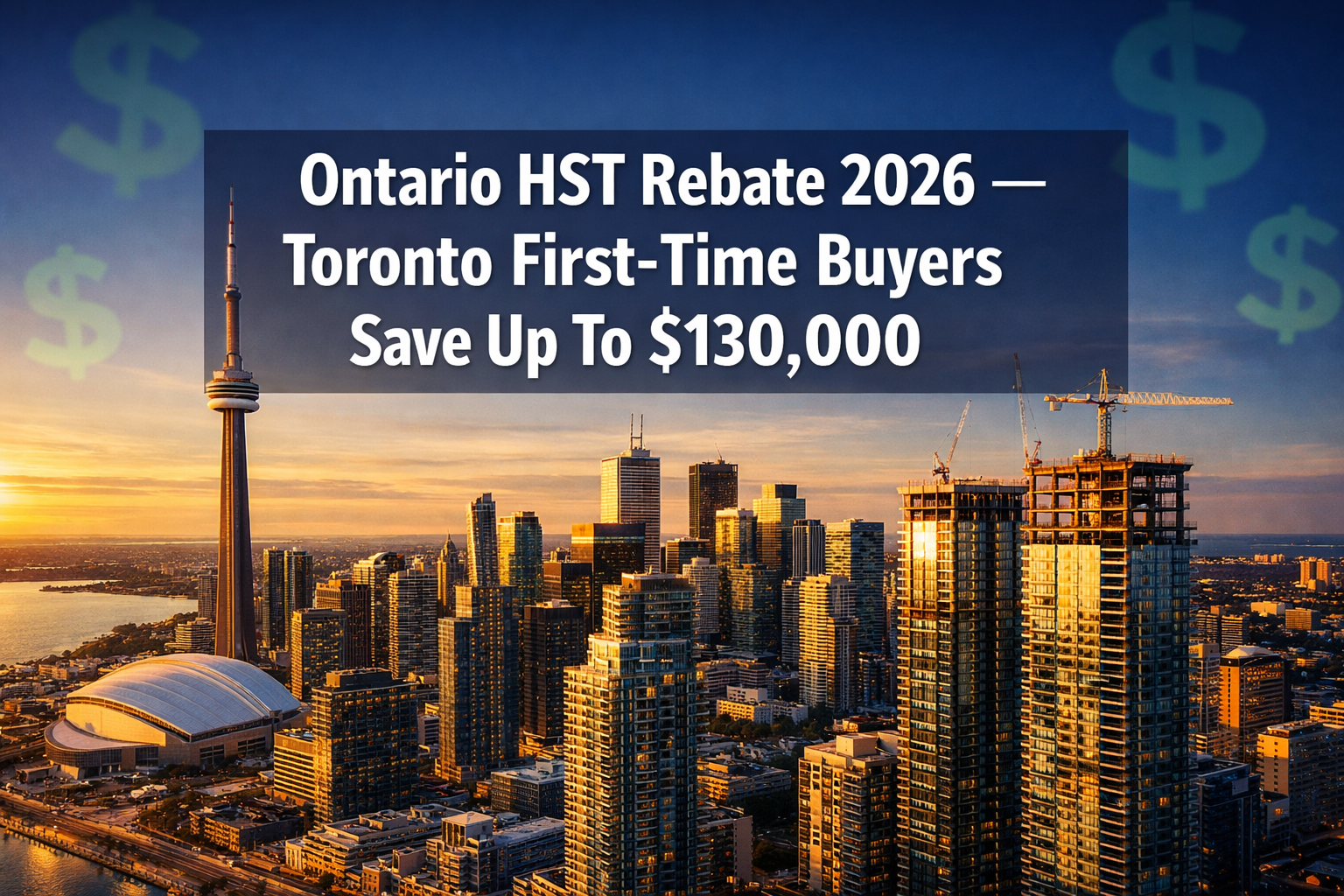
A single government announcement on March 25, 2026 quietly handed Toronto’s first-time buyers one of the largest tax breaks in Canadian real estate history — up to $130,000 back on a new home purchase. If you’ve been sitting on the fence about buying, the Ontario HST Rebate New Homes Toronto First Time Home Buyers 2026 program, combined with the softest Toronto home prices in over five years, may be the most compelling entry point this city has seen in a decade.
This guide breaks down everything you need to know: how the rebate works, what the current market looks like, where mortgage rates are headed, and exactly what steps to take right now.
Key Takeaways 🏠
- Save up to $130,000 — Ontario’s new HST rebate eliminates the full 13% tax on new homes priced up to $1.5M, for purchase agreements signed April 1, 2026 – March 31, 2027.
- First-time buyers can stack rebates — Combine the provincial rebate with the federal GST/HST rebate for potential savings of up to $180,000.
- Toronto prices are near a 5-year low — The average home price has dropped ~24% from its peak and has fallen below the $1M mark, creating a genuine buyer’s market.
- New mortgage rules help you qualify — 30-year amortizations are now available for all first-time buyers, and insured mortgages now cover homes up to $1.5M.
- This window is temporary — The rebate expires March 31, 2027. Acting within this one-year window is critical.
How the Ontario HST Rebate New Homes Toronto First Time Home Buyers 2026 Program Actually Works
What Was Announced — and Why It’s a Big Deal
On March 25, 2026, Premier Doug Ford announced that Ontario would eliminate the full 13% HST on new home purchases for one year. Industry experts have called it “arguably the biggest tax break for homebuyers in decades.” The Toronto Regional Real Estate Board formally welcomed the announcement, describing it as “a major step forward” for housing affordability.
Here’s what makes this rebate truly different from past programs: it’s not just for first-time buyers. Move-up buyers, investors purchasing rental properties, and all buyers of new primary residences now qualify. For first-time buyers specifically, the savings stack even higher.
The Rebate Tiers — What You’ll Actually Save
| Home Purchase Price | HST Rebate Amount |
|---|---|
| Up to $1,000,000 | Up to $130,000 (full 13%) |
| $1,000,001 – $1,500,000 | Full rebate, capped at $130,000 |
| $1,500,001 – $1,850,000 | Reduced rebate (sliding scale) |
| $1,850,000 and above | $24,000 (pre-existing structure) |
💡 Pull Quote: “For a $900,000 new condo in Toronto, the HST rebate alone saves you $117,000 — more than most buyers save in years of diligent investing.”
Stacking Rebates: First-Time Buyers Get Even More
If you’re a first-time buyer, you can combine the provincial rebate with the federal First-Time Home Buyer GST/HST rebate — potentially reaching $180,000 in total HST savings on qualifying properties. The federal 5% GST rebate has received royal assent and applies to agreements signed from March 20, 2025 onward.
On top of that, if you’re buying within the City of Toronto, you can claim an additional rebate of up to $4,475 on the Toronto municipal land transfer tax at closing. Be sure to also explore the First-Time Home Buyer Tax Credit in Canada for further federal savings.
Critical Deadlines You Cannot Miss ⏰
- Purchase agreement must be signed: April 1, 2026 – March 31, 2027
- Construction must begin by: December 31, 2028
- Substantial completion required by: December 31, 2031
- Applies to: New construction only — resale homes do not qualify
This is a temporary, one-year measure tied to Ontario’s provincial budget. Once March 31, 2027 arrives, the rebate disappears unless renewed.
What About Development Charges?
Ontario also announced concurrent cuts to development charges across the province by up to 50%. This reduces builder costs and should, over time, translate into lower pre-construction prices — another tailwind for buyers entering the new-build market in 2026.
Toronto’s 2026 Market Conditions: Why Now Is the Moment
Prices Are at a 5-Year Low 📉
Toronto’s average home price has fallen roughly 24% from its peak and has dipped below the $1M average mark for the first time in years. That’s the lowest level in over five years. For first-time buyers who were priced out during the frenzy of 2021–2022, this correction represents a genuine re-entry point.
Condos in particular have seen significant price softening, making them an increasingly attractive option. If you’re weighing your options, our guide on condo versus house purchases in Ontario can help you decide which property type fits your goals.
For a deeper dive into what this buyer’s market means for you, check out our step-by-step guide to buying your first home in Toronto’s 2026 buyer’s market.
The “Frozen Seller” Problem
Here’s the catch: while prices are down, inventory of move-in-ready resale homes is limited. Most existing homeowners are choosing to stay put rather than sell and move up — especially those locked into low-rate mortgages from 2020–2021. This “frozen seller” dynamic is shrinking the resale options available to first-time buyers, which is one more reason why new construction — and the HST rebate — becomes so strategically important right now.
The Iran War and Oil Shock: How Global Events Are Moving Mortgage Rates
The ongoing conflict in the Middle East and the Iran war have triggered an oil price shock that has pushed Canadian bond yields above 3%. This has a direct impact on fixed mortgage rates.
As of 2026:
- 5-year fixed rate: ~3.69%
- Variable rate: ~3.35%
- Bank of Canada policy rate: 2.25% (held in March 2026)
The Bank of Canada held its policy rate steady at 2.25% in March 2026, keeping variable rates relatively stable. However, the bond market — driven by geopolitical risk — has pushed fixed rates higher. This creates an interesting decision point for buyers. For a detailed analysis, read our breakdown of fixed vs. variable rates for Toronto first-time buyers in 2026.
New Mortgage Rules That Work in Your Favour
Two rule changes introduced in late 2024 and now fully in effect are making a real difference for first-time buyers:
- 30-year amortization is now available for all first-time buyers on insured mortgages — not just new construction. This lowers your monthly payment significantly. Learn more about 30-year amortization for first-time buyers.
- Insured mortgage cap raised to $1.5M — you can now put as little as 5–10% down on homes up to $1.5M and still access insured mortgage rates. This is a game-changer in a city where even “affordable” properties regularly exceed $800K.
The Mortgage Renewal Pressure in the Background
About 1 million Canadians are still facing higher mortgage rates at renewal in 2026 — many of them locked into ultra-low rates from 2021. This wave of renewals is adding financial pressure across the market and is one reason some sellers are reluctant to list (they don’t want to give up their old rates). For buyers, understanding this dynamic is important context. Our article on how 2026 mortgage renewals impact first-time home buyers explains this in detail.
Actionable Steps: How to Take Full Advantage of the HST Rebate in 2026
Step 1: Get Pre-Approved Before You Shop
Before you even look at a new development, get a mortgage pre-approval. With the insured cap now at $1.5M, many first-time buyers qualify for more than they expect. Pre-approval locks in your rate and gives you negotiating power. Always get pre-approved before buying — skipping this step is one of the most common first-time home buyer mistakes.
Step 2: Maximize Your Down Payment Using Government Programs
Stack every available savings tool:
- Tax-Free First Home Savings Account (FHSA): Contribute up to $8,000/year (lifetime limit $40,000) with full tax deductibility. Learn how to use your FHSA to buy a house.
- RRSP Home Buyers’ Plan: Withdraw up to $35,000 tax-free per person ($70,000 per couple). Review the RRSP Home Buyers’ Plan details.
- HST Rebate as Effective Equity: On a $900,000 new build, your $117,000 HST rebate essentially acts as an instant equity boost from day one.
Step 3: Understand the Rebate Application Process
The HST rebate is typically applied at closing through your builder or lawyer — you don’t wait for a cheque in the mail. However, you need to ensure:
- ✅ Your purchase agreement is signed between April 1, 2026 and March 31, 2027
- ✅ The property is a new build (not resale)
- ✅ You intend to use it as a primary residence (or as a rental property)
- ✅ Your lawyer is aware of the rebate and has confirmed it’s reflected in your closing statement
Step 4: Tips for Self-Employed Buyers
Self-employed Torontonians face unique qualification challenges, but the 2026 rule changes have opened new doors. With the insured mortgage cap now at $1.5M, even self-employed buyers can access insured rates on higher-value new builds — provided they can document income properly.
Key strategies for self-employed buyers:
- Use 2 years of Notice of Assessments to prove stated income
- Consider a B-lender if your declared income is lower than your actual earnings
- Work with a mortgage broker who specializes in self-employed files — our self-employed mortgage qualification guide walks through the specific strategies for 2026
Step 5: Act Before March 31, 2027
This cannot be overstated: the rebate is time-limited. Signing your purchase agreement before March 31, 2027 locks in your eligibility. Given that pre-construction timelines typically run 2–4 years, you’ll want to start exploring projects now to ensure you can sign within the window.
Is 2026 Really the Right Time to Buy? 🤔
The combination of factors in 2026 is genuinely rare:
| Factor | 2026 Reality |
|---|---|
| HST Rebate | Up to $130,000 — expires March 2027 |
| Toronto Home Prices | ~24% below peak, 5-year low |
| 30-Year Amortization | Now available to all first-time buyers |
| Insured Mortgage Cap | Raised to $1.5M |
| Variable Rate | 3.35% (stable) |
| Fixed Rate | ~3.69% (rising due to oil shock) |
The honest answer is: no market timing is ever perfect. Fixed rates are being pushed higher by geopolitical events outside Canada’s control. Inventory of desirable properties is limited. But the HST rebate alone represents a one-time savings opportunity that won’t exist after March 2027 — and Toronto prices at a 5-year low means you’re buying closer to the bottom than the top.
For a balanced perspective on whether this is the right moment for you, read why 2026 is the perfect entry point for first-time buyers in Toronto’s cooling market.
Conclusion: Your Next Steps Start Today
The Ontario HST Rebate New Homes Toronto First Time Home Buyers 2026 program is a genuine, time-sensitive opportunity. Up to $130,000 in HST savings — stackable to $180,000 for first-time buyers using the federal rebate — combined with Toronto’s lowest prices in half a decade, 30-year amortizations, and a raised insured mortgage cap creates a window that may not reopen.
Here’s your action plan:
- 📋 Get pre-approved — Know your budget before you shop
- 💰 Open or maximize your FHSA — Tax-free savings that compound your down payment
- 🏗️ Focus on new construction — Only new builds qualify for the HST rebate
- 📅 Sign your purchase agreement before March 31, 2027 — This is non-negotiable
- 🤝 Work with a mortgage broker — Especially if you’re self-employed or have a complex income situation
The market is giving first-time Toronto buyers a rare gift in 2026. The question isn’t whether the conditions are good — they clearly are. The question is whether you’ll act before this window closes.