Last updated: March 25, 2026
Quick Answer: A dermatologist removing moles uses one of several proven methods — surgical excision, shave removal, laser treatment, or cryotherapy — depending on the mole's size, depth, and whether it looks suspicious. Most procedures take under 30 minutes, are done under local anesthetic, and let you walk out the same day. If a mole is changing, irritating you, or simply bothering you cosmetically, getting it assessed by a qualified professional is the right first step.
Key Takeaways
- Not all moles need removal, but any mole that changes shape, colour, or size should be assessed promptly.
- A dermatologist or trained surgeon removes moles using excision (cutting), shave removal, laser, or cryotherapy — the method depends on the mole's characteristics.
- Suspicious moles are sent to pathology after removal; benign cosmetic moles may not require this step.
- Most mole removal procedures are quick outpatient procedures with minimal downtime.
- At-home removal kits, creams, and pens are not safe substitutes for professional care.
- Costs vary depending on the method and number of moles; many clinics offer cost estimators or free consultations.
- AI-assisted detection tools are improving diagnostic accuracy in 2026, but a trained clinician's judgment remains essential.
- Emerging therapies like RNA silencing show early promise for rare mole conditions, though surgery remains the standard of care today.
- Choosing a clinic with an experienced surgical team matters for both safety and cosmetic outcomes.
- You can often have multiple moles removed in a single visit, saving you time and follow-up appointments.
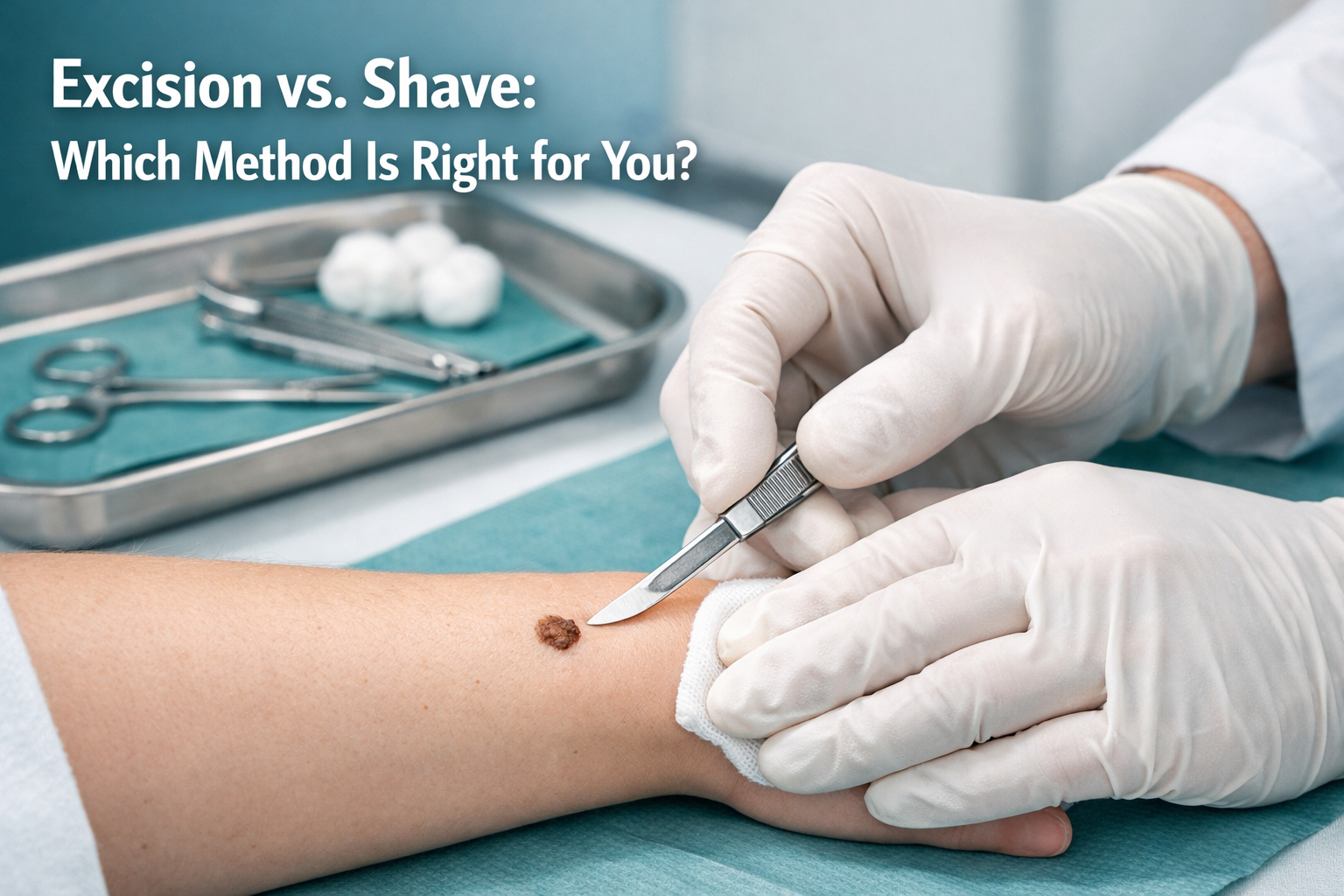
What Does a Dermatologist Removing Moles Actually Do?
When a dermatologist removes a mole, they first examine it carefully — often with a dermatoscope, a handheld magnifying tool — to assess its borders, colour, and depth. Based on that assessment, they choose the most appropriate removal method and apply local anesthetic to numb the area before starting.
The whole process is more straightforward than most people expect. Here's what typically happens:
- Consultation and assessment — The clinician examines the mole and discusses your concerns, medical history, and goals.
- Local anesthetic — A small injection numbs the skin around the mole. Most patients feel a brief sting, then nothing.
- Removal — Depending on the method, the mole is either cut out, shaved flush with the skin, treated with laser energy, or frozen off.
- Wound closure — Excisions are closed with sutures. Shave removals and laser treatments typically heal on their own.
- Pathology (if needed) — Suspicious or atypical tissue is sent to a lab for analysis.
- Aftercare instructions — You leave with clear wound care guidance and a follow-up plan.
Most appointments wrap up in 15 to 45 minutes, depending on the number of moles and the method used. You drive yourself home, return to desk work the same day, and get back to your normal routine within days.
What Are the Different Methods a Dermatologist Uses for Removing Moles?
The method a dermatologist uses depends on the mole's size, location, depth, and whether it raises any concern for abnormal cells. There's no single "best" technique — the right choice is the one matched to your specific situation.
Here's a breakdown of the main options:
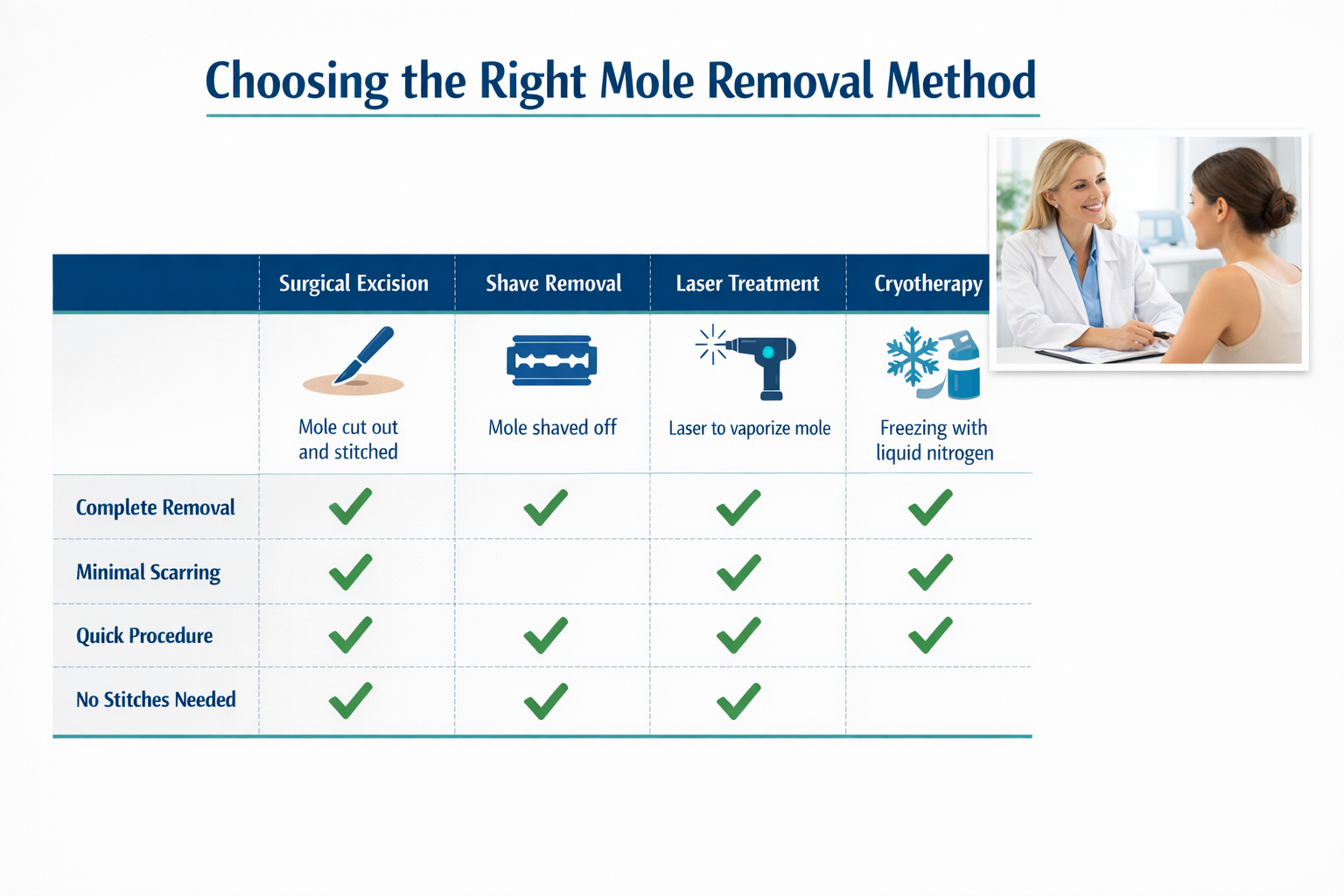
| Method | Best For | Leaves Sutures? | Pathology Possible? |
|---|---|---|---|
| Surgical excision | Deep, large, or suspicious moles | Yes | Yes |
| Shave removal | Raised, benign, cosmetic moles | No | Yes |
| Laser removal | Small, flat, pigmented moles | No | No |
| Cryotherapy | Superficial, benign lesions | No | No |
Surgical excision is the gold standard for moles that look irregular or need a pathology report. The surgeon cuts out the mole along with a small margin of surrounding skin, then closes the wound with sutures. It leaves a small linear scar that fades significantly over time.
Shave removal works well for raised, benign moles. The clinician uses a blade to shave the mole flush with the surrounding skin. No sutures needed, and healing is usually quick.
Laser removal targets the pigment in the mole and breaks it down into particles the body absorbs naturally. It's well-suited to smaller, flat moles and sensitive areas, and it's less invasive than cutting [5]. The limitation: no tissue sample is collected, so it's not appropriate for any mole with suspicious features.
Cryotherapy uses liquid nitrogen to freeze and destroy mole cells. It's fast and straightforward for superficial, clearly benign lesions, though it can cause temporary blistering.
Choose excision if: the mole is irregular, has changed recently, or your clinician wants a pathology sample. Choose shave or laser if the mole is clearly benign and your goal is cosmetic improvement.
How Do You Know When a Mole Needs to Be Removed?
Not every mole requires removal. But some moles do need attention — and knowing the difference matters.
The ABCDE rule is the most widely used guide for spotting a mole worth having checked:
- A — Asymmetry: One half doesn't match the other.
- B — Border: Edges are ragged, notched, or blurred.
- C — Colour: Multiple shades of brown, black, red, or white within one mole.
- D — Diameter: Larger than 6mm (about the size of a pencil eraser).
- E — Evolution: Any change in size, shape, colour, or new symptoms like bleeding or itching.
Even if a mole doesn't tick these boxes, you may still want it removed for practical reasons — it catches on clothing, sits in a spot that's repeatedly irritated, or you simply don't like how it looks. That's a completely valid reason to seek care.
Common reasons people book a mole removal appointment:
- A mole has changed noticeably over weeks or months
- A family history of melanoma or skin cancer
- A mole bleeds, itches, or crusts without injury
- Cosmetic concerns — the mole affects confidence or comfort
- A mole in a location that makes shaving or dressing difficult
If you're unsure whether your mole warrants attention, our guide on atypical moles covers the warning signs in more detail. You can also find a dermatologist in Toronto who can assess your specific situation.
Is a Dermatologist or a Surgeon Better for Removing Moles?
Both dermatologists and trained surgeons perform mole removal — and in many outpatient clinics, the two roles overlap. What matters most is the clinician's training, experience, and access to pathology services.
Dermatologists specialize in skin conditions and are highly skilled at diagnosing moles. They often perform shave removals and laser treatments in their offices.
General surgeons or outpatient surgical specialists are trained in excision techniques and are often the better choice for larger, deeper, or more complex moles that require suturing and a clean cosmetic result.
At a clinic like The Minor Surgery Center, patients benefit from an experienced surgical team that combines diagnostic skill with surgical precision — all in an outpatient setting that avoids the delays and overhead of a hospital.
Edge case to know: If your mole is on a cosmetically sensitive area (face, neck, décolletage), ask specifically about the surgeon's experience with minimizing scarring in that location. Technique and suturing skill vary, and it's a fair question to ask before booking.
For patients across the GTA, location-specific clinics offer expert outpatient care close to home:
- Mole removal in Mississauga
- Mole removal in Markham
- Mole removal in Oakville
- Mole removal in Brampton
- Mole removal in Scarborough
What Happens After a Dermatologist Removes a Mole?
Recovery after mole removal is usually straightforward. Most patients feel minimal discomfort once the anesthetic wears off, and the wound heals within one to three weeks depending on the method used.
Typical aftercare steps:
- Keep the area clean and covered for the first 24–48 hours.
- Avoid submerging the wound in water (baths, pools, hot tubs) until it's fully healed.
- Apply petroleum jelly or a prescribed ointment to keep the wound moist — this reduces scarring.
- Avoid direct sun exposure on the healing area; use SPF 30+ once healed.
- Watch for signs of infection: increasing redness, warmth, swelling, or discharge.
- Attend your follow-up to have sutures removed (usually 5–14 days after excision).
If your mole was sent to pathology, results typically come back within one to two weeks. Your clinic will contact you with the findings and discuss next steps if anything requires attention.
On scarring: All excisions leave some mark. With good wound care and time, most scars fade significantly. Silicone gel, vitamin E, and petroleum jelly are commonly used — our guide on best scar care after mole removal compares the evidence for each option.
One common question: can a removed mole grow back? In most cases, no — but if any cells remain at the margins, regrowth is possible. Your surgeon aims to remove the mole completely to prevent this. For more detail, see our article on whether moles grow back after removal.
How Much Does It Cost to Have a Dermatologist Remove a Mole?
Mole removal costs in Canada vary based on the method, the number of moles, and whether the procedure is medically necessary or cosmetic.
General cost factors:
- Medically necessary removal (suspicious mole, referred by a physician) may be covered by provincial health insurance (OHIP in Ontario).
- Cosmetic removal (no medical concern) is typically an out-of-pocket expense.
- Method: Laser and cryotherapy sessions may be priced differently than surgical excision.
- Number of moles: Many clinics offer reduced per-mole pricing when removing multiple moles in a single visit.
Because pricing varies by clinic and individual case, the most accurate approach is to use a cost estimator or book a consultation. The Minor Surgery Center offers a free mole removal cost estimator that gives you a realistic figure based on your specific situation.
Can you remove multiple moles at once? Yes — and it's often more efficient and cost-effective to do so. Learn more about removing multiple moles in one visit.
What Are the Risks of Dermatologist Mole Removal?
Mole removal performed by a qualified clinician is safe and well-tolerated. Serious complications are uncommon, but it's worth knowing what to watch for.
Possible risks include:
- Scarring — All excisions leave a scar; the size and visibility depend on technique, location, and your skin's healing.
- Infection — Rare when proper wound care is followed.
- Incomplete removal — If mole cells remain at the margin, the mole may partially regrow.
- Nerve sensitivity changes — Temporary numbness or tingling near the site, usually resolving within weeks.
- Allergic reaction — Rare reaction to local anesthetic or wound care products.
- Pigmentation changes — Especially with laser or cryotherapy on darker skin tones.
What doesn't belong on this list: cancer caused by removing a mole. This is a common concern, but it's not supported by evidence. Removing a benign mole does not trigger cancer. If you've wondered about this, our article on whether removing a mole causes cancer addresses it directly.
What's New in 2026: Advances in Mole Detection and Removal
The field of mole assessment and removal has seen meaningful progress in recent years. Here are the developments worth knowing about.
AI-assisted melanoma detection now achieves up to 90% accuracy in some studies, with research from Stanford Medicine reviewing over 67,000 evaluations showing improved diagnostic sensitivity across clinicians at all training levels [6]. This technology is increasingly available as a support tool for dermatologists — not a replacement for clinical judgment, but a useful second set of eyes.
Laser removal refinements continue to improve precision for smaller, flat moles in sensitive areas, offering a minimally invasive alternative to cutting for appropriate candidates [5].
RNA silencing therapy is an emerging area of research for a rare condition called Congenital Melanocytic Naevus (CMN), which causes large, painful moles covering up to 80% of the body in affected children [4]. Researchers at the Francis Crick Institute, UCL, and Great Ormond Street Hospital demonstrated 48-hour gene silencing in mice after direct injection of therapy particles, and also tested the approach successfully in human skin cells and tissue samples from affected children [3]. Published in the Journal of Investigative Dermatology, this research represents a potential future alternative to surgery for at-risk moles in this specific population [2]. It is not a current treatment option, but the science is promising.
FDA-approved gene therapy for a separate skin condition (recessive dystrophic epidermolysis bullosa) reached approval in 2025, with Phase III data showing 65% wound healing in treated patients — a sign of broader momentum in gene-based dermatology treatments [6].
For patients today, surgical excision and shave removal remain the most reliable, well-established options. These advances are worth watching, but they don't change the practical guidance for someone looking to have a mole assessed or removed right now.

Why Choose an Outpatient Surgical Clinic Over a Hospital for Mole Removal?
For most mole removals, a hospital is unnecessary — and often inconvenient. Outpatient surgical clinics offer the same quality of care with far less waiting, lower overhead, and a more personal experience.
Advantages of an outpatient clinic:
- Shorter wait times — No hospital queue or referral bottleneck for cosmetic cases.
- Focused expertise — Clinicians who perform mole removal regularly, not as a side task.
- Personalised treatment plan — Your case is discussed with you directly, not rushed through a busy ward.
- Comfort-first approach — Smaller, calmer environment designed for outpatient procedures.
- Efficient scheduling — Book, attend, and get back to your life the same day.
The Minor Surgery Center operates across the GTA with multiple clinic locations, an experienced surgical team, and a clear focus on safe and efficient surgery for conditions like mole removal, cyst excision, lipoma treatment, and more. Whether you're in downtown Toronto, Whitby, or Newmarket, there's a location close to you.
FAQ: Dermatologist Removing Moles
Q: Does mole removal hurt?
The procedure itself is painless — local anesthetic numbs the area completely before anything begins. You may feel a brief sting from the injection, then nothing during the removal. Some mild soreness is normal in the hours after the anesthetic wears off.
Q: How long does mole removal take?
Most single-mole removals take 15 to 30 minutes from start to finish. Removing multiple moles in one visit takes longer but is still typically completed within an hour.
Q: Will my mole removal be covered by OHIP?
If a physician refers you for removal of a suspicious or medically concerning mole, OHIP may cover it. Cosmetic removal — where the mole is benign and you want it gone for aesthetic reasons — is generally not covered and is paid out of pocket.
Q: Can I remove a mole at home?
No. At-home removal kits, creams, and pens are not safe or effective for true moles. They can cause scarring, infection, and — critically — they prevent proper pathology testing. If a mole turns out to be atypical, delayed diagnosis has real consequences.
Q: How do I know if my mole is cancerous?
Only a pathology report can confirm this. Clinically, the ABCDE criteria (asymmetry, border, colour, diameter, evolution) help flag moles that warrant closer assessment. If you're unsure, book an assessment — it's a quick appointment and worth the peace of mind.
Q: How long does it take for a mole removal site to heal?
Shave removals and laser sites typically heal within 1–2 weeks. Surgical excisions take 2–3 weeks to close fully, with the scar continuing to fade over 6–12 months.
Q: Is there a risk the mole will come back?
If the mole is fully excised with clear margins, regrowth is unlikely. Shave removals carry a slightly higher chance of partial regrowth if some cells remain below the surface.
Q: Can a dermatologist remove a mole on my face?
Yes. Facial moles are commonly removed, and an experienced surgeon will use techniques designed to minimize visible scarring. Ask specifically about the approach for cosmetically sensitive areas before booking.
Q: What should I do to prepare for mole removal?
Arrive with clean skin around the mole. Avoid blood-thinning medications (like aspirin or ibuprofen) for a few days beforehand if your clinician advises it. Wear comfortable clothing that gives easy access to the mole site.
Q: Can I exercise after mole removal?
Light activity is usually fine within a day or two. Avoid strenuous exercise, heavy lifting, or anything that stretches the wound site for at least a week after excision — this helps the wound close properly and reduces scarring risk.
Conclusion
Having a dermatologist remove a mole is one of the most common, straightforward outpatient procedures available — and for good reason. Whether the goal is peace of mind about a changing mole, relief from irritation, or simply a cleaner look, the process is fast, safe, and well within reach.
The key steps are simple: get the mole assessed by a qualified clinician, understand which removal method fits your situation, and follow the aftercare instructions carefully. Most people walk out of their appointment the same day, with a small bandage and a clear plan.
Your next steps:
- Check your moles using the ABCDE criteria. If anything concerns you, don't wait.
- Book a consultation with an experienced surgical team — many clinics offer free or low-cost initial assessments.
- Use a cost estimator if pricing is a concern before committing.
- Ask questions — about the method, the surgeon's experience, and what to expect during recovery.
At The Minor Surgery Center, the team is ready to help you get the answers you need and, when you're ready, the care you deserve. Browse our complete mole removal service or contact us to book a consultation — because a mole that's bothering you shouldn't keep you from getting on with your life.
References
[1] Potential Mole Reversal Therapy for Rare Condition – https://medicalxpress.com/news/2024-06-potential-mole-reversal-therapy-rare.html
[2] Research Shows Potential Life-Transforming Mole Reversal Therapy in Rare Condition – https://www.lifearc.org/2024/research-shows-potential-life-transforming-mole-reversal-therapy-in-rare-condition/
[3] Gene Silencing Therapy for CMN – Science Daily – https://www.sciencedaily.com/releases/2024/06/240617173527.htm
[4] Potential Life-Transforming Mole Reversal Therapy Shown in Rare Condition – UCL News – https://www.ucl.ac.uk/news/2024/jun/potential-life-transforming-mole-reversal-therapy-shown-rare-condition
[5] The Latest Advances in Mole Removal Techniques – https://www.rexburgskincare.com/the-latest-advances-in-mole-removal-techniques
[6] Dermatology Advances and Skincare Treatments 2026 – https://topdoctormagazine.com/news/dermatology-advances-skincare-treatments-2026/
Tags: dermatologist removing moles, mole removal, mole excision, skin mole removal, mole removal Toronto, surgical mole removal, cosmetic mole removal, mole removal cost, mole removal recovery, atypical moles, melanoma detection, outpatient mole removal