Last updated: March 25, 2026
Quick Answer: Collagen peptides by Vital Proteins are hydrolysed collagen supplements derived from grass-fed, pasture-raised cattle, delivering 20 grams of collagen per serving alongside hyaluronic acid and vitamin C. They are widely used to support skin, joint, hair, and nail health, and are recognised as one of the best-known collagen products in the consumer wellness market. Results vary by goal, with some benefits appearing in as little as three weeks and others requiring six months of consistent use.
Key Takeaways
- Vital Proteins is recognised as America's #1 collagen brand, credited with bringing collagen peptides into mainstream consumer wellness [6]
- Each serving provides 20g of collagen peptides, 18g of protein, 70 calories, zero sugar, and zero carbs [3]
- The formula contains Type I and Type III collagen plus vitamin C and hyaluronic acid — but does not include Type II collagen (cartilage-specific) [3]
- Collagen is sourced from grass-fed, pasture-raised cattle in Brazil, raised without antibiotics or hormones [3]
- The product is dairy-free, gluten-free, paleo-friendly, and Whole30-approved — but is not vegan [1]
- Benefit timelines differ: nails may strengthen in ~3 weeks; skin improvements generally require at least 12 weeks [3]
- Regular supplementation costs approximately $300+ every six months [3]
- In 2026, international demand — particularly from health-conscious consumers in China — continues to grow, with the US version sought for its quality control standards [2]
- Vital Proteins recently launched a Collagen & Protein Shake with 30g protein and 10g collagen, addressing a gap in the meal-replacement drink category [6]
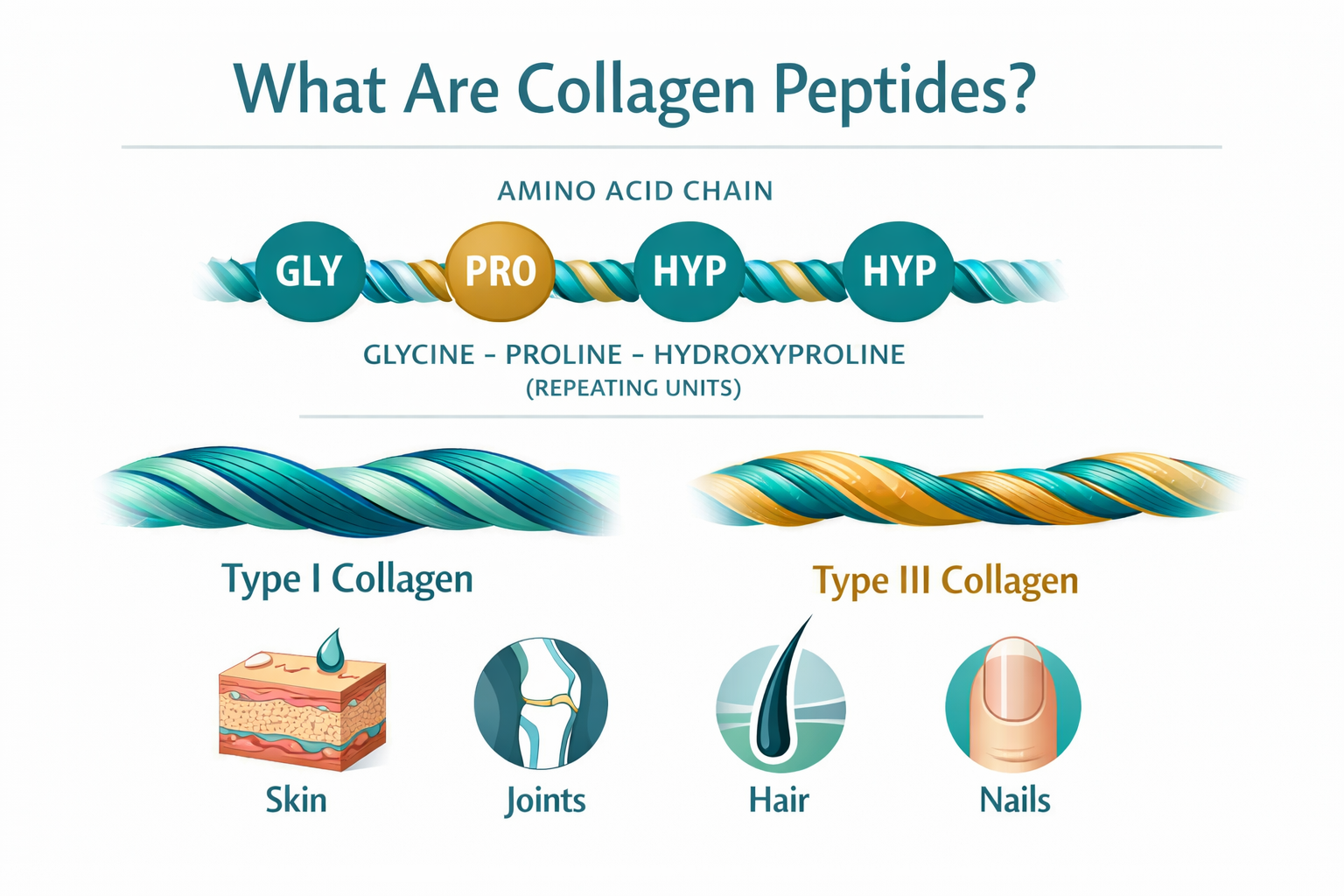
What Are Collagen Peptides by Vital Proteins, and How Do They Work?
Collagen peptides are short chains of amino acids produced by breaking down full-length collagen proteins through a process called hydrolysis. Vital Proteins' version uses bovine collagen hydrolysate, meaning the collagen has been broken into smaller fragments that dissolve easily in liquid and are absorbed efficiently by the digestive system.
How hydrolysis matters:
Full-length collagen molecules are too large to be absorbed intact. Hydrolysis cleaves them into peptides — primarily dipeptides and tripeptides — that pass through the gut wall into the bloodstream. Once absorbed, these peptides are thought to stimulate fibroblast activity, which supports the body's own collagen synthesis. This is the mechanism most researchers point to when discussing why collagen supplements may benefit skin and connective tissue.
What's actually in each serving:
| Nutrient | Amount per Serving |
|---|---|
| Collagen Peptides | 20g |
| Total Protein | 18g |
| Calories | 70 |
| Sugar | 0g |
| Carbohydrates | 0g |
| Vitamin C | 100% Daily Value |
| Hyaluronic Acid | Included |
Source: [3]
The inclusion of vitamin C is deliberate. Vitamin C is a required co-factor for collagen synthesis in the body — without it, the body cannot properly form the collagen triple helix. Hyaluronic acid is added for its role in skin hydration and joint lubrication. [3]
Common mistake: Many people assume all collagen supplements are equivalent. Vital Proteins uses Type I and Type III collagen, which target skin, hair, nails, bones, and joints. It does not contain Type II collagen, which is specific to cartilage. If cartilage support is the primary research interest, a different collagen source would be more appropriate. [3]
What Makes Vital Proteins' Sourcing Different?
The collagen in Vital Proteins products comes from grass-fed, pasture-raised cattle in Brazil, raised without antibiotics or hormones [3]. This sourcing decision matters for two reasons: the quality of the raw collagen material, and the ethical and dietary standards it satisfies.
Why grass-fed sourcing is relevant:
Cattle raised on pasture tend to have different nutritional profiles compared to grain-fed animals. While the downstream effect on collagen peptide quality is still an active area of research, the grass-fed designation satisfies the requirements of several popular dietary frameworks.
Dietary certifications at a glance:
- ✅ Dairy-free
- ✅ Gluten-free
- ✅ Paleo-friendly
- ✅ Whole30 approved
- ❌ Not vegan (bovine-derived)
- ❌ Not suitable for those with beef allergies
Source: [1]
Who this product is not for:
- Vegans or vegetarians seeking a plant-based collagen alternative
- Anyone with a known sensitivity or allergy to bovine products
- Researchers specifically studying Type II collagen or cartilage-specific peptides
Choose this product if: the goal involves skin, hair, nail, or general connective tissue support, and the dietary framework permits animal-derived supplements.
How Does Vital Proteins Compare to Other Collagen Supplements?
Vital Proteins is widely recognised as the brand that "put collagen peptides on the map" for everyday consumers, and it holds the position of America's #1 collagen brand [6]. That said, the market has grown significantly, and several competing products now exist.
Key differentiators for Vital Proteins:
| Feature | Vital Proteins | Generic Collagen Powder |
|---|---|---|
| Collagen per serving | 20g | Varies (5–20g) |
| Added Vitamin C | Yes (100% DV) | Rarely included |
| Hyaluronic Acid | Yes | Rarely included |
| Grass-fed sourcing | Yes | Not always specified |
| Whole30 approved | Yes | Varies |
| Flavoured options | Yes | Varies |
Market context in 2026:
Collagen remains one of the fastest-growing ingredients in the U.S. supplement market, expanding well beyond beauty into sports nutrition and active wellness [6]. Vital Proteins has responded to this shift by launching a Collagen & Protein Shake containing 30g of protein and 10g of collagen peptides per serving — described as the company's "first-of-its-kind innovation" [6]. This addresses a real gap: only 9% of new collagen-containing product launches between May 2020 and April 2025 were in nutritional or meal replacement drink formats [6].
International demand:
In 2026, the US-manufactured Vital Proteins Collagen Peptides (20oz unflavoured) remains a top-selling item at retailers like Costco and Amazon. Health-conscious consumers in China are increasingly seeking the US version specifically for its quality control standards, reflecting growing international trust in the brand [2].
What Are the Reported Benefits, and How Long Do They Take?
Collagen peptides by Vital Proteins are associated with several reported benefits across skin, joints, hair, and nails. The timeline for each differs considerably, and setting realistic expectations is important.
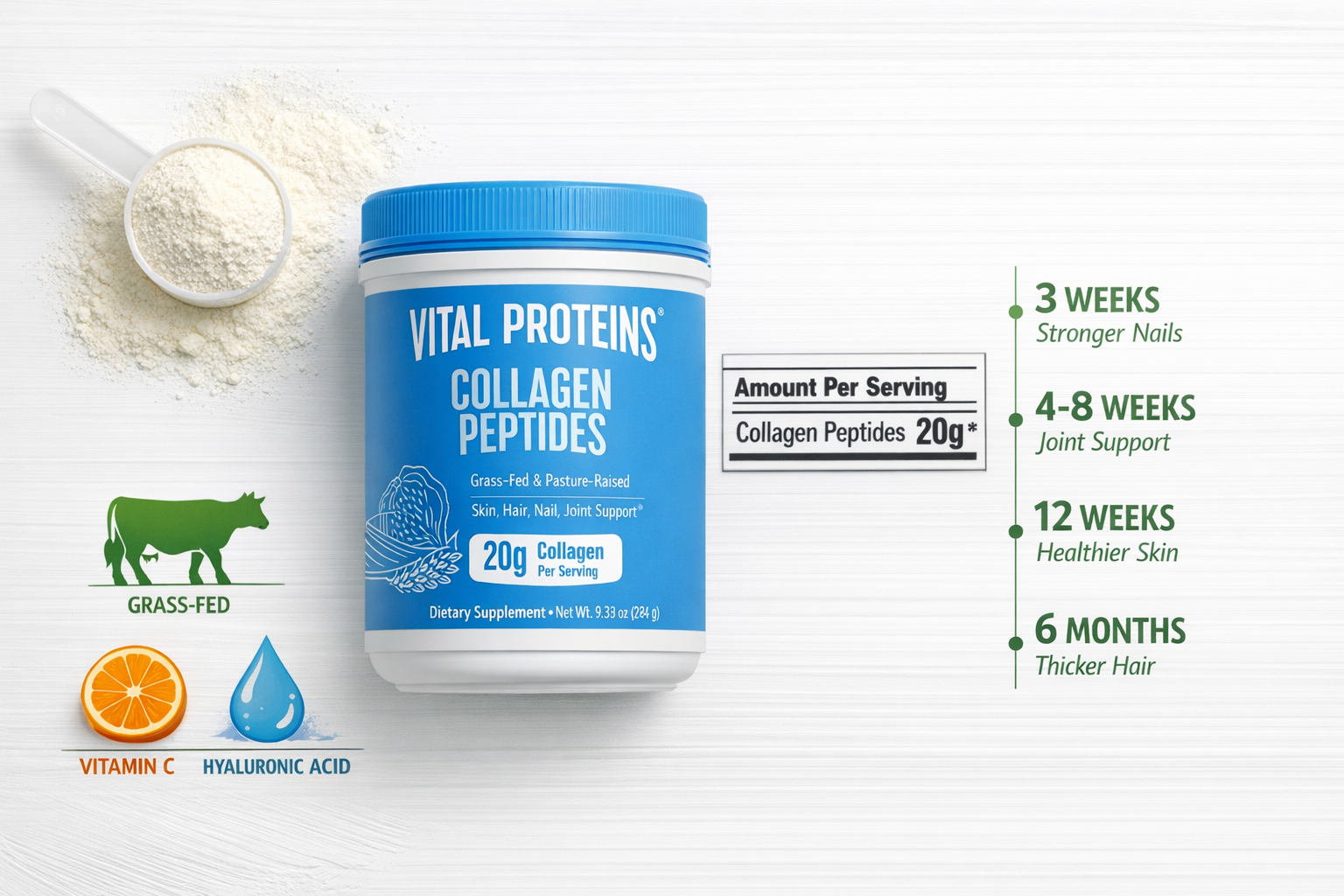
Documented benefit timeline [3]:
| Benefit Area | Approximate Timeframe |
|---|---|
| Nail strengthening | ~3 weeks |
| Joint support | 4–8 weeks |
| Skin improvements | 12 weeks minimum |
| Hair benefits | ~6 months |
These timelines are drawn from user-reported data and general collagen supplementation research. Individual results will vary based on age, baseline collagen levels, diet, and consistency of use.
What the research landscape looks like:
Several peer-reviewed studies have examined hydrolysed collagen supplementation for skin elasticity and joint comfort. Results are generally positive but study sizes are often small, and many are industry-funded. This is worth noting when evaluating claims. The science is promising but not conclusive across all benefit areas.
Practical note on skin: Collagen production naturally declines with age, accelerating after the mid-20s. Supplementation is not a replacement for sun protection, hydration, or a balanced diet — but it may complement those foundations.
Edge case: Some users report digestive discomfort when starting at a full 20g dose. Starting with half a serving and increasing gradually can reduce this.
How Should Collagen Peptides by Vital Proteins Be Used?
The unflavoured version of Vital Proteins Collagen Peptides dissolves in both hot and cold liquids, making it straightforward to incorporate into an existing routine.
Suggested use:
- Add one scoop (20g) to coffee, tea, water, a smoothie, or any liquid
- Stir or blend until fully dissolved — the unflavoured version has minimal taste
- Use consistently at the same time each day for best results
- Allow at least 8–12 weeks before assessing skin-related outcomes
Storage:
- Keep in a cool, dry place away from direct sunlight
- Seal the container after each use to prevent moisture absorption
- No refrigeration required for the dry powder
Flavoured vs. unflavoured:
Vital Proteins offers both. The unflavoured version is the most flexible — it can go into savoury foods as well as drinks. Flavoured versions (such as vanilla or chocolate) are better suited to smoothies or shakes where the flavour complements the mix.
Timing:
There is no strong evidence that a specific time of day produces meaningfully better results. Consistency matters more than timing. Some people prefer morning use to build it into a coffee routine; others add it to a post-workout shake.
What Does Vital Proteins Collagen Cost, and Is It Worth It?
Regular supplementation with collagen peptides by Vital Proteins costs approximately $300 or more every six months when used daily at the recommended dose [3]. That works out to roughly $50 per month, which places it in the mid-to-premium range for collagen supplements.
Cost considerations:
- The 20oz (567g) canister is the most cost-effective size for regular users
- Buying through Costco or in bulk on Amazon can reduce per-serving cost
- Subscription options on the Vital Proteins website may offer savings [4]
Is it worth the cost?
That depends on the goal. For general wellness support — skin, hair, nails, and joints — the product offers a well-sourced, third-party certifiable formula with added vitamin C and hyaluronic acid. Compared to buying those ingredients separately, the combined formula offers reasonable value.
For those primarily interested in protein supplementation, a standard whey or plant protein powder will typically deliver more protein per pound at a lower cost. Collagen peptides are not a complete protein (they lack tryptophan), so they should not be the sole protein source in a diet.
Choose collagen peptides if: the goal is connective tissue support alongside adequate dietary protein from other sources.
Choose a standard protein powder if: the primary goal is muscle protein synthesis or meeting daily protein targets.
How Do Collagen Peptides Relate to Research-Grade Peptides?
Collagen peptides and research-grade peptides occupy different spaces, but both fall under the broader category of peptide science — short chains of amino acids with specific biological roles.
The distinction:
- Collagen peptides (like those from Vital Proteins) are food-grade supplements derived from animal connective tissue, intended for dietary use
- Research-grade peptides are synthesised peptide sequences produced under strict laboratory conditions for use in scientific research — they are not food products
For researchers and laboratories interested in peptide science more broadly, the mechanisms underlying collagen synthesis, fibroblast stimulation, and extracellular matrix support are active areas of study. Peptides such as GHK-Cu — a copper-binding tripeptide — are studied in research contexts for their potential roles in skin and tissue repair, representing a distinct but related area of peptide biology.
Similarly, peptides like BPC-157 and TB-500 are subjects of ongoing research into connective tissue and repair mechanisms. The Glow 70mg combination — which includes TB-500, BPC-157, and GHK-Cu — is available from Peptide Pro for research purposes only.
Researchers exploring peptide mechanisms related to skin biology and ageing may also find SNAP-8 of interest, a synthetic octapeptide studied in the context of expression line research.
Important: Research-grade peptides supplied by companies like Peptide Pro are strictly for laboratory and scientific research use only. They are not food supplements and are not intended for human or animal consumption.
What Are the Most Common Questions About Vital Proteins Collagen?
Frequently asked questions about collagen peptides by Vital Proteins:
Q: Is Vital Proteins collagen safe to take daily?
The product is a food-grade supplement derived from bovine collagen. For most healthy adults, daily use at the recommended dose is generally well-tolerated. Anyone with a known medical condition or who takes medication should consult a healthcare professional before starting any supplement.
Q: Can collagen peptides replace protein powder?
No. Collagen peptides are not a complete protein — they lack tryptophan, one of the essential amino acids. They can supplement dietary protein but should not be the sole protein source.
Q: Does the powder dissolve in coffee?
Yes. The unflavoured version dissolves readily in hot liquids including coffee and tea without significantly altering taste or texture.
Q: Is Vital Proteins collagen third-party tested?
Vital Proteins states that its products undergo quality testing, and the product carries several dietary certifications (Whole30, paleo-friendly). For the most current testing documentation, check the official product page directly [4].
Q: Can men use collagen peptides?
Yes. Collagen is present throughout the body regardless of sex. Men may benefit from collagen supplementation for joint support, skin health, and general connective tissue maintenance.
Q: Does cooking destroy collagen peptides?
Hydrolysed collagen peptides are relatively heat-stable. Adding the powder to hot coffee or using it in cooked recipes should not significantly degrade its peptide content.
Q: How does the new Collagen & Protein Shake differ from the original powder?
The new shake contains 30g of protein and 10g of collagen peptides per serving, compared to the original's 20g of collagen and 18g of protein. The shake format is designed for convenience and positions the product in the meal replacement and sports nutrition space [6].
Q: Why are international consumers seeking the US version specifically?
Health-conscious consumers in markets like China are seeking the US-manufactured version for its quality control standards and sourcing transparency — a trend that has become more pronounced in 2026 [2].
Q: Is there a difference between collagen peptides and hydrolysed collagen?
These terms are used interchangeably. Both refer to collagen that has been broken down into smaller peptide fragments through hydrolysis to improve solubility and absorption.
Q: How does Vital Proteins' sourcing compare to marine collagen?
Vital Proteins uses bovine (cattle-derived) collagen, which provides Type I and Type III collagen. Marine collagen is also primarily Type I but comes from fish skin. Both are hydrolysed for absorption. The choice between them often comes down to dietary preference, allergen considerations, and specific collagen type requirements.
Q: What happened with Vital Proteins and the U.S. Open?
In August 2025, Vital Proteins became the first-ever "Official Collagen Partner of the U.S. Open," using the platform to expand its reach into sports nutrition and active wellness audiences [6].
Q: Are there any side effects?
Most users tolerate collagen peptides well. Reported side effects are uncommon but can include mild digestive discomfort, particularly at higher doses. Starting with a smaller amount and building up can help.
Conclusion
Collagen peptides by Vital Proteins represent one of the most established and well-recognised collagen supplements on the market in 2026. The formula is straightforward: 20g of hydrolysed bovine collagen per serving, sourced from grass-fed cattle, combined with vitamin C and hyaluronic acid to support the body's own collagen-related processes. The product suits those following paleo or Whole30 frameworks, and its unflavoured version integrates easily into a daily routine.
Actionable next steps:
- Define your goal first. Skin, nails, and hair require at least 8–12 weeks of consistent use. Joint support may show results sooner. Set a realistic timeline before evaluating whether the product is working.
- Check the collagen type. Vital Proteins provides Type I and III — appropriate for skin, hair, nails, and general connective tissue. If cartilage-specific support is the goal, look for a Type II collagen source.
- Account for the cost. At approximately $300+ per six months, this is a meaningful ongoing expense. Factor this into a supplement budget alongside other priorities.
- Don't rely on it as a sole protein source. Collagen lacks tryptophan. Ensure adequate complete protein from other dietary sources.
- For researchers interested in peptide science beyond dietary supplements, explore research-grade peptides through verified suppliers. Peptide Pro offers a curated range of high-purity peptides for laboratory use, including compounds relevant to skin biology and connective tissue research — all clearly labelled for research use only.
References
[1] Vital Proteins Collagen Peptides Review – https://barbend.com/vital-proteins-collagen-peptides-review/
[2] The 2026 Plan For Getting Vital Proteins Collagen Peptides To China Without Order Cancellations – https://www.comgateway.com/blogs/the-2026-plan-for-getting-vital-proteins-collagen-peptides-to-china-without-order-cancellations/
[3] Vital Proteins Collagen Peptides Review – https://shop.athleticinsight.com/blogs/reviews/vital-proteins-collagen-peptides-review
[4] Collagen Peptides – https://www.vitalproteins.com/products/collagen-peptides
[5] Newsroom – https://www.vitalproteins.com/blogs/newsroom
[6] Vital Proteins Serves Up Collagen At The Us Open – https://www.nutraingredients.com/Article/2025/08/29/vital-proteins-serves-up-collagen-at-the-us-open/
Tags: collagen peptides, Vital Proteins, hydrolysed collagen, collagen supplement review, Type I collagen, Type III collagen, grass-fed collagen, skin health supplements, joint support, collagen peptides 2026, bovine collagen, peptide science