25 Mar
Last updated: March 25, 2026
Quick Answer
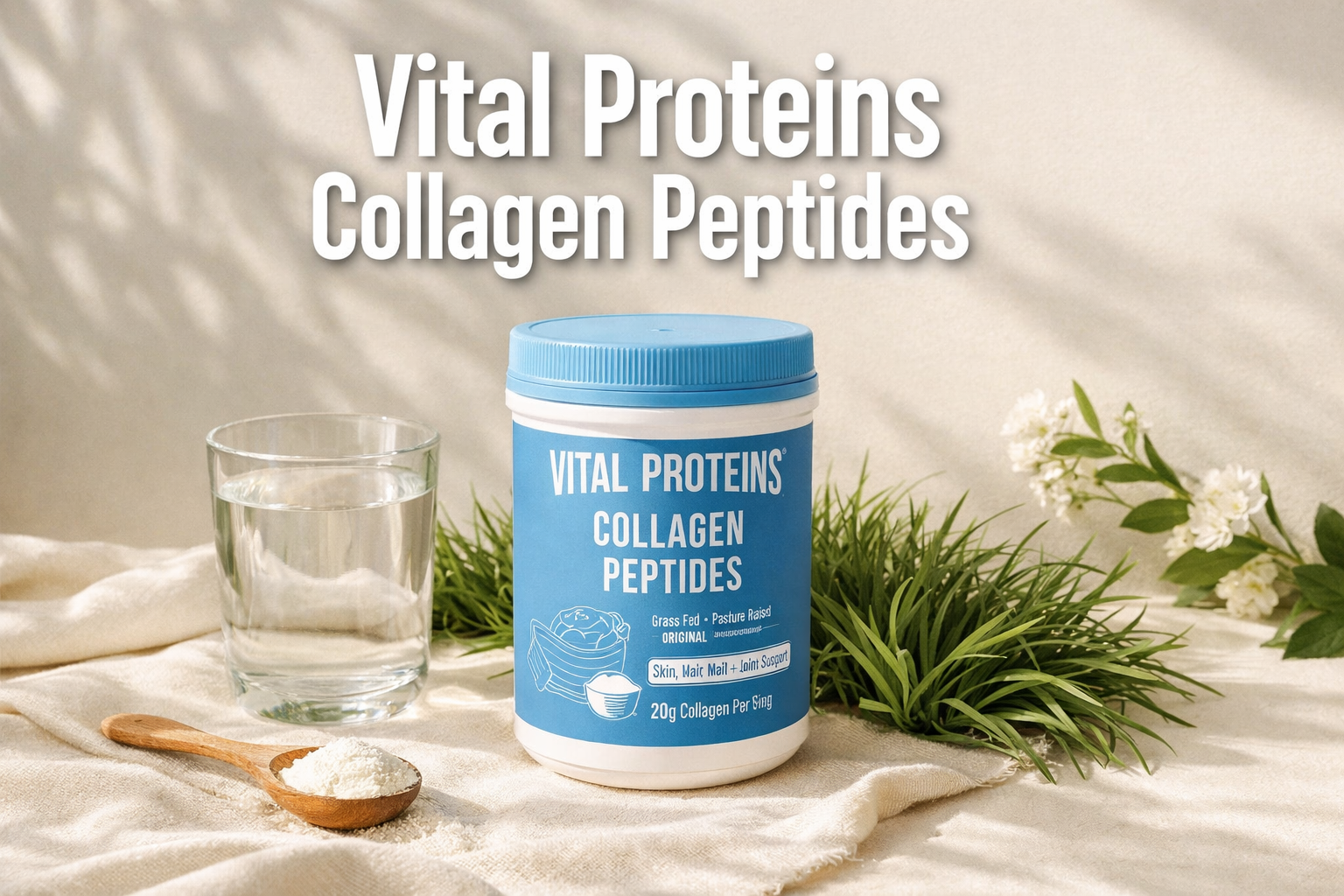
Vital Proteins Collagen Peptides is a bovine-sourced collagen supplement containing 20 grams of Type I and Type III collagen per serving, with just two core ingredients and no fillers. It is widely used to support skin, hair, nails, bones, and joints. Independent lab testing has ranked it among the top-performing collagen products for purity and label accuracy [2].
Key Takeaways
- Each serving delivers 20g of collagen peptides and 18g of protein, with 70 calories, no sugar, and no carbs [3]
- Only two ingredients: bovine collagen peptides and hyaluronic acid — no artificial sweeteners or fillers [3]
- Sourced from grass-fed, pasture-raised cattle in Brazil, meeting specific animal welfare and sustainability standards [3]
- Third-party tested: BarBend’s independent lab testing awarded A grades across metals, pesticides, phthalates, bisphenols, and label accuracy [2]
- Results take time: nails may improve by week three, joints by weeks 4–8, skin by week 12, and hair after approximately six months [3]
- Premium pricing: regular use costs approximately $25+ per month, or $300+ over six months [3]
- Vital Proteins is recognised as “America’s #1 collagen brand”, credited with establishing collagen peptides as a mainstream wellness category [6]
- Type II collagen is absent from the formula — those seeking cartilage-specific support may need a different product [3]
- Collagen is one of the fastest-growing supplement ingredients in the US market, now expanding into sports nutrition [6]
- Promotional offers are periodically available through the official Vital Proteins store [7]
What Are Vital Proteins Collagen Peptides, Exactly?
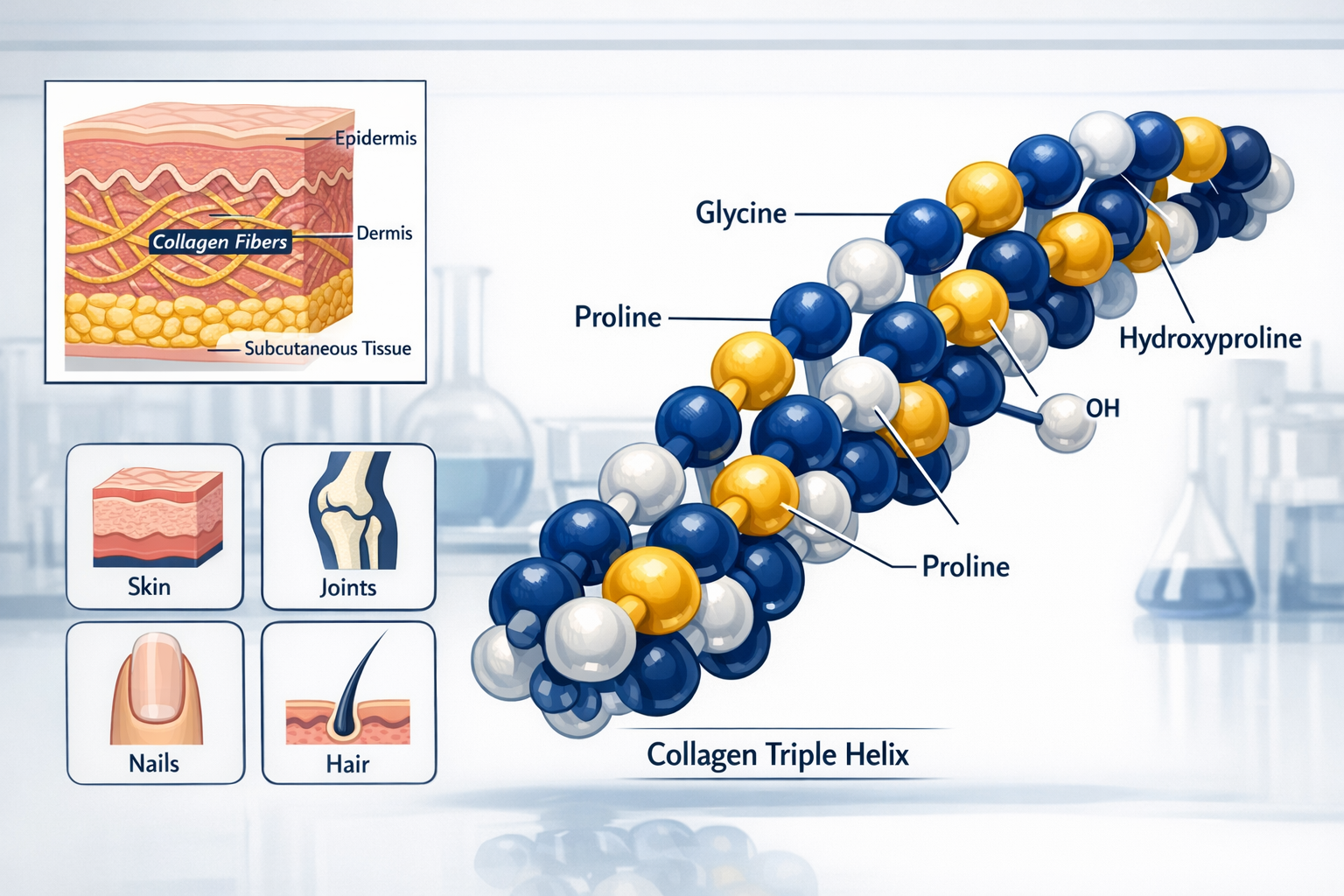
Vital Proteins Collagen Peptides is a hydrolysed collagen supplement made from bovine hide. Hydrolysis breaks full collagen proteins into shorter chains called peptides, which are smaller and more easily absorbed than intact collagen molecules.
The product contains Type I and Type III collagen — the two most abundant collagen types in the human body. Type I is the primary structural protein in skin, tendons, ligaments, and bone. Type III is found alongside Type I in skin and blood vessels. Together, they cover most of the structural connective tissue the body maintains and repairs throughout life [3].
What it does not contain: Type II collagen, which is the primary collagen in cartilage. Researchers or consumers specifically interested in cartilage support should note this distinction and look for products that explicitly include Type II collagen [3].
How the formula is composed
| Component | Amount per serving |
|---|---|
| Collagen peptides | 20g |
| Total protein | 18g |
| Calories | 70 |
| Sugar | 0g |
| Carbohydrates | 0g |
| Key added ingredient | Hyaluronic acid |
The ingredient list is deliberately short: bovine collagen peptides and hyaluronic acid. No fillers, no artificial sweeteners, no proprietary blends obscuring actual doses [3].
Where Does Vital Proteins Source Its Collagen?
Collagen is sourced from grass-fed, pasture-raised cattle in Brazil, from farms that meet Vital Proteins’ stated standards for animal welfare and environmental sustainability [3].
Grass-fed sourcing is commonly cited in the supplement industry as a quality marker. The reasoning is that grass-fed cattle have different fatty acid profiles and are generally raised with fewer antibiotics and growth hormones than conventionally farmed animals. Whether this meaningfully affects the final collagen peptide product is a separate question — but from a sourcing transparency standpoint, the company provides more detail than many competitors.
Why Brazil? Brazil has large-scale, established grass-fed cattle farming infrastructure. Several major collagen ingredient suppliers operate there, and it is a common origin for bovine collagen used in global supplement manufacturing.
How Does Vital Proteins Collagen Peptides Perform in Independent Testing?
Independent lab testing by BarBend placed Vital Proteins Collagen Peptides in the top 10% of collagen supplements tested, receiving A grades across all five testing categories: heavy metals, pesticides, phthalates, bisphenols, and label accuracy [2].
Label accuracy is particularly important. It confirms that the product actually contains what it claims — the stated dose of collagen peptides, at the stated concentration. Many supplements fail this basic check, so a clean result here is meaningful.
“Independent lab testing awarded A grades across metals, pesticides, phthalates, bisphenols, and label accuracy — placing it in the top 10% of collagen products tested.” [2]
What this means for buyers: Third-party testing reduces the risk of purchasing a product that is contaminated, underdosed, or mislabelled. It does not guarantee a specific health outcome, but it does confirm product integrity.
What Results Can You Realistically Expect, and When?
Results from vital proteins collagen peptides supplementation follow a predictable timeline based on tissue type. Faster-turnover tissues like nails respond sooner; slower-turnover tissues like joints and hair take considerably longer [3].
Estimated results timeline:
- Week 3: Nail strength and growth rate may show early improvement
- Weeks 4–8: Joint comfort and mobility changes become more noticeable
- Week 12: Skin hydration, elasticity, and texture improvements become measurable
- ~6 months: Hair thickness and visible growth changes may appear [3]
These timelines reflect general patterns reported in user experience data and are not guaranteed outcomes. Individual results vary based on age, baseline collagen levels, diet, and consistency of use.
Common mistake: Stopping supplementation at four to six weeks and concluding it “doesn’t work” — particularly for skin and hair goals, which require a minimum of 12 weeks and six months respectively to show meaningful change [3].
Who Is Vital Proteins Collagen Peptides Best Suited For?
Vital Proteins Collagen Peptides suits adults looking for a clean, unflavoured collagen supplement they can add to coffee, smoothies, or water without altering taste. The minimal ingredient list makes it suitable for people avoiding additives, and the grass-fed sourcing appeals to those prioritising animal welfare and transparency.
Choose this product if:
- You want a straightforward collagen peptide supplement with no unnecessary additives
- You are focused on skin, hair, nails, bone, or joint support (Type I and III collagen)
- You prefer a product with strong third-party testing credentials [2]
- You are comfortable with a premium price point for verified quality [3]
Consider alternatives if:
- You specifically need Type II collagen for cartilage research or support
- You are vegan or vegetarian (this product is bovine-derived)
- Budget is a primary concern — at $25+ per month, it sits at the higher end of the market [3]
- You are a researcher looking for isolated collagen peptide sequences for laboratory use (consumer supplements are not equivalent to research-grade peptides)
How Does Vital Proteins Fit Into the Broader Collagen Market in 2026?
Vital Proteins is recognised as “America’s #1 collagen brand” and is widely credited with popularising collagen peptides as a mainstream consumer wellness category [6]. The brand has expanded beyond its core collagen powder into ready-to-drink formats, creamers, and most recently, a Collagen & Protein Shake containing 30 grams of protein and 10 grams of collagen peptides per serving [6].
The U.S. Open partnership announced in August 2025 — making Vital Proteins the Official Collagen Partner — signals a deliberate move into sports nutrition and active wellness, a segment that has historically been dominated by whey and plant-based proteins [6].
Collagen remains one of the fastest-growing supplement ingredients in the US market, with demand expanding from beauty and anti-aging into fitness recovery and joint health [6]. International demand is also growing, with health-conscious consumers in markets like China increasingly seeking US-manufactured collagen products due to perceived quality control advantages [1].
As of March 2026, the 20oz unflavoured tub remains a top-selling item at US retailers including Costco and Amazon [1].
What Is the Difference Between Collagen Peptides and Research-Grade Peptides?
This is an important distinction, particularly for anyone arriving at this topic from a scientific or laboratory background.
Consumer collagen peptides (such as Vital Proteins) are food-grade hydrolysed proteins sold as dietary supplements. They contain a mixture of short collagen-derived amino acid chains, primarily intended for nutritional support. They are not produced under research-grade conditions, do not come with certificates of analysis (COAs) for individual peptide sequences, and are not suitable as reference materials in scientific research.
Research-grade peptides, by contrast, are synthesised to a specific sequence, produced under controlled conditions, and supplied with purity documentation. They are used in laboratory settings to investigate specific biological mechanisms — not for consumption.
At Peptide Pro, all peptides are supplied strictly for research use only, clearly labelled, and provided with full product information and COAs. The range includes compounds relevant to connective tissue, recovery, and anti-aging research — for example, GHK-Cu (50mg), a copper peptide with documented research interest in skin and tissue biology, and the Glow 70mg combination (TB-500, BPC-157, and GHK-Cu), which is frequently requested for recovery and tissue repair research. These are not the same as consumer collagen supplements and should not be confused with them.
For researchers interested in growth hormone-related peptides, Sermorelin 10mg and CJC-1295 without DAC are also available through the Peptide Pro catalogue. Similarly, BPC-157 10mg and TB-500 10mg are among the most frequently requested sequences for tissue and recovery research.
How Should You Use Vital Proteins Collagen Peptides?
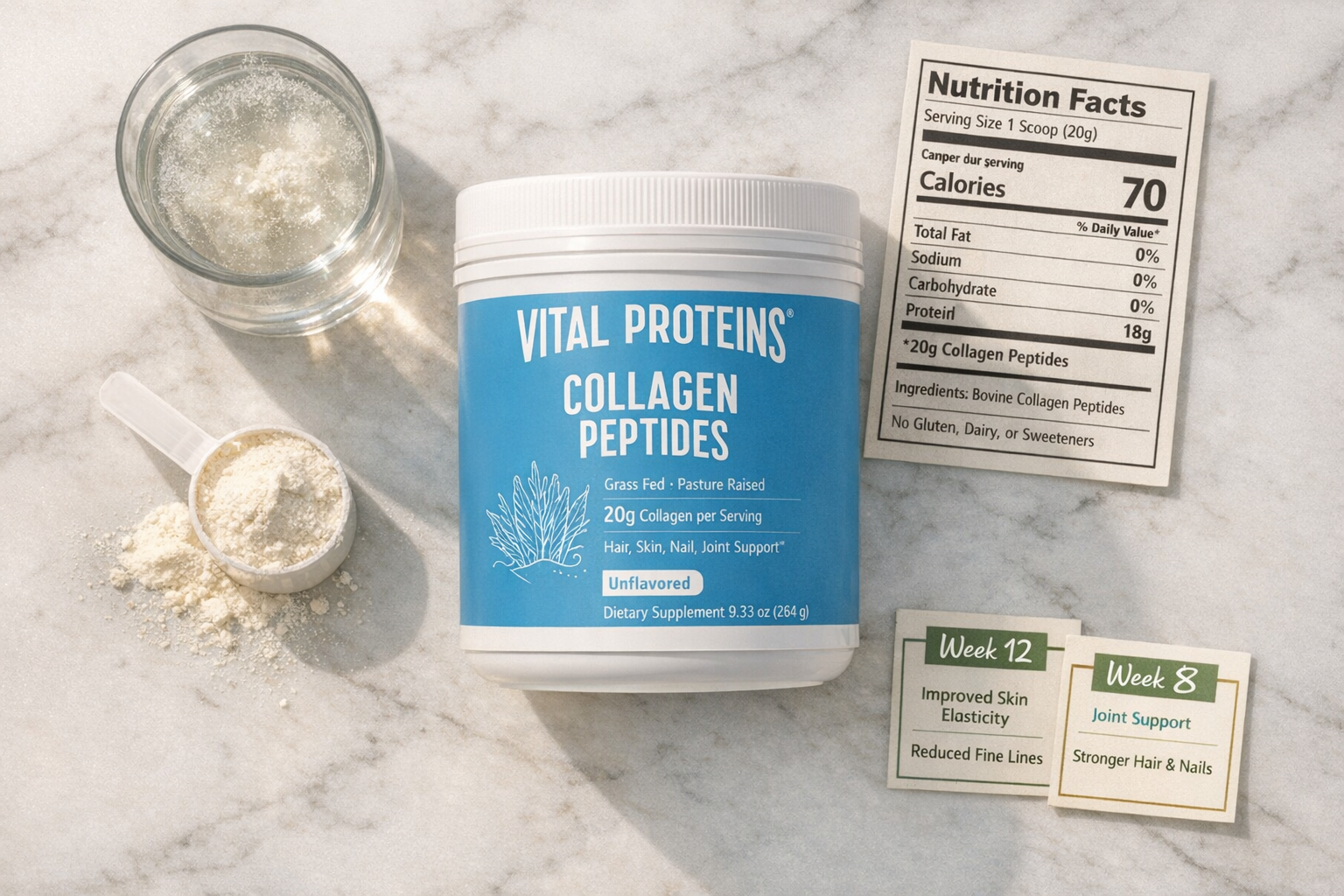
The standard serving is one scoop (approximately 20g) mixed into a hot or cold beverage. The unflavoured version dissolves well in coffee, tea, water, or smoothies without significantly altering taste or texture.
Practical usage notes:
- Timing: No strong evidence favours a specific time of day for collagen peptide supplementation. Morning coffee or a post-exercise smoothie are common choices for consistency
- With vitamin C: Some researchers suggest that vitamin C supports collagen synthesis pathways. Adding a vitamin C source alongside collagen supplementation is a common practice, though the direct interaction with supplemental collagen peptides is still being studied
- Consistency matters more than timing: Given the long timelines required to see results (12 weeks for skin, six months for hair), daily consistency is the most important variable [3]
- Storage: Keep the container sealed, in a cool dry place, away from moisture
Flavoured vs. unflavoured: Vital Proteins offers flavoured variants, but the unflavoured version remains the most versatile and avoids added sweeteners. For those who find plain collagen water unappealing, blending into a smoothie is the simplest solution.
Is the Premium Price Justified?
At approximately $25+ per month (or $300+ over six months of regular use), Vital Proteins Collagen Peptides sits at the premium end of the consumer collagen market [3].
Whether the price is justified depends on what you value:
- Third-party testing: The A-grade results across all BarBend testing categories [2] provide genuine assurance of product purity and label accuracy — something cheaper alternatives may not offer
- Ingredient simplicity: Two ingredients, no fillers, no proprietary blends
- Brand transparency: Grass-fed sourcing with stated origin [3]
- Market position: As the category leader [6], Vital Proteins carries a brand premium that partly reflects marketing spend rather than purely product cost
For budget-conscious buyers: Several competitor products offer similar collagen peptide formulations at lower price points. The trade-off is typically less rigorous third-party testing documentation. If verified purity matters to you, the premium may be worth it. If you are primarily looking for a basic collagen supplement with no specific quality requirements, lower-cost options exist.
Promotional offers are periodically available through the official Vital Proteins store [7], which can reduce the effective monthly cost for regular buyers.
Frequently Asked Questions
Q: What types of collagen does Vital Proteins Collagen Peptides contain?
Type I and Type III collagen, sourced from bovine hide. These target skin, hair, nails, bones, and joints. Type II collagen (cartilage-focused) is not included [3].
Q: How many grams of collagen are in each serving?
Each serving contains 20 grams of collagen peptides and 18 grams of total protein, with 70 calories and no sugar or carbs [3].
Q: Is Vital Proteins Collagen Peptides third-party tested?
Yes. Independent testing by BarBend awarded A grades across heavy metals, pesticides, phthalates, bisphenols, and label accuracy, placing it in the top 10% of collagen products tested [2].
Q: Where is the collagen sourced from?
From grass-fed, pasture-raised cattle in Brazil, on farms meeting Vital Proteins’ stated animal welfare and sustainability standards [3].
Q: How long before you see results?
Nails may improve by week three. Joints typically take 4–8 weeks. Skin requires at least 12 weeks. Hair changes may take approximately six months of consistent daily use [3].
Q: Can it be mixed into hot drinks?
Yes. The unflavoured version dissolves in both hot and cold liquids without significantly affecting taste or texture.
Q: Is this product suitable for vegans?
No. It is derived from bovine (cattle) hide. Vegan collagen alternatives typically use plant-based ingredients that support the body’s own collagen production rather than providing collagen directly.
Q: What is the difference between this and research-grade collagen peptides?
Consumer supplements like Vital Proteins are food-grade nutritional products. Research-grade peptides are synthesised to specific sequences under controlled laboratory conditions, supplied with COAs, and used strictly for scientific research — not for consumption. These are fundamentally different product categories.
Q: How does Vital Proteins compare to other collagen brands?
As “America’s #1 collagen brand” [6], it benefits from strong third-party testing credentials [2] and sourcing transparency [3]. Competitors may offer similar formulations at lower prices, but with less rigorous quality documentation.
Q: Are there any allergens to be aware of?
The product is derived from bovine collagen. Anyone with beef or bovine-related sensitivities should check the full label. It does not contain common allergens like gluten, dairy, or soy in the standard unflavoured formula, but always verify the current label before purchasing.
Q: Where can I buy it?
The product is available through the official Vital Proteins website [7], major US retailers including Costco and Amazon [1], and various international shipping services for buyers outside the US [1].
Q: Is there a promotional offer currently available?
Vital Proteins periodically runs promotions through their official store. A promotion was valid through March 30, 2026 on select products [7] — check the official site for current offers.
Conclusion
Vital Proteins Collagen Peptides is a well-formulated, independently verified collagen supplement that earns its position as the US market leader. The combination of a clean two-ingredient formula, grass-fed Brazilian sourcing, and A-grade third-party testing results [2] makes it one of the more credible options in a crowded supplement category.
The key things to keep in mind before purchasing:
- Set realistic timelines. Skin results require 12 weeks minimum; hair takes closer to six months. Consistency matters more than anything else [3].
- Confirm the collagen type matches your goal. Type I and III are present; Type II is not. If cartilage support is the priority, look elsewhere [3].
- Factor in the cost. At $25+ per month, this is a premium product. The third-party testing credentials justify some of that premium, but it is worth comparing alternatives if budget is a constraint [3].
- Understand what you are buying. Consumer collagen supplements and research-grade peptides are different product categories serving different purposes.
For researchers and laboratory professionals interested in peptides relevant to connective tissue biology, skin health, and recovery — including compounds like GHK-Cu, BPC-157, and TB-500 — Peptide Pro supplies high-purity, research-grade compounds with full COAs, same-day dispatch before 1pm (Mon–Fri), and fast UK and international delivery. All products are strictly for research use only.
References
[1] The 2026 Plan For Getting Vital Proteins Collagen Peptides To China Without Order Cancellations – https://www.comgateway.com/blogs/the-2026-plan-for-getting-vital-proteins-collagen-peptides-to-china-without-order-cancellations/
[2] Vital Proteins Collagen Peptides Review – https://barbend.com/vital-proteins-collagen-peptides-review/
[3] Vital Proteins Collagen Peptides Review – https://shop.athleticinsight.com/blogs/reviews/vital-proteins-collagen-peptides-review
[4] Press Releases – https://www.vitalproteins.com/pages/press-releases
[5] Collagen Peptides – https://www.vitalproteins.com/products/collagen-peptides
[6] Vital Proteins Serves Up Collagen At The US Open – https://www.nutraingredients.com/Article/2025/08/29/vital-proteins-serves-up-collagen-at-the-us-open/
[7] All Products – https://www.vitalproteins.com/collections/all-products
Tags: vital proteins collagen peptides, collagen peptides, bovine collagen, hydrolysed collagen, collagen supplement review, Type I collagen, Type III collagen, collagen for skin, collagen for joints, supplement testing, grass-fed collagen, peptide research