Last updated: March 25, 2026
Quick Answer: Collagen peptides are short-chain amino acid sequences derived from hydrolyzed collagen — the structural protein that makes up connective tissue, skin, bone, and cartilage. Vital Proteins is one of the most widely recognised brands producing collagen peptides, offering products ranging from powder supplements to functional beverages. Current research suggests a daily intake of 10–20 grams may support skin, joint, and connective tissue health, though individual outcomes vary. [2]
Key Takeaways
- Collagen is the most abundant protein in the human body, forming the structural foundation of skin, tendons, ligaments, cartilage, and bone.
- Hydrolysis breaks full collagen into peptides — shorter chains that are more readily absorbed in the digestive tract than intact collagen protein.
- Vital Proteins' flagship collagen peptides contain 20 grams of hydrolyzed collagen per serving, sourced from grass-fed, pasture-raised cattle. [2]
- Independent lab testing ranked Vital Proteins Collagen Peptides in the top 10% across all tested categories including metals, pesticides, and label accuracy, receiving an A grade across all categories. [2]
- VERISOL® collagen peptides, used in Vital Proteins' newer product lines, have been clinically studied for skin elasticity and fine line reduction within 30 days. [1]
- Product innovation is accelerating — Vital Proteins launched a collagen sparkling water in March 2026 and a ready-to-drink protein shake containing 30g protein plus 10g collagen peptides. [1][5]
- Collagen peptides are not the same as research peptides used in laboratory settings, though both fall under the broader peptide science umbrella.
- Not all collagen supplements are equal — sourcing, processing method, and third-party testing matter significantly for quality and consistency.
What Are Collagen Peptides, and How Do They Differ from Whole Collagen?
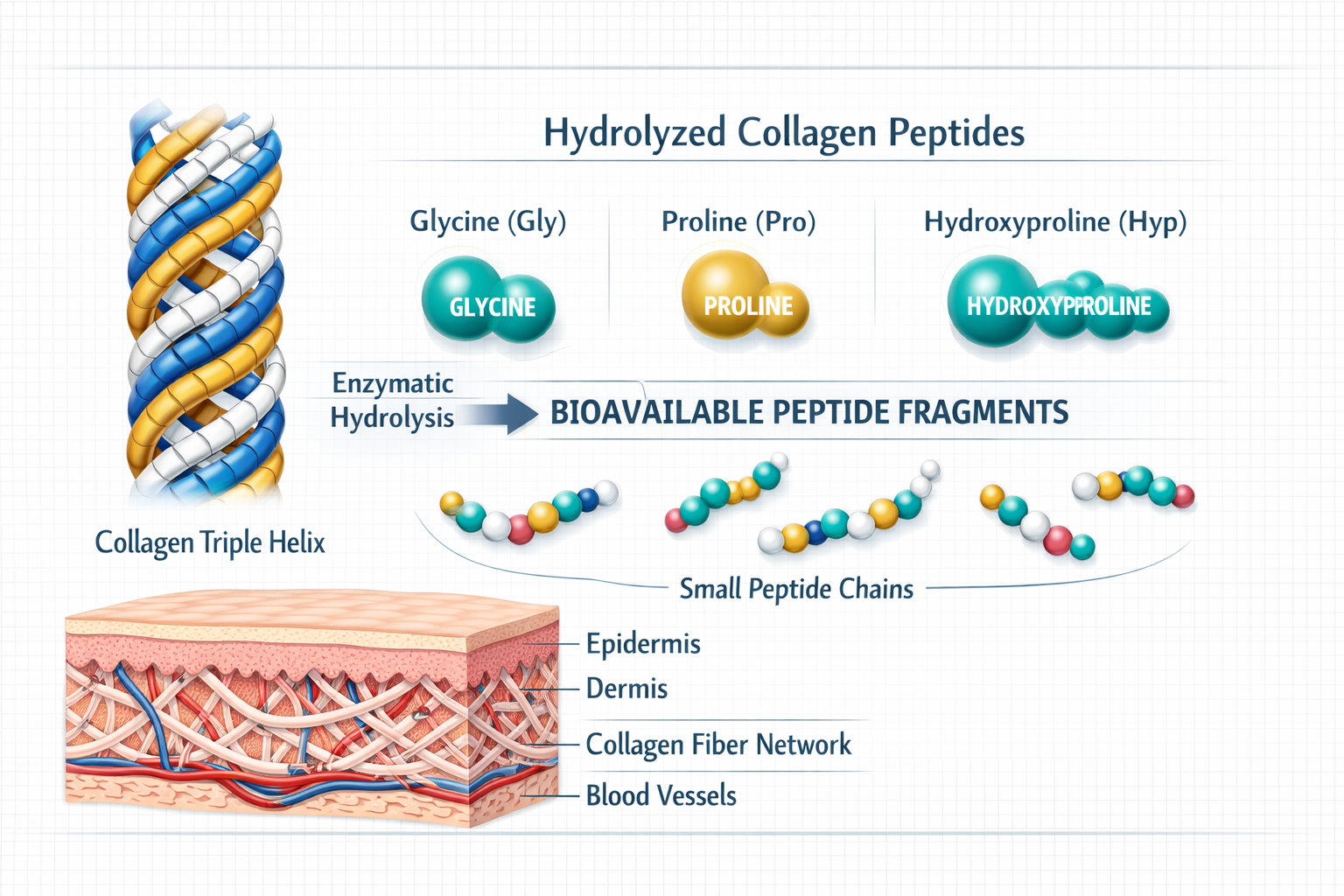
Collagen peptides are fragments of collagen protein produced by breaking down the full triple-helix collagen structure through a process called enzymatic hydrolysis. The result is shorter amino acid chains — peptides — that are more soluble and more readily absorbed than intact collagen.
Whole collagen vs. collagen peptides at a glance:
| Feature | Whole Collagen | Collagen Peptides |
|---|---|---|
| Molecular size | Large (high molecular weight) | Small (low molecular weight) |
| Solubility | Poor in cold liquids | Dissolves easily in hot or cold |
| Digestive absorption | Requires more breakdown | More readily absorbed |
| Common form | Gelatin (when heated/cooled) | Powder, capsule, liquid |
| Primary use | Cooking, food production | Dietary supplementation |
Collagen itself is made up primarily of three amino acids: glycine, proline, and hydroxyproline. These are the building blocks that the body uses to synthesise new collagen tissue. When you consume collagen peptides, these amino acids become available for the body to use in tissue repair and maintenance processes — though the body ultimately directs amino acids where they are needed most.
Important distinction for researchers: The term "peptide" covers an enormous range of compounds. Collagen peptides are dietary food-derived fragments used as nutritional supplements. Research peptides — such as BPC-157 or TB-500 — are synthetic sequences studied in laboratory settings and are strictly for research use only, not for human consumption.
What Does the Science Say About Collagen Peptides and Vital Proteins Products?
The evidence base for collagen peptides has grown considerably over the past decade, though it remains an active area of research with some limitations worth noting.
Skin health is the most studied application. VERISOL® collagen peptides — a specific bioactive collagen peptide ingredient featured in Vital Proteins' newer formulations — have been studied in clinical trials examining skin elasticity and the appearance of fine lines. Vital Proteins' product literature cites improvements in skin health in as little as 30 days. [1]
Joint and connective tissue support is another frequently cited area. Collagen peptides provide the amino acid substrates that cartilage tissue requires. Some research has examined their role in joint comfort, though this area benefits from more large-scale, independent studies.
Quality and purity matter as much as the science behind the ingredient. Independent lab testing placed Vital Proteins Collagen Peptides in the top 10% of all tested products across five categories: metals, pesticides, phthalates, bisphenols, and label accuracy — earning an A grade in each. [2] That kind of third-party verification is a meaningful quality signal.
Common mistake: Assuming all collagen peptide products are equivalent. The source material (bovine, marine, porcine), the hydrolysis method, and the specific peptide fractions used all influence the end product. VERISOL® is a patented ingredient with its own clinical data; generic hydrolyzed collagen may not share the same evidence base.
How Are Vital Proteins Collagen Peptides Formulated?
Vital Proteins offers several collagen peptide formulations, each designed for a different use case or preference.
The flagship collagen peptides powder contains 20 grams of hydrolyzed collagen per serving, sourced from grass-fed, pasture-raised cattle. [2] It is unflavoured, dissolves in hot or cold liquids, and is designed to be added to coffee, smoothies, or water.
The advanced formula builds on the standard product by adding 100% of the daily value of Vitamin C and 120 milligrams of hyaluronic acid per serving. [2] Vitamin C is a co-factor required for collagen synthesis in the body, so its inclusion is scientifically grounded rather than purely cosmetic.
Key formulation details for the standard product:
- Collagen source: Grass-fed, pasture-raised bovine hide
- Collagen per serving: 20 grams [2]
- Processing: Enzymatic hydrolysis to produce low-molecular-weight peptides
- Additives: Minimal — the unflavoured version contains collagen peptides only
- Certifications: The product has received strong independent quality ratings [2]
Choose the standard formula if you want a clean, versatile powder to add to existing food and drinks. Choose the advanced formula if you want added skin-support co-factors in a single product.
What New Vital Proteins Products Launched in 2026?
Vital Proteins has expanded significantly beyond its original powder format in 2026, entering new product categories that reflect broader trends in functional nutrition.
Collagen Sparkling Water
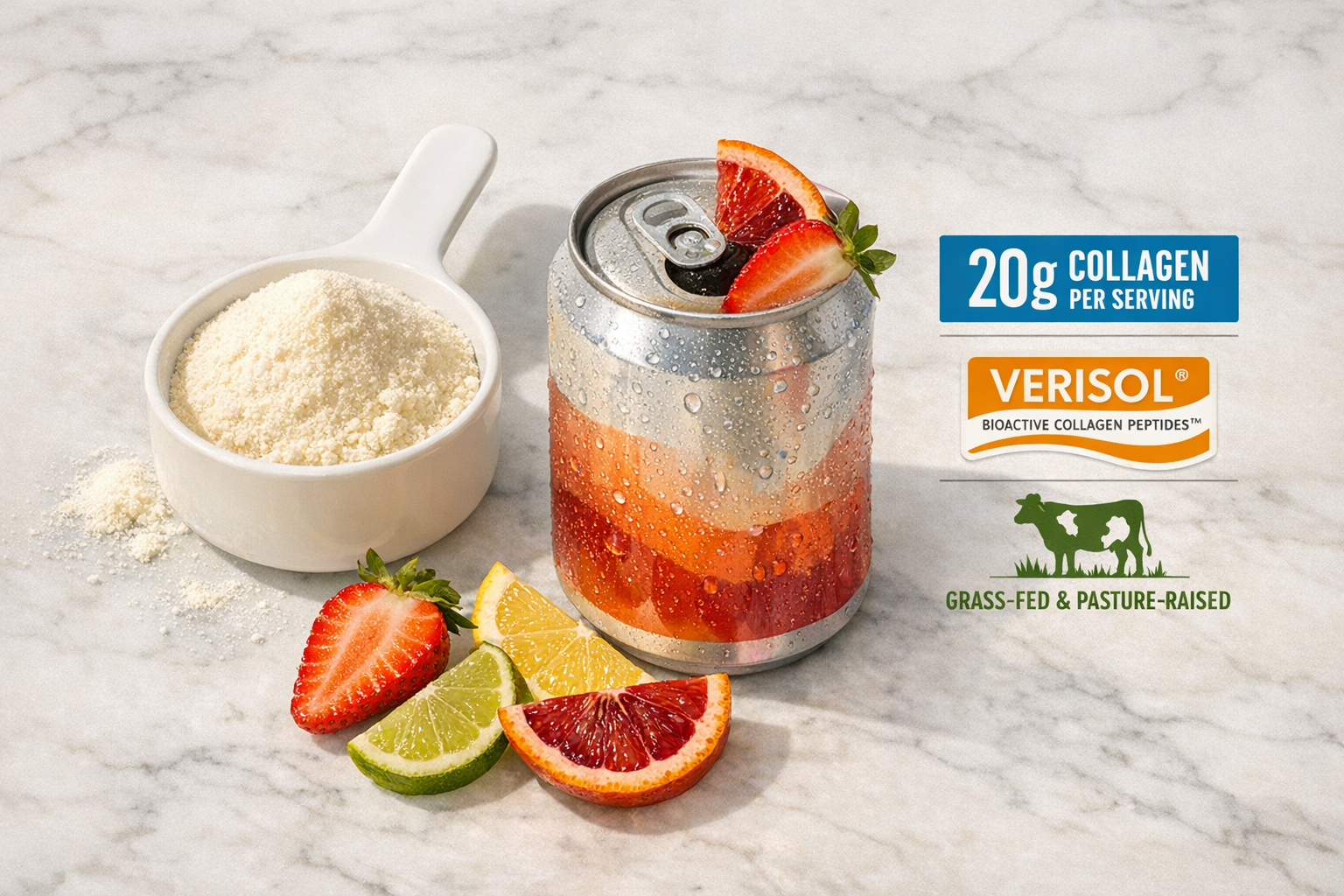
In March 2026, Vital Proteins unveiled its Collagen Sparkling Water, featuring VERISOL® collagen peptides in a ready-to-drink carbonated format. [1] This marked a notable move into the functional beverage category.
Product profile:
- Collagen type: VERISOL® bioactive collagen peptides [1]
- Vitamin C: 100% of the Daily Value per 12-ounce can [1]
- Sugar: 0 grams [1]
- Artificial sweeteners: None [1]
- Calories: 15 per can [1]
- Flavours: Strawberry Blossom, Lemon Lime, Blood Orange [1]
- Price: $2.50 per 12-ounce can; variety 12-packs at $17.99 at club stores [1]
- Retail availability: Launched nationwide at Walmart in March 2026, with expansion to vitalproteins.com, Amazon, and the Vital Proteins TikTok Shop planned for late spring 2026 [1]
Ready-to-Drink Protein Shake
Vital Proteins also launched its first ready-to-drink protein shake, containing 30 grams of protein plus 10 grams of collagen peptides in a light chocolate flavour. [5] This positions the brand within the high-protein beverage category, which grew 122% between 2020 and 2024. [5]
The move reflects a clear strategic direction: making collagen peptides accessible in convenient, on-the-go formats rather than requiring consumers to mix powders themselves.
How Do Collagen Peptides Fit Within Broader Peptide Science?
Collagen peptides vital proteins research sits at one end of a wide spectrum of peptide science. Understanding where it fits helps distinguish dietary supplementation from laboratory research.
Peptides are defined by their size: they are chains of amino acids shorter than proteins (typically fewer than 50 amino acids). Collagen peptides produced by hydrolysis typically range from 2 to 20 amino acids in length, making them small enough to be absorbed efficiently in the gut.
Research peptides studied in laboratory settings are also amino acid sequences, but they are typically synthetic, highly specific, and designed to interact with particular biological receptors or pathways. For example:
- GHK-Cu (copper peptide) is a naturally occurring tripeptide studied for its role in tissue remodelling and skin biology — research that shares conceptual ground with collagen peptide science.
- SNAP-8 is a synthetic octapeptide studied in the context of cosmetic research, specifically examining its effects on expression lines.
- KPV is a tripeptide derived from alpha-MSH, studied for its anti-inflammatory properties in research contexts.
These are strictly research compounds — for laboratory use only, not for human consumption. But they illustrate how peptide science extends far beyond collagen supplementation, with researchers examining how specific amino acid sequences interact with biological systems at a molecular level.
At Peptide Pro, all peptides are supplied strictly for research use only and are clearly labelled as such. The science of collagen peptides and the science of research peptides share foundational biochemistry — but they are distinct fields with different regulatory and application frameworks.
What Is the Recommended Daily Intake of Collagen Peptides?
Current research suggests consuming between 10 and 20 grams of collagen peptides per day for potential benefits, with most studies using doses in this range. [4] Vital Proteins' standard serving size of 20 grams aligns with the upper end of this guidance. [2]
Practical considerations:
- Timing: No strong evidence currently favours a specific time of day for collagen peptide consumption. Morning use (e.g., in coffee) is common for practical reasons.
- Consistency: Short-term use is unlikely to produce measurable effects. Most studies examining skin outcomes run for 4–12 weeks.
- Co-factors: Vitamin C is required for collagen synthesis. If your diet is low in Vitamin C, this may limit the benefit of collagen supplementation regardless of dose.
- Hydration: Collagen peptides are generally well tolerated. Adequate hydration supports overall connective tissue health.
Edge case: People with fish or shellfish allergies should check whether a collagen product is marine-derived. Bovine-sourced products like Vital Proteins' flagship powder are appropriate for those with seafood allergies but unsuitable for vegetarians or vegans.
How Does Vital Proteins Compare to Other Collagen Peptide Brands?
Vital Proteins is one of the most recognisable names in the collagen peptide market, but it operates in a competitive space. Here is how it compares on key criteria:
| Criteria | Vital Proteins | Generic/Budget Brands |
|---|---|---|
| Independent lab testing | Top 10% across all categories, A grade [2] | Varies widely; often untested |
| Collagen per serving | 20g hydrolyzed bovine collagen [2] | Typically 10–20g |
| Sourcing transparency | Grass-fed, pasture-raised cattle [2] | Often unclear |
| Advanced formulas | Yes (with Vitamin C + hyaluronic acid) [2] | Rarely |
| Product range | Powder, sparkling water, RTD shakes [1][5] | Usually powder only |
| Patented ingredients | VERISOL® in newer products [1] | Rarely |
| Price point | Mid-to-premium | Budget to mid |
Choose Vital Proteins if third-party quality verification and sourcing transparency matter to your purchasing decision. The independent A-grade rating across five testing categories [2] is a meaningful differentiator in a supplement market where quality control varies considerably.
Consider alternatives if budget is the primary constraint and you are comfortable with less testing transparency, or if you require a plant-based collagen alternative (note: true collagen is animal-derived; plant-based "collagen boosters" contain precursor nutrients rather than collagen itself).
What Are the Limitations and Considerations of Collagen Peptide Research?
Collagen peptide research is promising but not without limitations. A balanced view requires acknowledging both the evidence and its constraints.
Methodological considerations:
- Many studies are industry-funded, which does not invalidate them but warrants scrutiny of effect sizes and outcome measures.
- Sample sizes in skin health trials are often small (50–100 participants), limiting generalisability.
- Outcome measures for skin health (elasticity, hydration, fine lines) are real but subjective or require specialised equipment to measure reliably.
- Gut absorption of intact peptides is debated. Some research suggests specific peptide sequences survive digestion and reach target tissues; other work indicates amino acids are largely absorbed individually.
What the evidence does support reasonably well:
- Collagen peptides are a high-quality source of specific amino acids (glycine, proline, hydroxyproline) that are less abundant in typical protein sources like chicken breast or whey.
- VERISOL® specifically has clinical trial data supporting skin elasticity improvements. [1]
- Third-party quality testing for Vital Proteins products shows strong purity and label accuracy. [2]
What remains less certain:
- Whether collagen peptides outperform equivalent doses of other high-quality protein sources for joint or skin outcomes.
- Optimal dosing windows and whether specific peptide sequences matter more than total amino acid load.
This is an active research area. Researchers studying related peptide mechanisms — including tissue repair peptides like BPC-157 — contribute to a broader understanding of how peptide sequences interact with biological repair systems, though such compounds are strictly for laboratory research.
How Should Collagen Peptides Be Stored and Used?
Proper storage preserves the quality and potency of collagen peptide products.
For powder formats:
- Store in a cool, dry place away from direct sunlight and moisture.
- Seal the container tightly after each use.
- Do not store near heat sources (e.g., on top of a kettle or near a hob).
- Most products have a shelf life of 2 years from manufacture when stored correctly.
For ready-to-drink formats (sparkling water, shakes):
- Store unopened cans at room temperature.
- Refrigerate after opening and consume promptly.
- Check the best-before date, particularly for products containing added vitamins.
Reconstitution note: Collagen peptide powders are designed to dissolve — they do not require reconstitution in the same way that lyophilized research peptides do. For guidance on handling research-grade peptides, Peptide Pro provides detailed educational resources on reconstitution and storage for laboratory professionals.
FAQ: Collagen Peptides and Vital Proteins
Q: Are collagen peptides the same as protein powder?
Collagen peptides are a type of protein supplement, but they have a different amino acid profile than whey, casein, or plant proteins. They are high in glycine, proline, and hydroxyproline — amino acids less common in standard protein powders — but low in tryptophan, making them an incomplete protein source on their own.
Q: Is Vital Proteins collagen peptides third-party tested?
Yes. Independent lab testing placed Vital Proteins Collagen Peptides in the top 10% of all tested products across metals, pesticides, phthalates, bisphenols, and label accuracy, with an A grade in all categories. [2]
Q: How many grams of collagen should you take per day?
Current research suggests 10–20 grams per day. [4] Vital Proteins' standard serving is 20 grams. [2] Most clinical studies examining skin outcomes use doses in this range over 4–12 weeks.
Q: What is VERISOL® collagen?
VERISOL® is a patented bioactive collagen peptide ingredient produced by GELITA. It has been studied in clinical trials for skin elasticity and fine line reduction. Vital Proteins uses VERISOL® in its Collagen Sparkling Water launched in March 2026. [1]
Q: Can vegetarians or vegans use collagen peptides?
No. Collagen is an animal-derived protein. Vital Proteins' flagship product is bovine-sourced. Marine collagen (fish-derived) is another option for non-vegetarians who avoid beef. There is no true vegan collagen supplement — products marketed as "vegan collagen" contain precursor nutrients (like Vitamin C and amino acids) that support the body's own collagen production.
Q: Does Vital Proteins collagen dissolve in cold water?
Yes. Hydrolyzed collagen peptides are water-soluble and dissolve in both hot and cold liquids, unlike gelatin which requires heat.
Q: Are collagen peptides safe?
Collagen peptides from reputable sources with third-party testing are generally well tolerated in healthy adults. People with allergies to the source animal, or those on specific medical diets, should check with a healthcare professional. Vital Proteins products have strong safety profiles based on independent testing. [2]
Q: What is the difference between collagen peptides and research peptides?
Collagen peptides are food-derived dietary supplements. Research peptides are synthetic amino acid sequences studied in laboratory settings for their biological activity. They are entirely different categories — research peptides are strictly for laboratory use only and are not intended for human consumption.
Q: Where can I buy Vital Proteins Collagen Sparkling Water?
The sparkling water launched nationwide at Walmart in March 2026, with expansion to vitalproteins.com, Amazon, and the Vital Proteins TikTok Shop planned for late spring 2026. [1]
Q: Does taking Vitamin C with collagen peptides matter?
Vitamin C is a required co-factor for the body's collagen synthesis pathway. Vital Proteins' advanced formula includes 100% of the daily value of Vitamin C per serving. [2] If dietary Vitamin C intake is low, supplementing it alongside collagen peptides is a reasonable approach.
Conclusion
Collagen peptides vital proteins research represents a well-developed area of nutritional science with a growing evidence base, particularly for skin health applications. Vital Proteins has established itself as a quality-focused brand with strong independent testing credentials [2], a transparent sourcing approach, and an expanding product portfolio that now includes functional sparkling water featuring clinically studied VERISOL® collagen peptides [1] and a ready-to-drink protein shake. [5]
Actionable next steps:
- Verify quality before purchasing any collagen peptide product — look for third-party testing results covering metals, pesticides, and label accuracy.
- Match the product to your goal: standard powder for versatility, advanced formula for added skin co-factors, sparkling water for on-the-go convenience.
- Set realistic expectations: consistent daily use over 4–12 weeks is the timeframe most studies use to assess outcomes.
- Ensure adequate Vitamin C intake alongside collagen peptides to support the body's own synthesis pathways.
- Distinguish dietary collagen from research peptides: if you are a researcher interested in the broader science of peptide biology — including tissue repair, skin remodelling, or connective tissue research — explore the Peptide Pro research catalogue for high-purity compounds supplied strictly for laboratory use.
The science of peptides — from dietary collagen to research-grade compounds — continues to advance rapidly in 2026. Whether the interest is nutritional supplementation or laboratory research, quality, purity, and evidence-based sourcing remain the non-negotiable foundations of any credible approach.
References
[1] Bubbles With Benefits: Vital Proteins Unveils Collagen Sparkling Water – https://www.prnewswire.com/news-releases/bubbles-with-benefits-vital-proteins-unveils-collagen-sparkling-water-302703980.html
[2] Vital Proteins Collagen Peptides Review – https://barbend.com/vital-proteins-collagen-peptides-review/
[3] Press Releases – https://www.vitalproteins.com/pages/press-releases
[4] Vital Proteins – https://www.vitalproteins.com
[5] Food Dive: Danone Activia Vital Proteins Shake – https://www.fooddive.com/news/danone-activia-vital-proteins-shake-bloody-mary-ketchup/757211/
[6] Vital Proteins Newsroom – https://www.vitalproteins.com/blogs/newsroom
Tags: collagen peptides, vital proteins, collagen peptides vital proteins, hydrolyzed collagen, VERISOL collagen, collagen sparkling water, collagen supplement review, peptide science, bovine collagen, skin health supplements, collagen daily intake, functional beverages