24 Apr
Last updated: April 24, 2026
Quick Answer
Meta has raised its investment in an El Paso, Texas AI data center from $1.5 billion to over $10 billion, with plans to scale the campus to 1 gigawatt (GW) of power capacity by 2028. The project represents one of the largest single-site data center commitments in U.S. history and is central to Meta’s long-term AI infrastructure strategy, even as it faces growing regulatory scrutiny in Texas.
Key Takeaways
- 💰 Investment jumped from $1.5 billion to over $10 billion, a more than sixfold increase in committed capital [1][2]
- ⚡ Target capacity is 1 GW by 2028, enough to power roughly 750,000 average U.S. homes
- 🤖 The facility is purpose-built as an AI data center, not a general-purpose cloud campus
- 🏗️ Construction is already underway in El Paso, with the project scope expanding significantly from its original design [2]
- 🔍 The expansion is happening amid growing Texas regulatory scrutiny, raising questions about permitting, water use, and grid impact [1]
- 🌐 The El Paso site is part of Meta’s broader $65 billion global infrastructure push for 2026 (estimated, based on Meta’s publicly stated capital expenditure guidance)
- 🏙️ The project is expected to bring significant economic activity to the El Paso region, including construction jobs and long-term operational roles
- 🔋 Securing reliable, large-scale power is the single biggest logistical challenge the project faces
What Exactly Is Meta Building in El Paso?
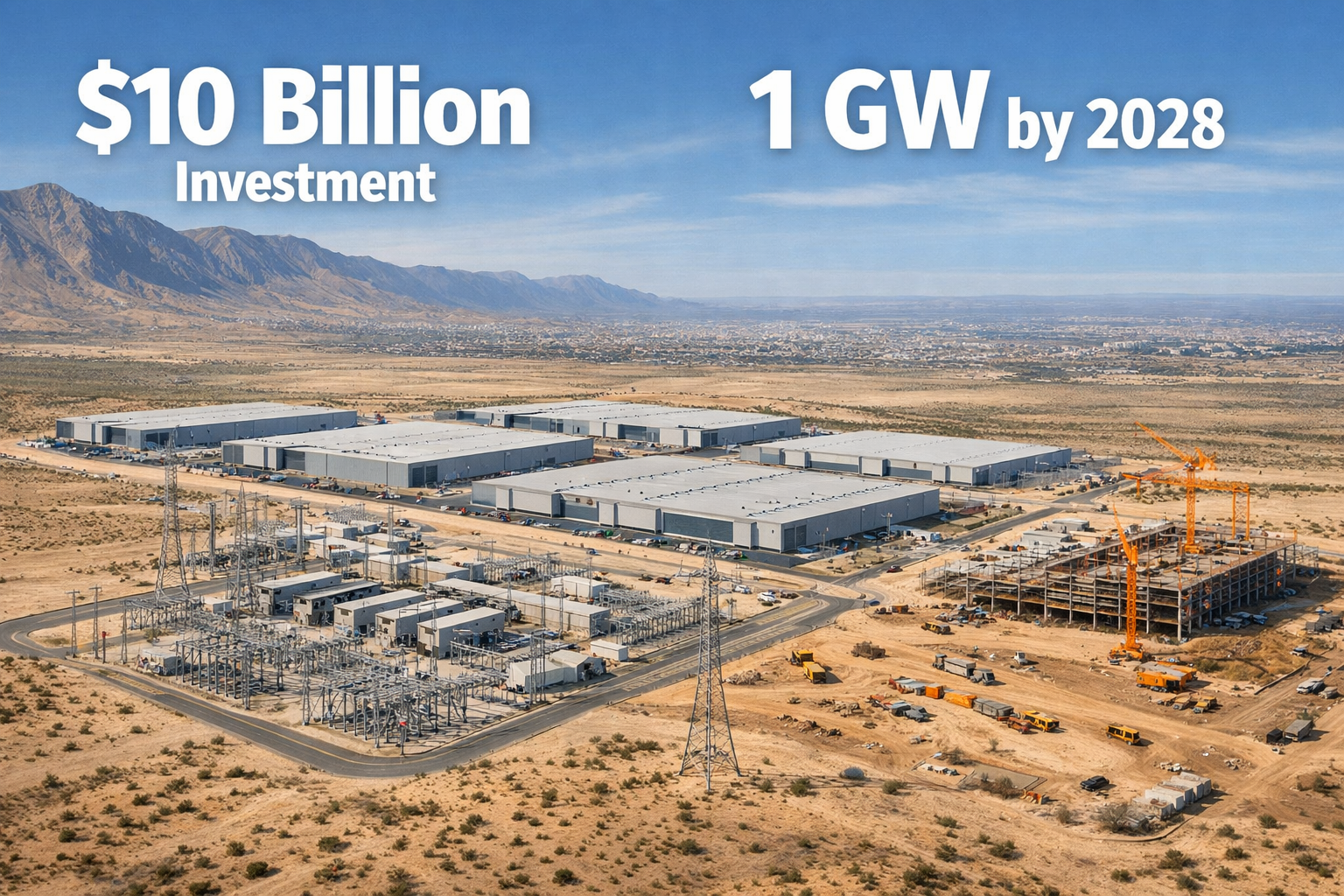
Meta is constructing a dedicated AI data center campus in El Paso, Texas, designed from the ground up to support the compute demands of large-scale artificial intelligence workloads. The facility is not a standard cloud storage or content delivery hub — it is specifically engineered to train and run AI models at a scale that requires extraordinary amounts of electricity and specialized hardware.
The original project was announced at a cost of approximately $1.5 billion. That figure has since been revised dramatically upward to over $10 billion, with the planned power capacity expanded to 1 gigawatt [1][2]. To put that in context, 1 GW is roughly the output of a large nuclear reactor and enough electricity to serve a mid-sized American city.
Key project details at a glance:
| Feature | Detail |
|---|---|
| Location | El Paso, Texas |
| Original investment | ~$1.5 billion |
| Revised investment | Over $10 billion [1][2] |
| Target power capacity | 1 GW by 2028 [1][2] |
| Primary use | AI model training and inference |
| Regulatory environment | Under growing Texas scrutiny [1] |
Why El Paso? The city offers a large available land footprint, proximity to cross-border infrastructure, and access to Texas’s deregulated energy market — factors that make it attractive for large industrial projects.
Why Did Meta’s Investment Jump from $1.5 Billion to $10 Billion?
The tenfold-plus increase reflects a fundamental shift in how Meta views AI infrastructure — not as a supporting cost, but as a core competitive asset. When the project was first scoped, the AI compute landscape looked very different. Since then, the race to build and deploy large language models, recommendation engines, and multimodal AI systems has accelerated sharply across the industry.
Meta’s leadership has made clear that falling behind on compute capacity is not an option. The company competes directly with Google, Microsoft, Amazon, and a growing field of AI-native startups. Each of those competitors is also spending aggressively on data center infrastructure.
Factors driving the investment increase:
- AI model scale: Training frontier AI models now requires clusters of tens of thousands of specialized chips running continuously for months
- Inference demand: As Meta deploys AI features across Facebook, Instagram, WhatsApp, and its Ray-Ban smart glasses, real-time inference workloads are growing fast
- Supply chain lessons: Post-pandemic disruptions taught hyperscalers to over-invest early rather than scramble for capacity later
- Competitive pressure: Google and Microsoft have both announced multi-billion-dollar data center expansions, forcing Meta to match pace
The shift from $1.5 billion to $10 billion is not just a budget revision — it signals that El Paso has been elevated from a regional facility to a flagship AI campus [2].
How Does 1 GW of Power Capacity Compare to Other Data Centers?
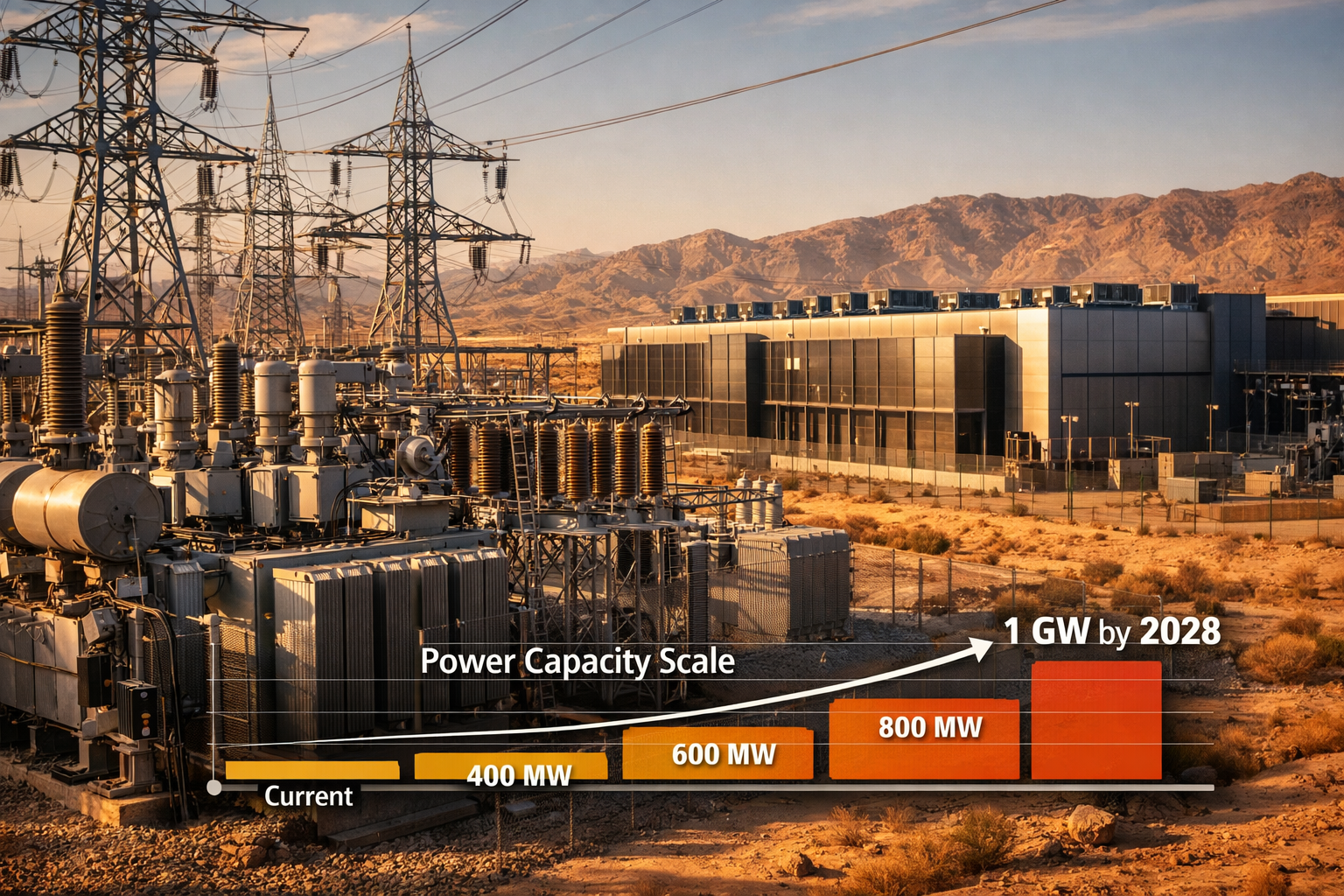
1 GW is an exceptional target. Most large hyperscale data centers operate in the range of 100 to 500 megawatts (MW). Reaching 1 GW at a single campus would place the El Paso facility among the most powerful data center sites ever built anywhere in the world.
For comparison:
- A typical large cloud data center: 50–200 MW
- Microsoft’s announced nuclear-backed facilities: up to 800 MW (estimated, based on publicly reported plans)
- Meta’s El Paso target: 1,000 MW (1 GW) by 2028 [1][2]
Achieving that capacity requires more than just building server halls. It demands:
- Dedicated power generation or long-term utility contracts at a scale that strains regional grids
- High-voltage transmission upgrades connecting the campus to the broader Texas grid
- Cooling infrastructure capable of managing the enormous heat output of AI accelerators
- Redundant power systems to ensure uptime for mission-critical AI workloads
The 1 GW target is ambitious enough that it will almost certainly require Meta to work directly with Texas utilities and potentially with independent power producers to secure supply — a process that takes years and involves significant regulatory coordination [1].
What Are the Biggest Challenges Facing the El Paso Project?
Power procurement and grid integration are the dominant challenges. At 1 GW, the El Paso campus would represent a material addition to the regional load on the Texas grid, which is managed by ERCOT (the Electric Reliability Council of Texas). That scale of demand doesn’t get approved or connected overnight.
Key challenges include:
1. Grid capacity and transmission ERCOT has faced well-documented reliability concerns in recent years. Adding a 1 GW load in West Texas requires transmission upgrades that can take three to five years to plan, permit, and build. Meta will need to either fund those upgrades directly or negotiate cost-sharing arrangements with utilities.
2. Water consumption Data centers at this scale often use evaporative cooling systems that consume millions of gallons of water annually. El Paso is located in a desert region with limited freshwater resources, making water use a politically sensitive issue and a likely point of regulatory friction.
3. Texas regulatory scrutiny The project is occurring amid growing state-level scrutiny of large data center developments [1]. Texas legislators and regulators have become more attentive to the grid impacts of hyperscale facilities, particularly after high-profile grid stress events. Meta will need to navigate permitting processes that are becoming more demanding.
4. Construction timelines Building at this scale in a compressed timeframe — targeting 1 GW by 2028 — requires coordinating thousands of construction workers, securing specialized equipment (including custom electrical gear with long lead times), and managing supply chains that are already stretched thin across the industry.
Common mistake to avoid: Assuming that announcing a $10 billion investment guarantees a 2028 completion. Large infrastructure projects of this complexity routinely face delays. The 2028 target is a goal, not a guarantee.
What Does This Mean for El Paso’s Regional Economy?
The economic impact on El Paso is expected to be substantial, though the full effect will unfold over several years rather than arriving all at once. Construction phases typically generate the most immediate employment, while operational phases create smaller but longer-lasting job bases.
Expected economic contributions:
- Construction employment: Projects of this scale typically employ thousands of workers across electrical, civil, mechanical, and general contracting trades during peak construction phases
- Permanent operations jobs: Data centers at this size generally employ hundreds of full-time workers in roles ranging from facilities management to network engineering
- Indirect economic activity: Supplier relationships, local services, and tax revenue all expand alongside a project of this magnitude
- Infrastructure investment: Upgrades to roads, utilities, and telecommunications infrastructure benefit the broader region
El Paso’s location near the U.S.-Mexico border also gives the project strategic significance. The region has a large bilingual workforce and established cross-border logistics networks, both of which are assets for a long-term operational facility.
For context, large-scale infrastructure investment decisions — whether in data centers, manufacturing, or real estate — follow similar economic logic to major construction projects in other sectors. Just as understanding the cost to build a house in Ontario requires factoring in labor, materials, and regulatory costs, data center development involves layered cost structures that ripple through local economies.
How Does the El Paso Campus Fit Into Meta’s Broader AI Strategy?
The El Paso campus is one piece of a much larger infrastructure buildout. Meta has publicly committed to aggressive capital expenditure on AI infrastructure throughout 2025 and 2026, with data center construction representing the largest single line item in that spending.
Meta’s AI strategy rests on several pillars:
- Custom silicon: Meta has developed its own AI training chips (MTIA) to reduce dependence on third-party suppliers and improve cost efficiency at scale
- Open-source AI: Meta’s Llama family of models is deployed both internally and externally, requiring massive compute for ongoing training and fine-tuning
- On-device AI: Products like the Ray-Ban Meta smart glasses push AI inference to the edge, but the models powering them are trained in facilities like El Paso
- Social platform AI: Recommendation algorithms, content moderation, and generative AI features across Meta’s apps all run on centralized infrastructure
The El Paso site, with its 1 GW target, is designed to handle the most compute-intensive workloads — specifically the training of large AI models that can take weeks or months of continuous GPU or custom chip operation to complete [2].
Choose El Paso-style mega-campus investment if: your AI workload requires sustained, high-density compute at a scale where distributed cloud spending becomes more expensive than owned infrastructure. For Meta, owning the compute at this scale is both a cost and a strategic control decision.
What Is the Texas Regulatory Scrutiny About?
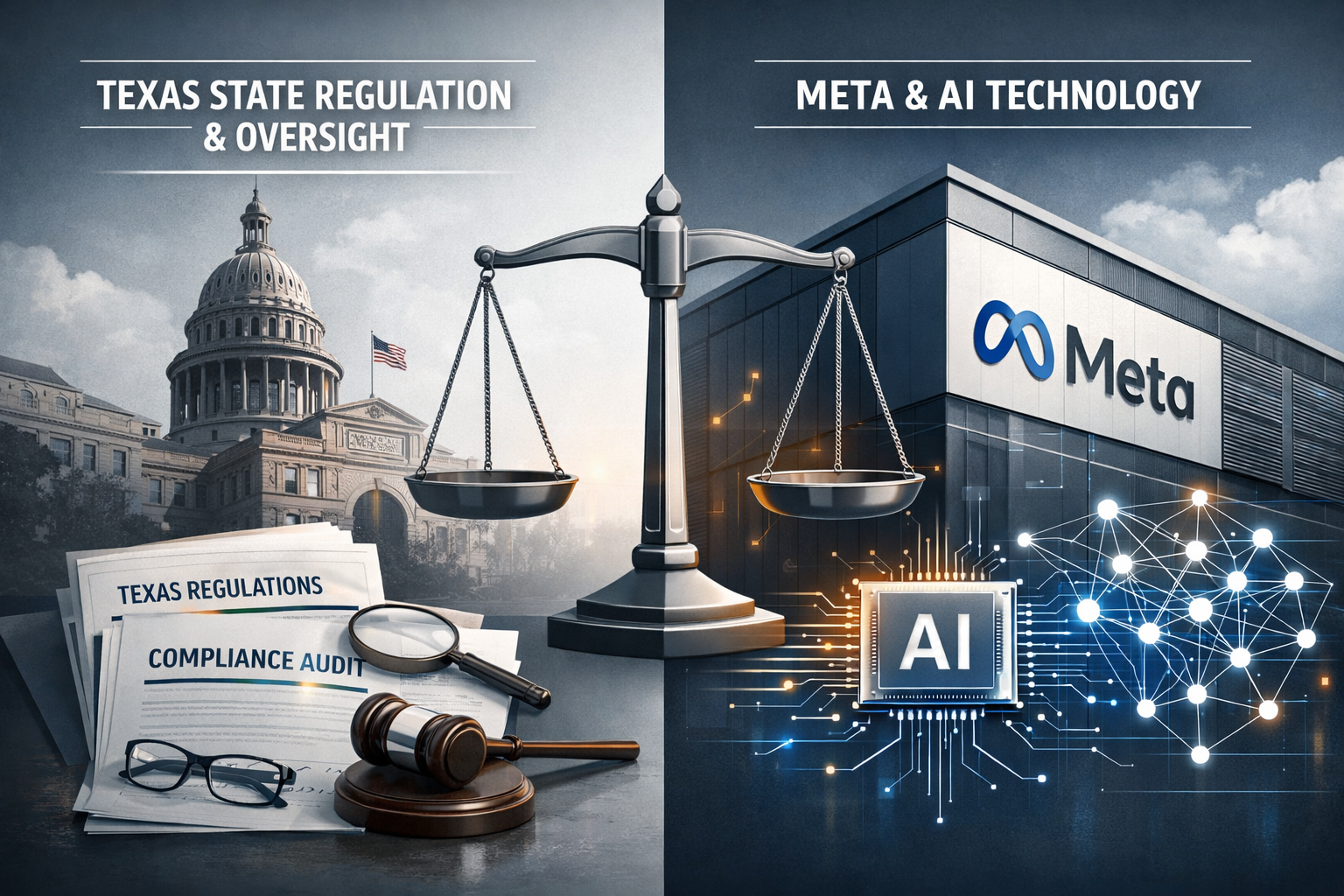
Texas lawmakers and regulators are paying closer attention to hyperscale data center projects because of their outsized impact on the state’s power grid and local resources [1]. The scrutiny is not unique to Meta — it reflects a broader policy conversation happening across Texas about how to balance economic development with grid reliability and resource stewardship.
Specific areas of regulatory concern include:
- Grid load additions: ERCOT must approve large new loads, and the process has become more rigorous following grid stress events
- Water rights: In West Texas, water is a finite and politically charged resource; large industrial water users face increasing scrutiny
- Tax incentives: Texas has historically offered significant property tax abatements to attract data centers; some legislators are questioning whether those deals deliver sufficient public benefit
- Local permitting: El Paso city and county governments have their own approval processes for large industrial developments
Meta’s situation is complicated by the scale of the expansion. A $1.5 billion project draws one level of regulatory attention; a $10 billion project drawing 1 GW of power draws a fundamentally different level of scrutiny [1]. The company will need sustained engagement with state and local officials to keep the project on track.
This dynamic — where large-scale investment triggers heightened regulatory review — is familiar in other capital-intensive industries. In the mortgage and real estate world, for example, Canada’s economic outlook and shifting policy environments similarly affect how large development projects get financed and approved.
What Are the Implications for U.S. AI Infrastructure Competition?
Meta’s El Paso commitment signals that the AI infrastructure race has entered a new phase — one defined by gigawatt-scale campuses rather than incremental capacity additions. This has implications that extend well beyond Meta’s own competitive position.
Broader implications:
- Energy sector: Demand from AI data centers is becoming a material driver of new power generation investment across the U.S., accelerating interest in nuclear, natural gas, and large-scale renewable projects
- Real estate and construction: The pipeline of hyperscale data center projects is creating sustained demand for industrial construction labor and specialized electrical equipment
- Regional competition: Cities and states are actively competing to attract these investments, offering infrastructure support, streamlined permitting, and tax incentives
- Supply chain pressure: The concentration of large projects in a short timeframe is straining the supply of transformers, switchgear, and other long-lead electrical components
For investors and policymakers, the El Paso project is a leading indicator of where AI infrastructure spending is heading. The companies that secure power capacity and permitted land today will have a structural advantage in deploying AI capabilities through the end of the decade.
Understanding how large capital commitments interact with regional economic conditions is relevant across many sectors. Just as Canada’s GDP growth and U.S. economic trends shape mortgage and housing markets, the flow of hyperscale infrastructure investment reshapes regional economies in lasting ways.
FAQ: Meta’s El Paso AI Data Center Expansion
Q: How much is Meta investing in the El Paso data center? Meta has raised its investment to over $10 billion, up from an original commitment of approximately $1.5 billion. [1][2]
Q: When will the El Paso campus reach 1 GW capacity? The target is 1 gigawatt by 2028, though large infrastructure projects of this complexity can face delays. [1][2]
Q: What will the El Paso facility be used for? It is purpose-built as an AI data center, focused on training and running large-scale artificial intelligence models. [1]
Q: Why is Texas scrutinizing the project? Texas regulators and lawmakers are concerned about the project’s impact on the state’s power grid, water resources, and the terms of any public subsidies or tax incentives. [1]
Q: Is 1 GW a realistic target for a single data center campus? It is at the extreme high end of what has been attempted globally. Most hyperscale campuses operate well below 500 MW. Reaching 1 GW requires exceptional power procurement and grid integration work.
Q: How does this compare to Meta’s other data center investments? The El Paso project, at over $10 billion and 1 GW, appears to be one of Meta’s largest single-site commitments. Meta operates data centers across the U.S., Europe, and Asia, but few if any match this scale.
Q: What energy sources will power the campus? No official energy mix has been publicly confirmed. At 1 GW scale, a combination of grid power, long-term renewable contracts, and potentially dedicated generation assets is likely required.
Q: Will the project create local jobs? Yes. Large data center campuses generate significant construction employment during build phases and hundreds of permanent operational jobs once complete.
Q: What happens if Texas regulators block or delay the project? Regulatory friction could delay construction timelines or require Meta to modify the project’s scope, particularly around power draw and water use. It is unlikely to result in full cancellation given the scale of capital already committed.
Q: How does Meta’s El Paso investment compare to competitors? Google, Microsoft, and Amazon are all spending aggressively on AI data center infrastructure. Projects at the 1 GW scale are emerging as the new benchmark for top-tier AI compute campuses across the industry.
Q: Is the $10 billion figure a final number? Based on the pattern of the original $1.5 billion being revised upward, the $10 billion figure should be understood as the current commitment. As AI compute demands grow, further revisions are possible.
Q: What does 1 GW of data center power actually mean in practical terms? 1 GW equals 1,000 megawatts. That is roughly the continuous output of a large nuclear power plant and enough electricity to power approximately 750,000 average U.S. homes under normal conditions.
Conclusion: What to Watch and What It Means
Meta’s $10 Billion El Paso Expansion: Building 1 GW Capacity for 2028 AI Dominance is more than a construction project — it is a strategic declaration about where AI competition is headed. The jump from $1.5 billion to over $10 billion, and the ambition to reach 1 GW by 2028, reflects a company making a long-term bet that compute capacity will be the defining constraint in the AI era [1][2].
Actionable next steps depending on your perspective:
- For energy and infrastructure investors: Watch ERCOT filings and Texas utility earnings calls for signals about how the grid is adapting to hyperscale demand. The El Paso project will require transmission upgrades that create investment opportunities across the power sector.
- For El Paso businesses and workers: Construction and facilities management trades are the immediate opportunity. Longer term, the campus will create demand for local services, logistics, and technical talent.
- For policymakers: The El Paso case is a live case study in balancing economic development incentives against grid reliability and resource stewardship. How Texas navigates this will set precedents for other states.
- For AI industry observers: Track whether Meta hits its 2028 power target. If it does, the El Paso campus will be one of the most powerful AI training facilities in the world. If it doesn’t, the reasons why will reveal the real bottlenecks in hyperscale AI infrastructure.
- For competitors: The scale of Meta’s commitment raises the floor for what it takes to stay competitive in frontier AI development. Companies without comparable infrastructure plans will face growing disadvantages in model quality and deployment speed.
The El Paso project will take years to complete, but its trajectory is already reshaping how the industry thinks about AI infrastructure at scale. The decisions being made in 2026 will determine competitive positions through the end of the decade and beyond.
Just as major economic shifts — like how the Canada-U.S. tariff environment affects financial planning or how Bank of Canada policy decisions ripple through mortgages — require careful monitoring and adaptive strategy, the AI infrastructure buildout demands the same kind of forward-looking attention from anyone with a stake in the outcome.
References
[1] Meta Raises El Paso Ai Data Center Spend To Over 10 Billion As Texas Scrutiny Grows – https://www.techdogs.com/tech-news/td-newsdesk/meta-raises-el-paso-ai-data-center-spend-to-over-10-billion-as-texas-scrutiny-grows
[2] Meta Expands El Paso Data Center Project To 1 Gigawatt Raising Investment To More Than 10b – https://www.virtualbx.com/feature-story/meta-expands-el-paso-data-center-project-to-1-gigawatt-raising-investment-to-more-than-10b/