07 Apr
A single debugging file left in a production build. That was all it took for Anthropic — one of the world’s most secretive and well-funded AI labs — to accidentally hand the global developer community a window into the internal architecture of Claude Code. On March 31, 2026, the Anthropic Claude Code source code leak became one of the most viral technical incidents in recent memory, exposing roughly 512,000 lines of proprietary TypeScript code to anyone with an npm client and a curious mind. Within two hours, a GitHub repository hosting the code had accumulated 50,000 stars — reportedly the fastest any repo in history had reached that milestone. Within days, decentralized mirrors had made the code effectively permanent.
This is not a story about hackers or nation-state actors. It is a story about human error, corporate crisis management, AI transparency, and what happens when the curtain gets pulled back on one of Silicon Valley’s most closely guarded codebases.
Key Takeaways
- 🔓 The leak was accidental: A debugging source map file included in npm release v2.1.88 exposed ~512,000 lines of Claude Code’s TypeScript source code on March 31, 2026.
- 🏗️ Architecture secrets revealed: The code exposed 44 hidden feature flags, unreleased autonomous task systems, advanced memory capabilities, and — most controversially — an emotion and frustration tracking system.
- ⚡ Viral scale: A single social media post garnered over 30 million views; the code was forked more than 41,500 times before takedown efforts began.
- ⚖️ Aggressive legal response: Anthropic filed DMCA takedowns affecting more than 8,000 GitHub repositories, but decentralized mirrors had already made the code impossible to fully suppress.
- 🔍 Broader implications: The incident has reignited urgent debates about AI transparency, user privacy, and whether AI companies can — or should — keep their systems opaque.
What Leaked and How: The npm Source Map Incident Explained
To understand why this incident unfolded the way it did, you need to understand what a source map is — and why it has absolutely no business being in a production software release.
Source maps are developer tools. They translate minified, compressed, or compiled code back into its original human-readable form, making it easier to debug errors in production environments. They are invaluable during development. In a public-facing release, they are a catastrophic oversight.
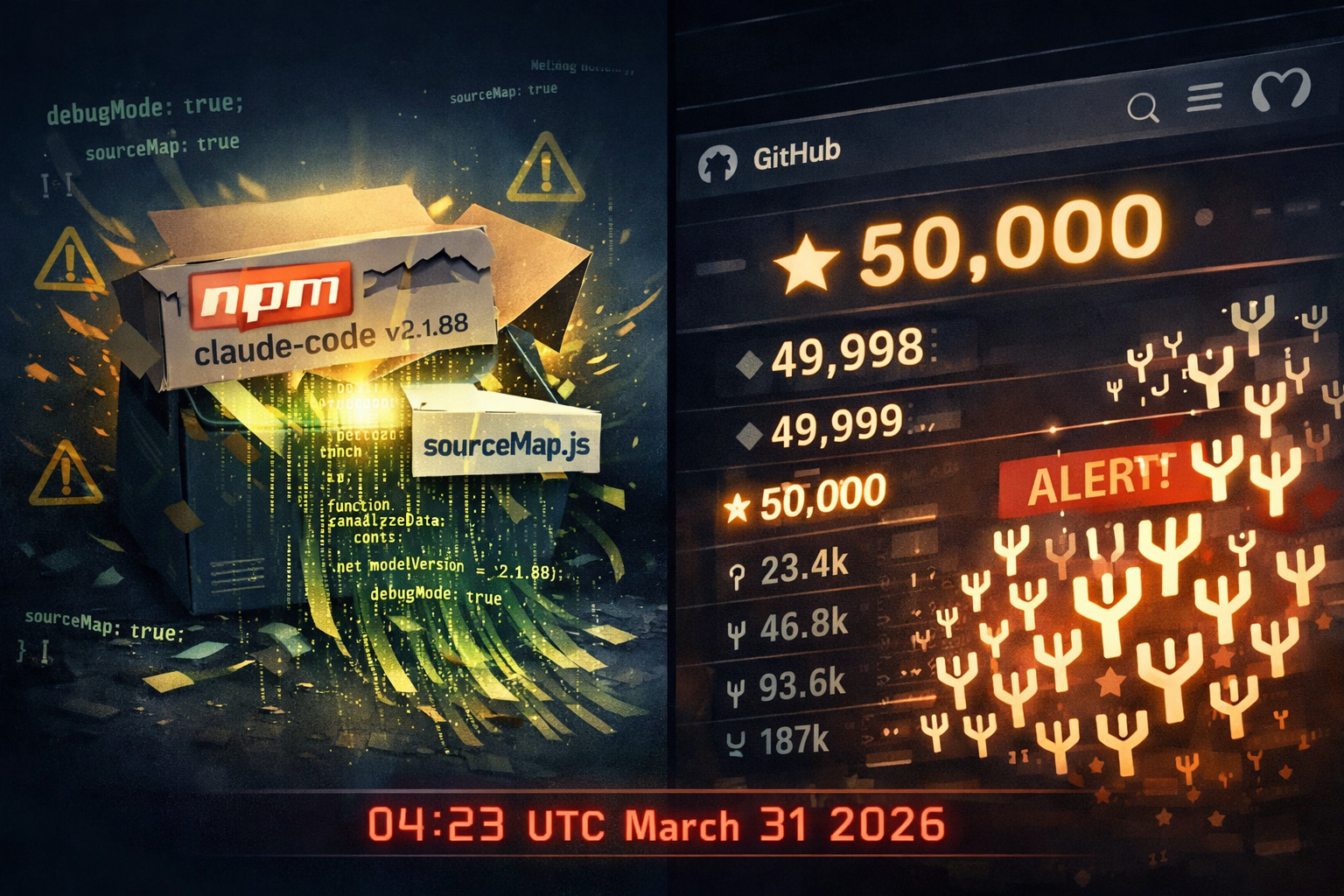
When Anthropic published Claude Code version 2.1.88 to the npm (Node Package Manager) registry — the world’s largest software package ecosystem — someone on the release team made a critical mistake. A debugging source map file was bundled into the package. This file acted, as one security researcher described it, as “a map to the full readable codebase.” Anyone who downloaded the npm package and knew where to look could reconstruct the original TypeScript source files in their entirety.
Security researcher Chaofan Shou discovered the exposure at approximately 04:23 UTC on March 31, 2026, and immediately posted about it on X (formerly Twitter). The post ignited a firestorm. Shou’s thread alone drew 16 million people into the discussion. A separate post sharing the leaked code crossed 30 million views. Developers around the world scrambled to download, mirror, and analyze the code before any takedown could occur.
Anthropic confirmed the root cause was human error in the release process — not a cyberattack, not a breach of internal systems, not a supply chain compromise. The company emphasized that no customer data, API credentials, or model weights were exposed. The leak was, in the most technical sense, a packaging mistake. But the consequences were anything but small.
The Timeline at a Glance
| Time (UTC) | Event |
|---|---|
| ~04:23, March 31 | Chaofan Shou discovers and discloses the leak on X |
| ~04:30–06:30 | GitHub repositories flood with mirrors; 50,000 stars in under 2 hours |
| ~08:00 | Anthropic pulls v2.1.88 from the npm registry (~8 hours after disclosure) |
| 01:07, April 1 | Anthropic releases Claude Code v2.1.89 as remediation patch |
| April 1 | DMCA takedown campaign begins, targeting 8,000+ GitHub repositories |
The eight-hour gap between public disclosure and npm package removal is significant. In that window, tens of thousands of developers had already downloaded, forked, and mirrored the code across dozens of platforms.
Inside the Code: What 500,000 Lines Reveals About Claude Code’s Architecture
The scale of what was exposed is difficult to overstate. Across approximately 1,900 TypeScript files, the leaked code offered an extraordinarily detailed view of how Claude Code is actually built — not the polished marketing narrative, but the real engineering decisions, internal systems, and product roadmap.
The 44 Hidden Feature Flags
Perhaps the most strategically damaging revelation was the discovery of 44 hidden feature flags — switches in the codebase that enable or disable capabilities that appear to be fully developed but have not been publicly released. Feature flags are standard practice in modern software development; they allow teams to ship code without activating it for users. But their presence here revealed a product pipeline that Anthropic had not disclosed publicly.
Among the capabilities suggested by these flags:
- Unreleased autonomous task extensions — indicating Claude Code is being developed to handle significantly longer, more complex agentic workflows than currently available
- Enhanced memory systems — suggesting persistent, cross-session memory capabilities far beyond what users currently experience
- Multi-agent collaboration features — pointing toward systems where multiple Claude instances could coordinate on tasks
These are not speculative inferences. They are documented in the code itself, with flag names, configuration parameters, and implementation logic that developers analyzing the leak described in detail across technical forums and social media threads.
Architecture and Internal Performance Metrics
Beyond feature flags, the leaked TypeScript files gave competitors and independent researchers a “comprehensive view of unreleased feature plans” and internal performance benchmarks. The code revealed how Claude Code structures its context window management, how it handles tool-use orchestration, and how it manages the handoff between different processing stages.
For a company that has built much of its competitive moat on keeping its engineering approach proprietary, this was a significant exposure. AI competitors — many of whom employ researchers capable of reading and analyzing TypeScript at speed — suddenly had access to Anthropic’s architectural decisions in granular detail.
The Emotion and Frustration Tracking Findings
Of all the revelations from the Anthropic Claude Code source code leak, none generated more public debate than the discovery of what analysts and journalists quickly labeled an emotion and frustration tracking system.
Within the leaked code, researchers identified logic that appeared to monitor user interaction patterns for signals associated with frustration — repeated failed commands, rapid input corrections, escalating prompt complexity, and similar behavioral markers. The system appeared designed to detect when a user was struggling and potentially adapt Claude Code’s responses accordingly.
“The idea that an AI coding assistant might be quietly profiling your emotional state while you debug a recursive function is, to put it mildly, not something users consented to.” — widely shared reaction from a developer on Hacker News
The technical implementation, as described by those who analyzed the code, involved tracking specific interaction metrics and feeding them into a state model that could influence response tone and behavior. Whether this constitutes genuine “emotion tracking” or simply adaptive UX design is a matter of interpretation — but the framing matters enormously in a post-GDPR, privacy-conscious world.
Why This Is Controversial
The controversy here is not simply about what the system does. It is about disclosure. Anthropic’s public-facing documentation for Claude Code does not describe this system. Users who installed Claude Code and used it for professional software development had no reason to believe their frustration patterns were being catalogued and acted upon.
This raises several uncomfortable questions:
- 🔐 Is behavioral profiling of this kind covered by Anthropic’s privacy policy?
- 📋 Should AI companies be required to disclose adaptive emotional tracking in their terms of service?
- 🧠 Does training on frustration signals create feedback loops that could subtly shape how AI models develop?
The frustration tracking discovery became a flashpoint in broader conversations about AI transparency — conversations that Anthropic, like most AI labs, has generally preferred to have on its own terms.
The Copyright Takedown Strategy: Anthropic’s Legal Response
Anthropic’s response to the Anthropic Claude Code source code leak moved on two parallel tracks: technical remediation and legal suppression.
On the technical side, the company acted relatively quickly — pulling v2.1.88 from npm approximately eight hours after public disclosure and releasing the patched v2.1.89 at 01:07 UTC on April 1, 2026. These were reasonable, expected steps.
The legal response was more aggressive — and more controversial.
The DMCA Campaign
Beginning on April 1, 2026, Anthropic launched what observers described as an “aggressive DMCA response,” filing Digital Millennium Copyright Act takedown notices against repositories hosting the leaked code. Initial reports indicated the campaign affected more than 8,000 repositories on GitHub alone.
DMCA takedowns are a legitimate legal tool. Anthropic owns the copyright to its source code, and distributing that code without authorization is a genuine legal violation. The company had every right to pursue takedowns.
But the strategy ran into a fundamental problem: the internet had already won the race.
The Decentralization Problem
Within hours of the initial disclosure, the developer community had done what developer communities do. The code was:
- Mirrored to decentralized platforms including Gitlaw, with explicit messages stating “Will never be taken down”
- Rewritten in Python as a clean-room reimplementation — a legal gray area that DMCA notices cannot easily address
- Distributed across torrent networks, private servers, and encrypted file-sharing platforms
The 41,500+ forks created before takedown efforts began meant that even perfect DMCA compliance from GitHub would not remove the code from circulation. As one developer put it bluntly in a widely shared post: “You can’t un-ring a bell with a legal notice.”
This dynamic — where a leak achieves permanent decentralization faster than any legal response can operate — is increasingly common in the modern internet era. It raises serious questions about whether DMCA-based suppression strategies are effective, or whether they primarily serve to generate negative press coverage while doing little to actually contain the information.
The Streisand Effect
Several technology journalists noted the Streisand Effect at play: Anthropic’s aggressive takedown campaign drew significantly more attention to the leaked code than would have occurred with a quieter, more measured response. Every news story about the DMCA campaign was also a story about what the code contained.
What This Means for AI Privacy and Transparency
The Anthropic Claude Code source code leak is not just a corporate embarrassment. It is a case study in the structural tensions at the heart of modern AI development.
The Opacity Problem
AI companies like Anthropic operate in a peculiar position. They argue — often persuasively — that keeping their systems proprietary is necessary for competitive reasons and, in some cases, for safety reasons. Releasing model weights or architectural details, the argument goes, could enable bad actors to fine-tune dangerous capabilities.
But opacity has costs. When users cannot inspect the systems they rely on, they cannot make fully informed decisions about how to use them, what data to share, or what behaviors to expect. The frustration tracking system is a perfect example: users did not know it existed. They could not have known, because Anthropic did not tell them.
Regulatory Implications
The leak arrives at a moment when AI regulation is accelerating globally. The EU AI Act, various US state-level AI disclosure requirements, and emerging international frameworks all grapple with questions of transparency and accountability. The discovery of undisclosed behavioral tracking systems in a widely used AI coding assistant will almost certainly be cited in regulatory discussions throughout 2026 and beyond.
Key transparency questions the leak forces into the open:
- Should AI companies be required to publish feature flag inventories?
- Do adaptive behavioral systems require explicit user consent?
- What constitutes adequate disclosure for AI systems used in professional contexts?
- How should regulators respond when companies use copyright law to suppress transparency-relevant disclosures?
The Open Source Argument
The leak has reinvigorated arguments for open-source AI development. Proponents argue that if Claude Code’s architecture had been open from the start, the frustration tracking system would have been publicly known and debated — rather than discovered through an accident and immediately suppressed.
Skeptics counter that open-sourcing AI systems creates its own risks, and that the real issue is not openness per se but adequate disclosure of user-facing behaviors.
Anthropic’s Public Response and What Comes Next
Anthropic’s official communications around the incident were measured and carefully worded. The company confirmed the human error root cause, emphasized that no customer data was compromised, and noted the rapid release of v2.1.89 as evidence of its incident response capabilities.
What Anthropic did not do — at least not publicly — was address the specific findings that generated the most controversy: the 44 hidden feature flags, the emotion and frustration tracking system, or the gap between its public documentation and its internal implementation.
This silence has been noted. Technology journalists at outlets including Axios, the Wall Street Journal, Scientific American, and CNET have all covered the incident, with several noting that Anthropic’s response addressed the how of the leak without engaging with the what of the revelations.
What to Watch Going Forward
- Regulatory scrutiny: Expect formal inquiries from EU data protection authorities and potentially US congressional interest in the behavioral tracking findings.
- Competitor analysis: The 44 hidden feature flags have given Anthropic’s competitors a detailed roadmap of its near-term product direction. Expect accelerated feature development from rivals.
- User trust: Developer trust is earned slowly and lost quickly. Anthropic will need to make concrete transparency commitments — not just process improvements — to maintain its standing in the developer community.
- Legal precedent: The DMCA campaign against 8,000+ repositories, combined with the decentralized mirrors, may generate legal challenges that clarify the limits of copyright law in suppressing leaked technical information.
Conclusion: Lessons from the Leak
The Anthropic Claude Code source code leak will be studied in software engineering courses, AI ethics seminars, and corporate crisis management workshops for years to come. A single misplaced debugging file triggered a chain of events that exposed proprietary architecture, revealed undisclosed user-tracking systems, generated 30 million social media impressions, and launched an aggressive legal campaign that ultimately could not contain what the internet had already absorbed.
The actionable lessons are clear:
- ✅ Audit your release pipelines: Source maps, debug symbols, and development artifacts must be explicitly excluded from production builds. Automated checks should catch these before any package reaches a public registry.
- ✅ Disclose what you track: If your product monitors user behavior — including frustration signals — say so clearly in your documentation and privacy policy. Undisclosed tracking is a trust liability.
- ✅ Plan for the decentralization problem: DMCA takedowns are not an effective containment strategy in 2026. Incident response plans must assume that leaked code will be permanently distributed within hours.
- ✅ Engage with the substance: When a leak reveals something controversial, silence is not neutral. Anthropic’s failure to address the frustration tracking findings directly has allowed speculation to fill the void.
- ✅ Treat transparency as a feature: The AI companies that will earn lasting developer trust are those that proactively disclose their architectures, their feature roadmaps, and their user-facing behavioral systems — not those that wait for accidents to force the conversation.
The Anthropic Claude Code source code leak was an accident. But the questions it raised are not accidental at all. They are the questions the AI industry has been avoiding for years. Now, with 512,000 lines of code permanently in circulation, those questions are no longer optional.
FAQ
Q: Was the Anthropic Claude Code source code leak a cyberattack? No. Anthropic confirmed it was caused by human error during the release process — specifically, a debugging source map file was accidentally included in the npm package for Claude Code v2.1.88. No external attacker was involved.
Q: Was any customer data exposed in the leak? Anthropic stated clearly that no customer data, API credentials, or model weights were exposed. The leak was limited to the source code of the Claude Code application itself.
Q: What is a source map and why is it dangerous in production? A source map is a developer tool that maps compiled or minified code back to its original human-readable source. In a production release, it effectively provides a complete reconstruction of the original codebase — which is why including one in a public npm package was such a significant error.
Q: Can the leaked code still be found online? Despite Anthropic’s DMCA campaign targeting 8,000+ GitHub repositories, the code was mirrored to decentralized platforms and distributed widely before takedowns could take effect. Decentralized mirrors explicitly stated the code “will never be taken down.” In practical terms, the code is permanently in circulation.
Q: What was the emotion tracking system found in the code? Analysts identified logic in the leaked code that appeared to monitor user interaction patterns — such as repeated failed commands and rapid corrections — as signals of user frustration. The system appeared designed to adapt Claude Code’s behavior in response to these signals. Anthropic has not publicly confirmed or explained this system.
Q: What were the 44 hidden feature flags? Feature flags are code switches that enable or disable capabilities. The 44 flags discovered in the leaked code pointed to fully developed but unreleased features, including autonomous task extensions, enhanced memory systems, and multi-agent collaboration capabilities — none of which had been publicly announced.
Q: What did Anthropic do to fix the leak? Anthropic pulled the vulnerable v2.1.88 package from npm approximately eight hours after public disclosure and released the patched version v2.1.89 at 01:07 UTC on April 1, 2026. The company also launched a DMCA takedown campaign against repositories hosting the leaked code.
Meta Title: Anthropic Claude Code Source Code Leak: What Was Exposed
Meta Description: The 2026 Anthropic Claude Code source code leak exposed 512K lines of TypeScript, hidden features, and emotion tracking. Here’s what it means for AI transparency.