25 Mar
Last updated: March 25, 2026
Quick Answer: Building multi-agent systems for AI agencies in 2026 centers on the Model Context Protocol (MCP), an open standard that lets AI agents connect directly to business tools, databases, and APIs without custom integration code. Combined with agent-to-agent coordination protocols, MCP enables agencies to deploy scalable, automated workflows across enterprise clients — replacing fragile one-off integrations with a governed, reusable architecture.
Key Takeaways
- MCP is now the dominant standard for connecting AI agents to external tools, backed by Anthropic, OpenAI, Google DeepMind, Microsoft, and AWS [1][2]
- The protocol uses JSON-RPC 2.0 messaging with OAuth 2.1 authentication, making enterprise security compliance achievable by design [1][3]
- Three protocols serve distinct roles: MCP handles agent-to-tool connections, A2A manages agent-to-agent coordination, and ACP covers lightweight messaging [1]
- Over 10,000 active MCP servers exist globally, with 97 million monthly SDK downloads as of December 2025 [1]
- Governance transferred to the Linux Foundation in December 2025, removing vendor lock-in concerns and opening adoption to all competitors [2]
- A hybrid MCP + A2A approach is the recommended architecture for complex, multi-agent enterprise deployments [1]
- Healthcare multi-agent systems using MCP have demonstrated 40% faster data retrieval and 25% improvement in diagnosis accuracy [1]
- By mid-2026, centralized orchestration platforms are expected to make multi-agent workflows accessible through no-code interfaces [2]
What Is MCP and Why Does It Matter for AI Agencies in 2026?
MCP (Model Context Protocol) is an open communication standard that allows AI agents to connect with external tools, data sources, and APIs through a single, consistent interface. For AI agencies, it solves the biggest bottleneck in enterprise deployments: every new client integration no longer requires custom code from scratch.
Anthropic created MCP in November 2024 and donated governance to the Linux Foundation on December 9, 2025 [2]. That transfer was significant — it removed the perception that MCP was a proprietary Anthropic tool and opened the door for every major AI player to adopt it without competitive hesitation. OpenAI, Google DeepMind, Microsoft, and AWS have all since integrated MCP support [1].
Why this matters for agencies specifically:
- Client onboarding becomes faster because MCP-compatible agents can discover and connect to tools dynamically
- Agencies can build reusable agent templates instead of rebuilding integrations for each client
- Security compliance is built into the protocol rather than bolted on afterward
- The growing ecosystem of 10,000+ active MCP servers means most enterprise tools already have connectors available [1]
“MCP functions as a universal connector — solving the AI bottleneck by allowing models to communicate directly with business systems rather than relying on chat interfaces.” [2]
The shift is from chat-based prompting (where a human types instructions) to agentic workflows (where agents autonomously retrieve context, call tools, and complete tasks end-to-end).
How Does MCP Actually Work? The Technical Architecture Explained
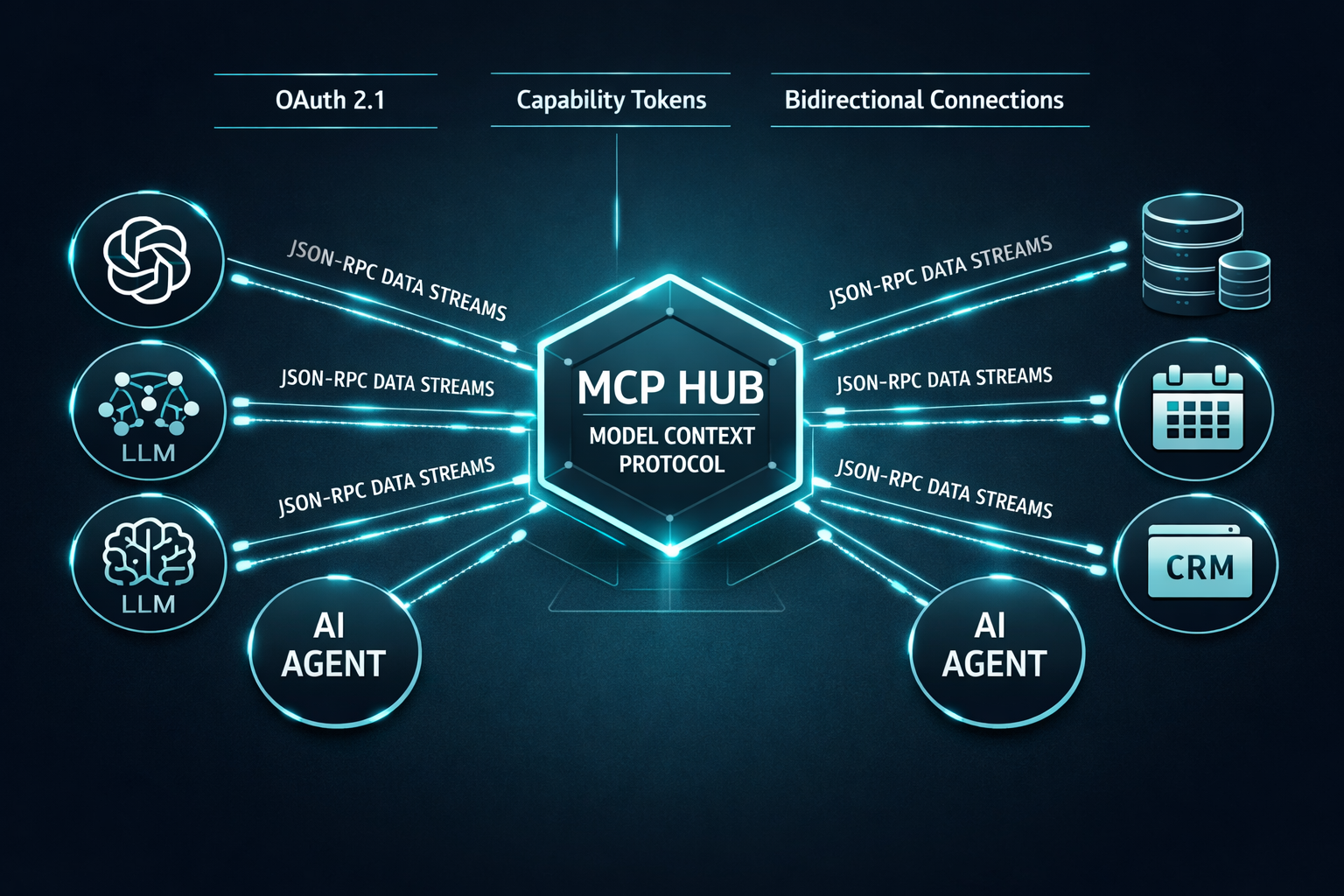
MCP uses JSON-RPC 2.0 messaging over bidirectional client-server connections [1][3]. Each connection is secured through OAuth 2.1 authentication with capability-based tokens that carry specific, scoped permissions — meaning an agent accessing a CRM database cannot automatically access payroll data unless explicitly granted [2].
Core components of an MCP connection:
| Component | Role |
|---|---|
| MCP Host | The AI application or agent runtime (e.g., Claude, GPT-based agent) |
| MCP Client | Manages the connection to a specific MCP server |
| MCP Server | Exposes tools, resources, and prompts from a business system |
| Capability Tokens | Scoped permissions that govern what each agent can access |
What MCP standardizes:
- Tool schemas — a consistent format for describing what a tool does and what inputs it accepts
- Resource schemas — structured access to files, databases, and APIs
- Capability discovery — agents can query a server to find out what functions are available without prior configuration [3]
- Context retrieval — agents pull relevant data at runtime rather than relying on static prompts
Common mistake: Many agencies initially try to use MCP for everything, including agent-to-agent communication. MCP is designed for vertical integration (agent to tool), not horizontal coordination (agent to agent). Using it for both creates unnecessary complexity.
Choose MCP when: An agent needs to read from or write to an external system — a database, calendar, CRM, email service, or file storage.
Choose A2A when: One agent needs to delegate a subtask to another specialized agent and receive a structured result back.
What Are the Three Core Protocols and When Should Agencies Use Each?
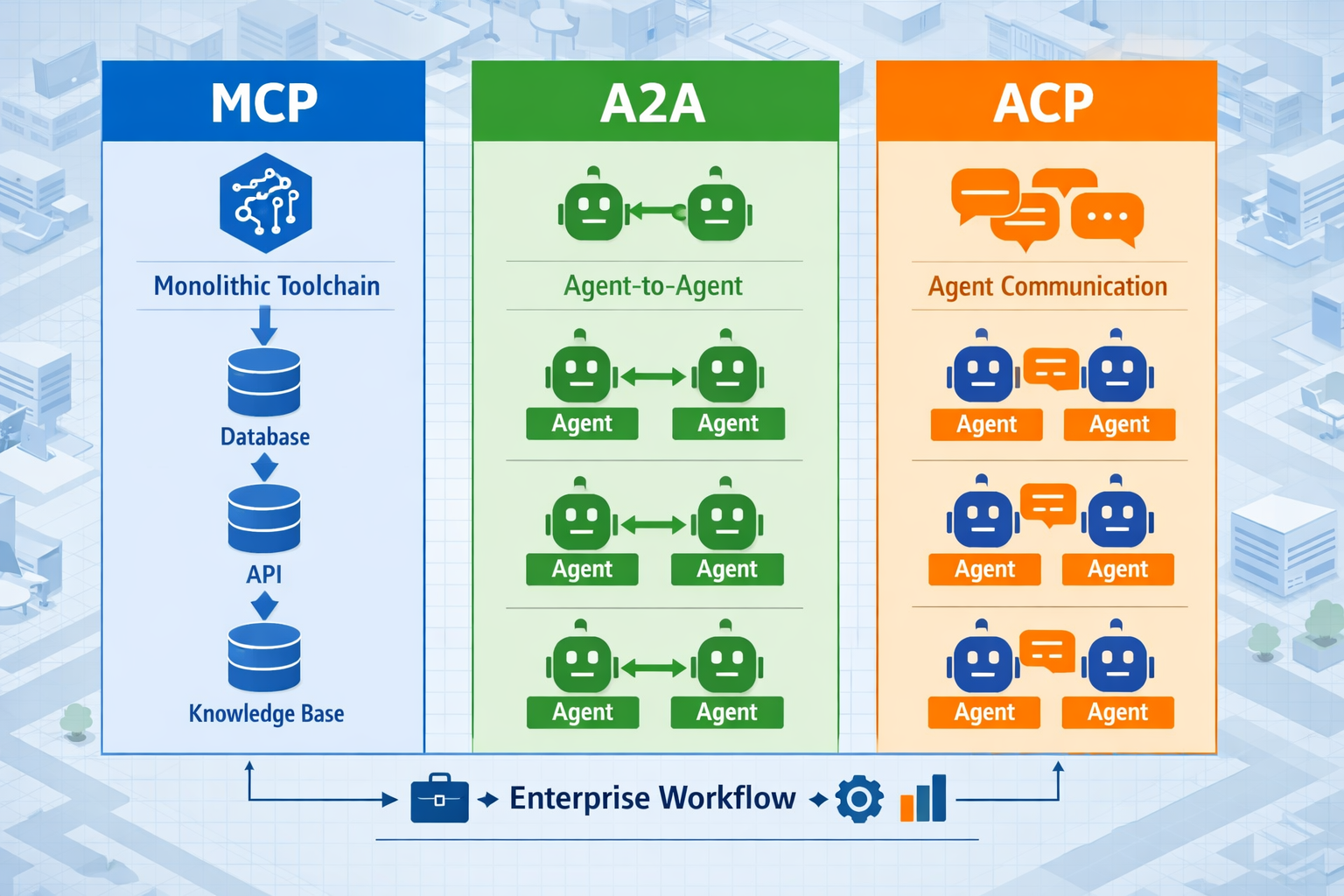
Three protocols now define the multi-agent communication landscape in 2026, and they serve different purposes [1]. Agencies that understand the distinction build cleaner, more maintainable systems.
MCP (Model Context Protocol) — Vertical integration
- Connects agents to tools and data sources
- Best for: database queries, API calls, file access, CRM reads/writes
- Governance: Linux Foundation (neutral, open)
A2A (Agent-to-Agent Protocol) — Horizontal coordination
- Manages communication between agents
- Best for: task delegation, multi-step workflows, specialist agent routing
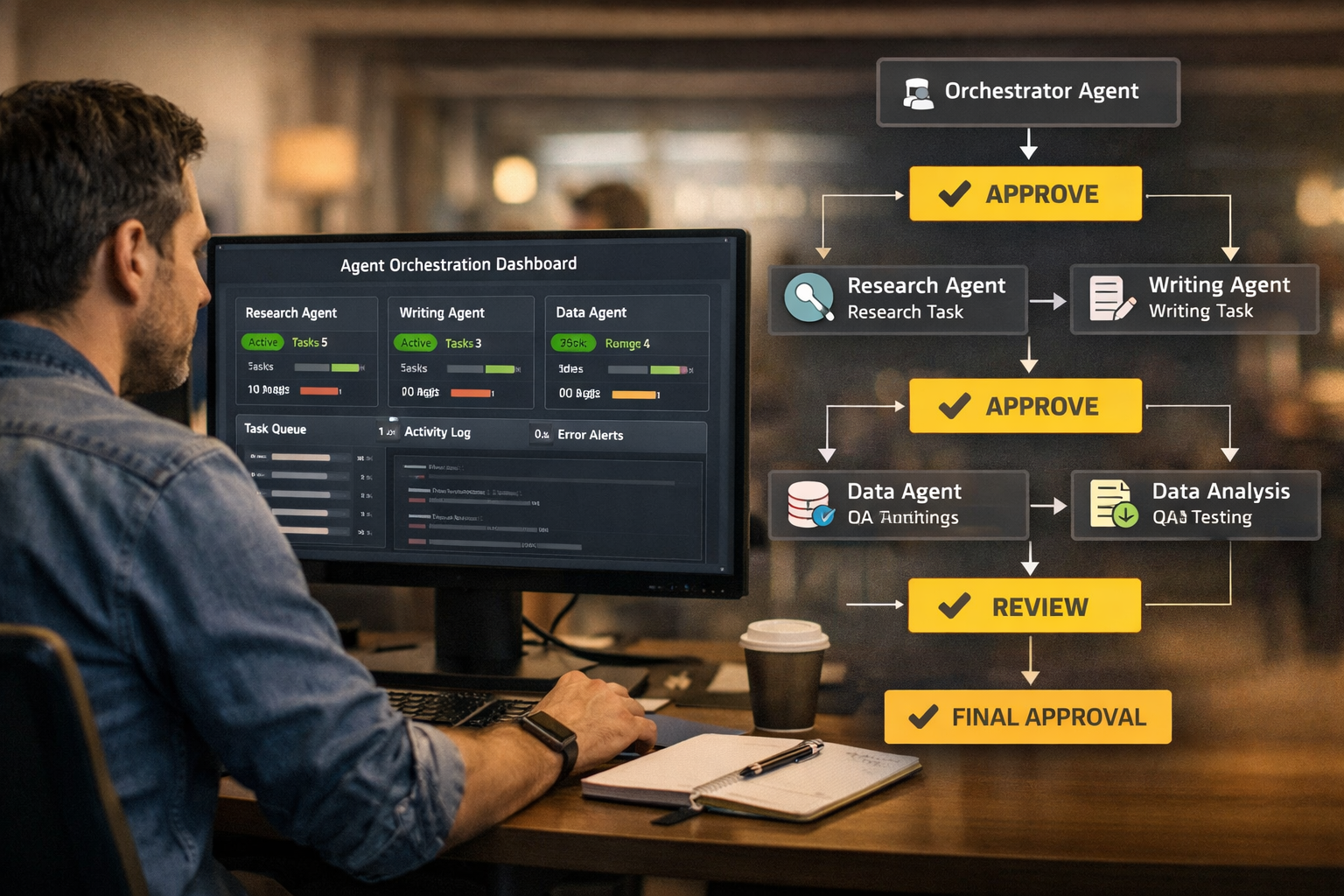
- Use case: an orchestrator agent assigning research to a research agent and writing to a content agent
ACP (Agent Communication Protocol) — Lightweight messaging
- Minimal overhead, rapid deployment
- Best for: simple notification passing, low-latency event triggers, edge deployments
The hybrid approach is now the industry standard [1]. Most enterprise deployments combine MCP for tool connections with A2A for agent coordination. A typical architecture looks like this:
- Orchestrator agent receives a task from a human or trigger
- Orchestrator uses A2A to delegate subtasks to specialist agents
- Each specialist agent uses MCP to access the tools it needs
- Results flow back through A2A to the orchestrator
- Orchestrator synthesizes output and delivers the final result
Edge case: For very simple, single-agent deployments (one agent, one tool), ACP alone may be sufficient and avoids the overhead of setting up full MCP infrastructure.
Building Multi-Agent Systems for AI Agencies: A Step-by-Step Architecture Guide
Building multi-agent systems for AI agencies in 2026 follows a repeatable pattern once the protocol layer is understood. The steps below apply whether an agency is building for a healthcare client, a financial services firm, or a marketing operation.
Step 1: Map the client’s workflow Identify every task that currently requires a human to switch between systems. Each system-switch is a candidate for an MCP tool connection.
Step 2: Define agent roles Assign a single, clear responsibility to each agent. Avoid “do-everything” agents — they’re harder to debug and less reliable.
- Orchestrator agent: receives goals, breaks them into subtasks, routes to specialists
- Specialist agents: each owns one domain (research, writing, data retrieval, QA, communication)
- Tool agents: thin wrappers around specific MCP server connections
Step 3: Set up MCP servers for each tool Most major platforms (Salesforce, HubSpot, Google Workspace, Slack, SQL databases) now have published MCP server implementations. For custom internal tools, agencies build lightweight MCP servers using the open SDK.
Step 4: Configure OAuth 2.1 and capability tokens Define exactly what each agent is permitted to access. Scope permissions to the minimum required for the task. This is where enterprise security compliance is established — not as an afterthought.
Step 5: Build the orchestration layer The orchestrator is the most critical component. It must handle:
- Task decomposition
- Agent selection
- Error recovery (what happens when a specialist agent fails or times out)
- Result synthesis
Step 6: Test with adversarial inputs Multi-agent systems fail in unexpected ways. Test with malformed data, missing permissions, tool unavailability, and conflicting agent outputs before deploying to a client environment.
Step 7: Monitor and iterate Log every agent action, tool call, and decision point. MCP’s audit trail capability makes this straightforward and is often required for regulated industries [2].
Timeframe estimate: A well-scoped, three-agent system for a single enterprise workflow typically takes 4–8 weeks from design to production deployment, assuming MCP servers for the required tools already exist.
What Does Enterprise-Grade Security Look Like in MCP-Based Systems?
MCP’s security model is enterprise-ready by design, not by configuration. OAuth 2.1 authentication and capability-based tokens mean that agents operate within governed sandboxes — they can only access what they’ve been explicitly granted permission to access [2].
Key security features:
- Scoped capability tokens — each agent receives only the permissions needed for its specific role
- Audit trails — every tool call and data access is logged, which satisfies compliance requirements in healthcare (HIPAA), finance (SOC 2), and legal sectors
- No persistent data leakage — agents retrieve context at runtime rather than storing sensitive data in model memory
- Sandboxed execution — agents cannot access systems outside their defined capability scope
Real-world validation: A multi-agent clinical system built on MCP achieved HIPAA compliance with full audit trails while also delivering a 40% reduction in data retrieval time and a 25% improvement in diagnosis accuracy [1]. The system reached ROI within six months of deployment.
Common mistake: Agencies sometimes grant broad permissions during development for convenience, then forget to tighten scopes before production. Always audit capability tokens before a client goes live.
How Are AI Agencies Structuring Their Service Offerings Around MCP in 2026?
AI agencies that are winning enterprise contracts in 2026 are positioning MCP expertise as a core differentiator. The protocol’s complexity is real enough that most enterprise clients cannot implement it internally — which creates a durable service opportunity.
Three common agency service models:
1. MCP Integration-as-a-Service Build and maintain MCP server connections for a client’s existing tool stack. Ongoing retainer for monitoring, updates, and new integrations as the client’s tech stack evolves.
2. Full Multi-Agent System Design and Deployment End-to-end architecture: workflow mapping, agent design, MCP setup, orchestration layer, testing, and handoff. Project-based with optional maintenance retainer.
3. Agent Orchestration Consulting Advise clients on protocol selection (MCP vs. A2A vs. ACP), architecture decisions, and vendor selection without necessarily building the system. Suitable for clients with internal engineering teams.
Platforms accelerating agency delivery: AgentX now offers over 1,000 MCP integrations, which significantly reduces the time agencies spend building custom connectors [5]. Frameworks like LangGraph, AutoGen, and CrewAI provide orchestration scaffolding that agencies can customize rather than build from scratch.
Industry analyst outlook: By mid-2026, platforms like Google Gemini are expected to enable advanced agentic multistep workflows through intuitive interfaces with scheduled and logical triggers — which will shift agency value from “building the plumbing” toward “designing the strategy and governance layer” [2].
What Are the Most Common Mistakes When Building Multi-Agent Systems?
Even experienced engineering teams make predictable errors when building multi-agent systems for the first time. Knowing these in advance saves weeks of debugging.
Mistake 1: Over-engineering the agent count More agents do not mean better results. Start with the minimum number of agents needed to complete the workflow. Add agents only when a single agent’s context window or capability scope becomes a genuine bottleneck.
Mistake 2: Ignoring failure modes What happens when an MCP server is unavailable? When an agent returns an unexpected output format? When two agents produce conflicting results? Every production system needs explicit error handling and fallback logic.
Mistake 3: Treating the orchestrator as a simple router The orchestrator needs to understand task dependencies, manage state across multiple agent calls, and synthesize partial results. Underbuilding the orchestrator is the single most common cause of multi-agent system failures.
Mistake 4: Skipping capability scoping Broad permissions are a security liability and make audit trails meaningless. Scope every capability token before testing, not just before production.
Mistake 5: Not logging agent decisions Without logs, debugging a multi-agent failure is nearly impossible. MCP’s architecture supports detailed logging — use it from day one.
Mistake 6: Assuming one protocol handles everything MCP handles tool connections. A2A handles agent coordination. Using MCP for agent-to-agent messaging creates unnecessary overhead and breaks the intended architecture [1].
FAQ: Building Multi-Agent Systems and MCP in 2026
Q: What is MCP in simple terms? MCP (Model Context Protocol) is a standard that lets AI agents connect to external tools and data sources — like a CRM, database, or calendar — using a consistent, secure interface instead of custom code for each connection.
Q: Who created MCP and who governs it now? Anthropic created MCP in November 2024. Governance transferred to the Linux Foundation in December 2025, making it a neutral open standard not controlled by any single vendor [2].
Q: Is MCP the same as A2A? No. MCP connects agents to tools (vertical integration). A2A connects agents to other agents (horizontal coordination). Most enterprise systems use both [1].
Q: How many MCP servers exist in 2026? Over 10,000 active MCP servers exist globally, with 97 million monthly SDK downloads as of December 2025 [1].
Q: Do I need to be a developer to use MCP? Building MCP servers requires development skills. However, by mid-2026, platforms like Google Gemini are expected to offer no-code interfaces for common MCP-based workflows [2].
Q: What programming languages support MCP? The official MCP SDK supports Python, TypeScript, and Java. Community SDKs exist for Go, Rust, and C#.
Q: How long does it take to build a multi-agent system for a client? A three-agent system with existing MCP server connectors typically takes 4–8 weeks from design to production. Custom MCP server builds add 2–4 weeks per tool.
Q: What industries are adopting multi-agent MCP systems fastest? Healthcare, financial services, and legal are leading adoption due to the need for both automation and compliance audit trails. Marketing and e-commerce agencies are close behind.
Q: What is the difference between an orchestrator agent and a specialist agent? An orchestrator agent receives a high-level goal, breaks it into subtasks, and delegates to specialist agents. Specialist agents execute specific tasks within a narrow domain and return results to the orchestrator.
Q: Is MCP secure enough for regulated industries? Yes. MCP uses OAuth 2.1 and scoped capability tokens, supports full audit trails, and enables sandboxed agent execution. It has been successfully deployed in HIPAA-compliant healthcare environments [1][2].
Q: What frameworks work best with MCP for agency deployments? LangGraph, AutoGen, and CrewAI are the most commonly used orchestration frameworks in 2026. AgentX offers 1,000+ pre-built MCP integrations for faster deployment [5].
Q: How does MCP handle authentication for multiple enterprise clients? Each client deployment maintains its own OAuth 2.1 credentials and capability token scopes, keeping client environments fully isolated from one another.
Conclusion: Actionable Next Steps for AI Agencies
Building multi-agent systems for AI agencies using the MCP standard and agent orchestration in 2026 is no longer experimental — it’s the architecture that enterprise clients expect. The protocol ecosystem has matured, governance is neutral, and the tooling is production-ready.
Actionable next steps for agencies:
- Audit your current client integrations. Identify which ones involve repetitive tool-switching that could be replaced by an MCP-connected agent.
- Get certified in MCP architecture. The Linux Foundation and several training platforms now offer structured learning paths. This is a genuine differentiator in client pitches.
- Start with a hybrid MCP + A2A pilot. Choose one client workflow, map it to the three-protocol framework, and build a minimum viable multi-agent system before scaling.
- Establish a security review process. Build capability token scoping and audit trail review into every deployment checklist.
- Follow the orchestration platform roadmap. As platforms like Google Gemini roll out no-code agentic interfaces in mid-2026, agencies that understand the underlying architecture will be positioned to build on top of those platforms — not be replaced by them.
The agencies that invest in MCP expertise now are building a durable technical moat. The protocol is open, the ecosystem is growing, and enterprise demand for governed, auditable AI automation is accelerating. The infrastructure is in place — the opportunity is in knowing how to use it.
References
[1] AI Agent Protocols 2026 Complete Guide – https://www.ruh.ai/blogs/ai-agent-protocols-2026-complete-guide
[2] How MCP Will Supercharge AI Automation in 2026 – https://hallam.agency/blog/how-mcp-will-supercharge-ai-automation-in-2026/
[3] AI Agent Protocols – https://getstream.io/blog/ai-agent-protocols/
[4] 2026 Enterprise MCP Adoption Roadmap – https://arc.cdata.com/blog/2026-enterprise-mcp-adoption-roadmap
[5] Best Multi-Agent Frameworks in 2026: Why AgentX Leads the Pack – https://www.agentx.so/mcp/blog/best-multi-agent-frameworks-in-2026-why-agentx-leads-the-pack
[6] Model Context Protocol (MCP): Why Every AI Developer Needs MCP in 2026 – https://pub.towardsai.net/model-context-protocol-mcp-why-every-ai-developer-needs-mcp-in-2026-e68d39a49417