Last updated: March 25, 2026
Quick Answer: You should see a dermatologist to check moles at least once a year for a routine full-body skin exam, and sooner if any mole changes in size, shape, or colour, starts bleeding, or simply looks different from your other spots. Early detection is the single most effective way to catch skin cancer before it becomes serious.
Key Takeaways
- The Skin Cancer Foundation recommends a professional full-body skin exam once per year for all adults [7]
- Higher-risk individuals (50+ moles, family history of melanoma, prior skin cancer) should be screened more frequently [2]
- Use the ABCDE rule to self-assess moles: Asymmetry, Border, Color, Diameter, Evolving [2]
- A professional skin check typically takes 10–15 minutes and uses a dermatoscope for close-up assessment [1]
- Any mole that develops after age 30, bleeds, itches, or won't heal warrants prompt evaluation [1]
- Monthly self-checks at home help you catch changes between professional appointments [1]
- Mole removal, when needed, is a straightforward outpatient procedure with a quick recovery
- The "Ugly Duckling" rule is a useful secondary check: if one mole looks notably different from all your others, get it looked at [2]
What Does a Dermatologist Actually Do When Checking Moles?
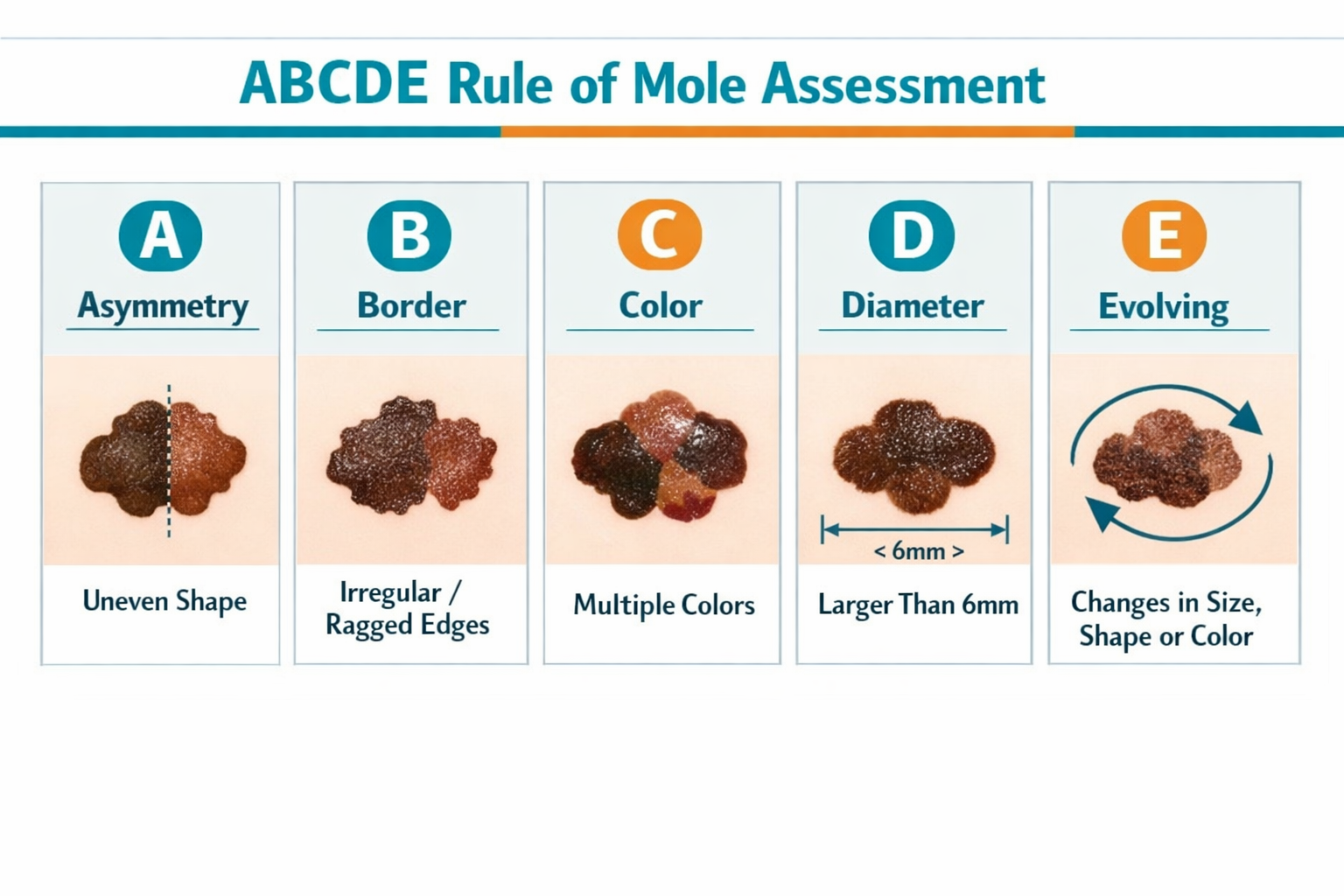
A dermatologist performs a full-body skin exam, visually inspecting every mole, spot, and lesion on your skin. The exam typically takes 10–15 minutes and uses a handheld device called a dermatoscope, which magnifies the skin up to 10 times to reveal details invisible to the naked eye [1].
Here's what to expect during a typical appointment:
- Full-body inspection: The dermatologist checks your entire skin surface, including your scalp, between toes, and under nails
- Dermatoscope assessment: Suspicious moles are examined up close for colour patterns, borders, and internal structure
- Photography: Lesions of concern may be photographed to track changes over time [2]
- Biopsy recommendation: If a mole looks suspicious, the doctor will recommend removing a small tissue sample for lab analysis [2]
- Personalised advice: You'll leave with guidance on self-monitoring and when to return
The exam is painless and non-invasive. Think of it like a routine dental check — quick, low-effort, and genuinely worth doing every year.
How Do You Know When to See a Dermatologist to Check Moles?
Most adults should book a skin check once a year, but certain signs mean you shouldn't wait for your annual appointment [7].
See a dermatologist promptly if any mole:
- Changes in size, shape, or colour over weeks or months [1]
- Has an irregular, blurry, or notched border
- Contains multiple colours (brown, black, red, white, or blue)
- Is larger than 6 mm across (roughly the size of a pencil eraser)
- Bleeds, itches, or crusts without an obvious cause
- Appears after age 30 — new moles in adulthood are worth checking [1]
- Looks noticeably different from all your other moles (the Ugly Duckling rule) [2]
Common mistake: Many people wait until a mole "looks really bad" before booking an appointment. By that point, changes may have been progressing for months. The goal is to catch things early, when treatment is simplest.
If you're unsure whether your mole needs attention, it's always better to get it checked. A quick assessment gives you clarity — and peace of mind.
Who Is at Higher Risk and Needs More Frequent Checks?
Some people face a meaningfully higher risk of melanoma and other skin cancers, and annual checks alone may not be enough for them [4].
You're in a higher-risk category if you have:
| Risk Factor | Recommended Frequency |
|---|---|
| Personal history of melanoma | Yearly + spot checks as needed [3] |
| Family history of melanoma | At least once per year [4] |
| 50 or more moles on your body | Annual professional skin checks [2] |
| History of non-melanoma skin cancer | Yearly, with close monitoring [4] |
| Significant childhood sun exposure or sunburns | Annual screening [3] |
| Fair skin, light eyes, or red/blonde hair | Annual or more frequent checks [4] |
| Adults over age 65 | Annual skin checks [4] |
| Weakened immune system | Discuss frequency with your doctor |
If you fall into one or more of these groups, talk to your doctor or a skin specialist about a personalised screening schedule. For many higher-risk patients, twice-yearly checks are appropriate.
For Toronto-area residents looking to understand their options, our guide to finding a dermatologist in Toronto is a helpful starting point.
What Is the ABCDE Rule and How Do You Use It?
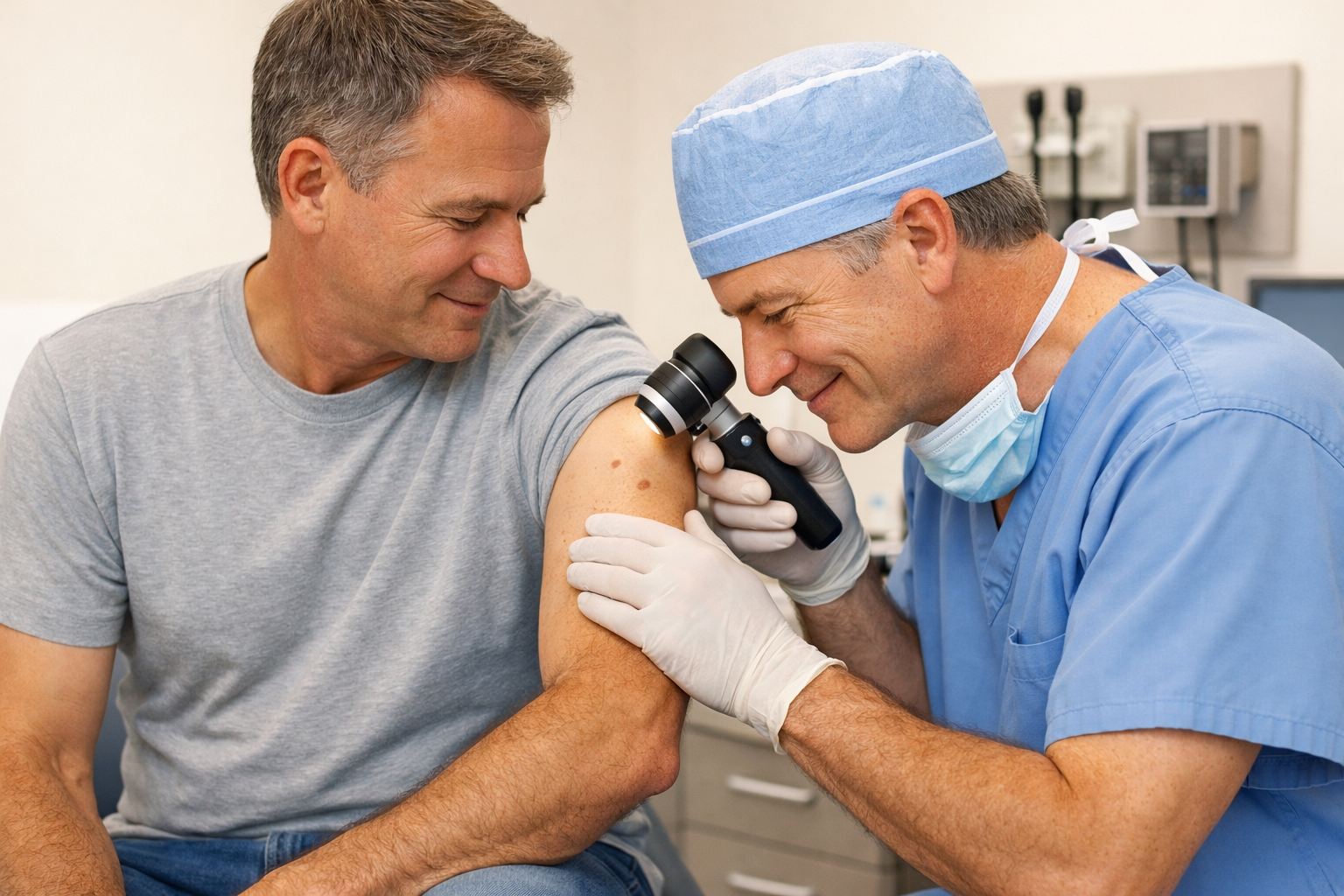
The ABCDE rule is the standard self-screening tool recommended by dermatologists worldwide. It gives you a structured way to assess any mole at home [2].
A — Asymmetry: One half of the mole doesn't match the other. Benign moles are usually symmetrical.
B — Border: The edges are irregular, ragged, notched, or blurred. Normal moles have smooth, well-defined borders.
C — Color: The mole has multiple shades — varying tones of brown, black, red, white, or blue. Uniform colour is a reassuring sign.
D — Diameter: Larger than 6 mm (the size of a pencil eraser). Most benign moles are smaller.
E — Evolving: Any change in size, shape, colour, or new symptoms like bleeding or itching. This is arguably the most important criterion.
A mole doesn't need to tick all five boxes to warrant attention. Even one ABCDE flag is enough reason to book an appointment.
The Ugly Duckling rule works alongside ABCDE: if one mole simply looks different from all your others — regardless of its individual features — it deserves a closer look [2]. Trust your instincts.
For a deeper look at atypical moles and what they mean, see our article on atypical moles explained.
How Often Should You See a Dermatologist to Check Moles?
For most healthy adults with no significant risk factors, once a year is the standard recommendation from the Skin Cancer Foundation [7].
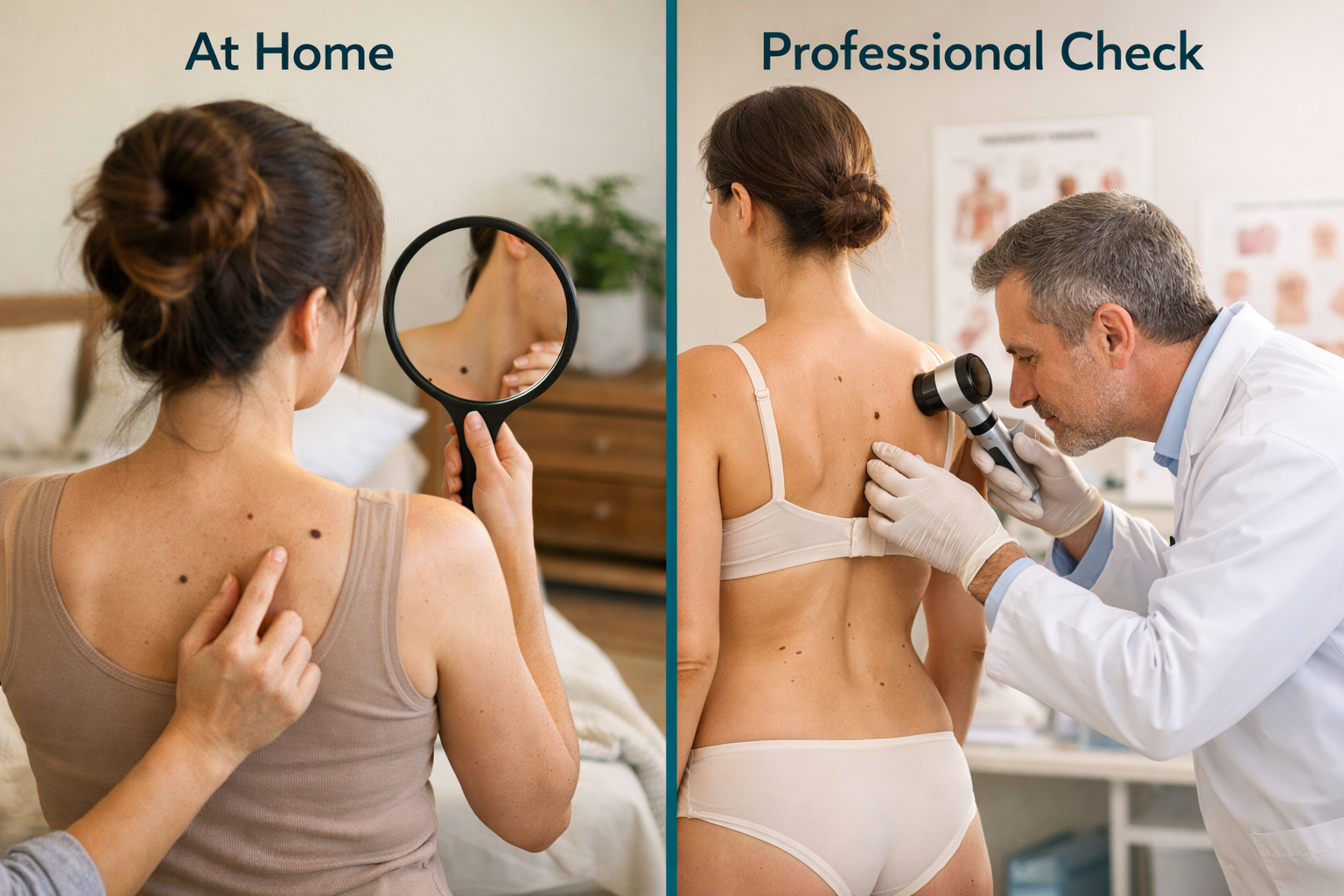
Between professional appointments, monthly self-checks are strongly encouraged. They take only a few minutes and help you notice changes before your next scheduled visit [1].
A practical monthly self-check routine:
- Stand in good lighting in front of a full-length mirror
- Check your face, neck, ears, and scalp (use a comb to part hair)
- Examine your chest, abdomen, and both sides of your arms
- Use a handheld mirror to check your back, shoulders, and buttocks
- Check your legs, feet, and between your toes
- Ask a family member to help with hard-to-see areas like the back and scalp [2]
If you notice any change during a self-check, don't wait for your annual appointment. Book a spot check promptly.
What Happens If a Mole Looks Suspicious?
If a dermatologist identifies a concerning mole, the next step is usually a skin biopsy — removing a small sample of tissue so it can be examined under a microscope [2].
This sounds more alarming than it is. A biopsy is a minor, local-anaesthetic procedure that takes minutes. Most results come back benign. But when they don't, early detection makes an enormous difference to treatment outcomes.
After a suspicious mole is identified:
- A biopsy is performed (shave, punch, or excisional, depending on the mole)
- Results typically return within 1–2 weeks
- If benign: you'll be advised on monitoring frequency
- If atypical or malignant: a wider excision may be recommended to ensure clean margins
If removal is recommended, an outpatient surgical clinic is often the most efficient route. Procedures are quick, performed under local anaesthetic, and don't require a hospital stay.
At The Minor Surgery Center, our experienced surgical team has performed over 9,000 mole procedures. We offer expert outpatient care with a comfort-first approach — so you can get back to your life quickly, without the hospital hassle.
Can a GP Check Moles, or Do You Need a Specialist?
Your family doctor (GP) can perform a basic visual assessment of a mole and refer you onward if something looks concerning. However, a dermatologist or trained skin specialist offers a more thorough evaluation using a dermatoscope and greater diagnostic experience with skin lesions.
Choose a GP if:
- You want an initial opinion before deciding on next steps
- You need a referral to a dermatologist through the public system
- The mole is clearly benign and you just want reassurance
Choose a dermatologist or specialist clinic if:
- You have multiple moles or a history of skin cancer
- You want a comprehensive full-body skin check
- A mole is showing ABCDE warning signs
- You'd prefer a faster appointment without a long wait
In Ontario, wait times for dermatology through the public system can stretch to several months. Many patients choose private clinics for faster access, especially when they have a mole they're worried about. A personalised treatment plan and same-week appointments are often available at outpatient clinics.
If you're in the Greater Toronto Area, The Minor Surgery Center has locations across the region, including Mississauga, Scarborough, Markham, Brampton, and North York.
What Does Mole Removal Involve If a Check Reveals a Problem?
If a skin check identifies a mole that needs to come off — whether for medical or cosmetic reasons — the removal process is straightforward and minimally invasive.
Typical mole removal steps:
- Consultation: The surgeon assesses the mole, discusses options, and outlines the procedure
- Local anaesthetic: The area is numbed so you feel no pain during the procedure
- Excision: The mole is removed using a scalpel or shave technique, depending on its type and depth
- Closure: Small sutures may be placed, or the area may be left to heal naturally
- Pathology (if needed): Tissue is sent to a lab for analysis
- Recovery: Most patients return to normal activity the same day or next day
The whole procedure typically takes 15–30 minutes. Scarring is minimal when performed by an experienced surgeon using proper technique. For more on what to expect, see our article on whether mole removal hurts and whether stitches are needed.
Wondering about cost? Our free mole removal cost estimator gives you a personalised estimate based on your specific situation.
Frequently Asked Questions
Q: How often should I see a dermatologist to check moles?
Most adults should have a full-body skin check once a year. If you have risk factors like a history of skin cancer, 50+ moles, or a family history of melanoma, more frequent checks may be recommended [7].
Q: Can I check my own moles at home?
Yes, and you should. Monthly self-checks using the ABCDE rule help you catch changes between professional appointments. Use a mirror for hard-to-see areas, or ask someone to help with your back and scalp [1].
Q: What does a dermatologist look for when checking moles?
Dermatologists assess moles for asymmetry, irregular borders, multiple colours, large diameter, and any signs of change or evolution. They use a dermatoscope for magnified detail and may photograph suspicious lesions for monitoring [2].
Q: Is it normal to have lots of moles?
Yes, most adults have between 10 and 40 moles. Having 50 or more moles does increase your melanoma risk and qualifies you for annual professional skin checks [2].
Q: What's the difference between a benign mole and a suspicious one?
A benign mole is typically round or oval, uniform in colour, symmetrical, and stable over time. A suspicious mole may be asymmetrical, have uneven borders or multiple colours, be larger than 6 mm, or have changed recently. See our guide to benign moles explained for more detail.
Q: Do new moles after age 30 need to be checked?
Yes. New moles appearing in adulthood — especially after age 30 — are worth having assessed by a professional, as most new growths in adulthood are not typical moles [1].
Q: What is the Ugly Duckling rule?
It's a simple screening concept: if one mole looks noticeably different from all your other moles, it deserves professional evaluation — even if it doesn't clearly fit the ABCDE criteria [2].
Q: Can a GP remove a mole, or do I need a specialist?
GPs can perform basic mole removal, but for complex, larger, or cosmetically sensitive moles, a surgeon or specialist clinic typically offers better outcomes and more precise technique.
Q: How long does a professional skin check take?
A full-body skin exam typically takes 10–15 minutes [1]. It's painless and non-invasive.
Q: What happens if a mole biopsy comes back abnormal?
Depending on the result, your doctor may recommend a wider excision to remove surrounding tissue and ensure clean margins. This is a minor outpatient procedure in most cases.
Q: Is mole removal covered by OHIP in Ontario?
Mole removal is covered by OHIP when it is deemed medically necessary (i.e., the mole is suspicious or causing symptoms). Cosmetic removal is not covered. Check with your clinic for specifics.
Q: Are mole-checking apps reliable?
Smartphone apps can be a useful prompt to seek professional care, but they are not a substitute for a clinical exam. For a balanced look at this topic, see our article on whether 3D mole mapping apps are reliable.
Conclusion
Seeing a dermatologist to check moles is one of the simplest, most effective things you can do for your long-term health. A 10–15 minute annual skin exam can catch changes that are invisible to the naked eye — and early detection makes treatment far more straightforward.
Your action steps:
- Book your annual skin check if you haven't had one in the past year
- Start monthly self-checks using the ABCDE rule and the Ugly Duckling rule
- Don't wait if a mole is changing, bleeding, or just looks different — book a prompt assessment
- Know your risk level — if you have 50+ moles, a family history of melanoma, or prior skin cancer, discuss a more frequent screening schedule with your doctor
- Choose the right clinic — for faster access and expert outpatient care, a specialist minor surgery clinic can often see you sooner than the public system
At The Minor Surgery Center, we make the process straightforward. From initial assessment to safe and efficient surgery, our experienced surgical team is here to help you get the answers you need — and get back to your life. Explore our mole removal services across the GTA or visit our FAQ page to learn more.
References
[1] Watch (The Skin Cancer Explosion Coming in 2026) – https://www.youtube.com/watch?v=tCez9ZndBWg
[2] Skin Cancer Screening – MD Anderson Cancer Center – https://www.mdanderson.org/prevention-screening/get-screened/skin-cancer-screening.html
[3] Skin Cancer Screening Guidelines: Who Needs It and When – https://www.robertcgriffithmd.com/blog/1376218-skin-cancer-screening-guidelines-who-needs-it-and-when/
[4] Who Should Be Screened For Skin Cancer – Mayo Clinic Cancer Blog – https://cancerblog.mayoclinic.org/2024/07/11/who-should-be-screened-for-skin-cancer/
[7] Annual Exams – The Skin Cancer Foundation – https://www.skincancer.org/early-detection/annual-exams/
Tags: dermatologist to check moles, mole screening, skin cancer detection, ABCDE rule, mole removal Toronto, melanoma prevention, skin check, atypical moles, full body skin exam, mole biopsy, mole mapping, outpatient mole removal