Last updated: March 25, 2026
Quick Answer: A first-time home buyer incentive is a government or lender program that reduces the upfront cost of purchasing a home, typically through down payment assistance, tax credits, reduced mortgage insurance, or preferential loan terms. In 2026, buyers in Canada and the United States have access to a range of federal, provincial/state, and local programs, but many have strict income limits, funding caps, and expiry dates. Acting early in the year matters because several programs exhaust their funding by spring.
Key Takeaways
- 🏠 First-time buyer incentives include grants, forgivable loans, tax credits, shared equity programs, and low-down-payment mortgages.
- 💰 In Canada, the First Home Savings Account (FHSA) and the RRSP Home Buyers' Plan remain the most powerful tax-advantaged tools available in 2026.
- 🇺🇸 In the U.S., FHA loans, VA loans, USDA loans, and state-level down payment assistance (DPA) programs are the primary vehicles for first-time buyer savings.
- 📅 Multiple state-level incentives are set to expire by March 31, 2026, so timing your application matters. [1]
- 🏦 The proposed federal $25,000 Down Payment Toward Equity Act has not yet been passed into law as of 2026. [5]
- 📊 2026 FHA loan limits increased in most counties, giving buyers $20,000–$40,000 more purchasing power with credit score approval starting at 580. [1]
- ⚠️ Most programs define "first-time buyer" as someone who has not owned a principal residence in the past three years, not necessarily someone buying for the very first time.
- ✅ Stacking multiple incentives (e.g., FHSA + RRSP HBP in Canada, or DPA + FHA in the U.S.) is legal and often the smartest financial move.
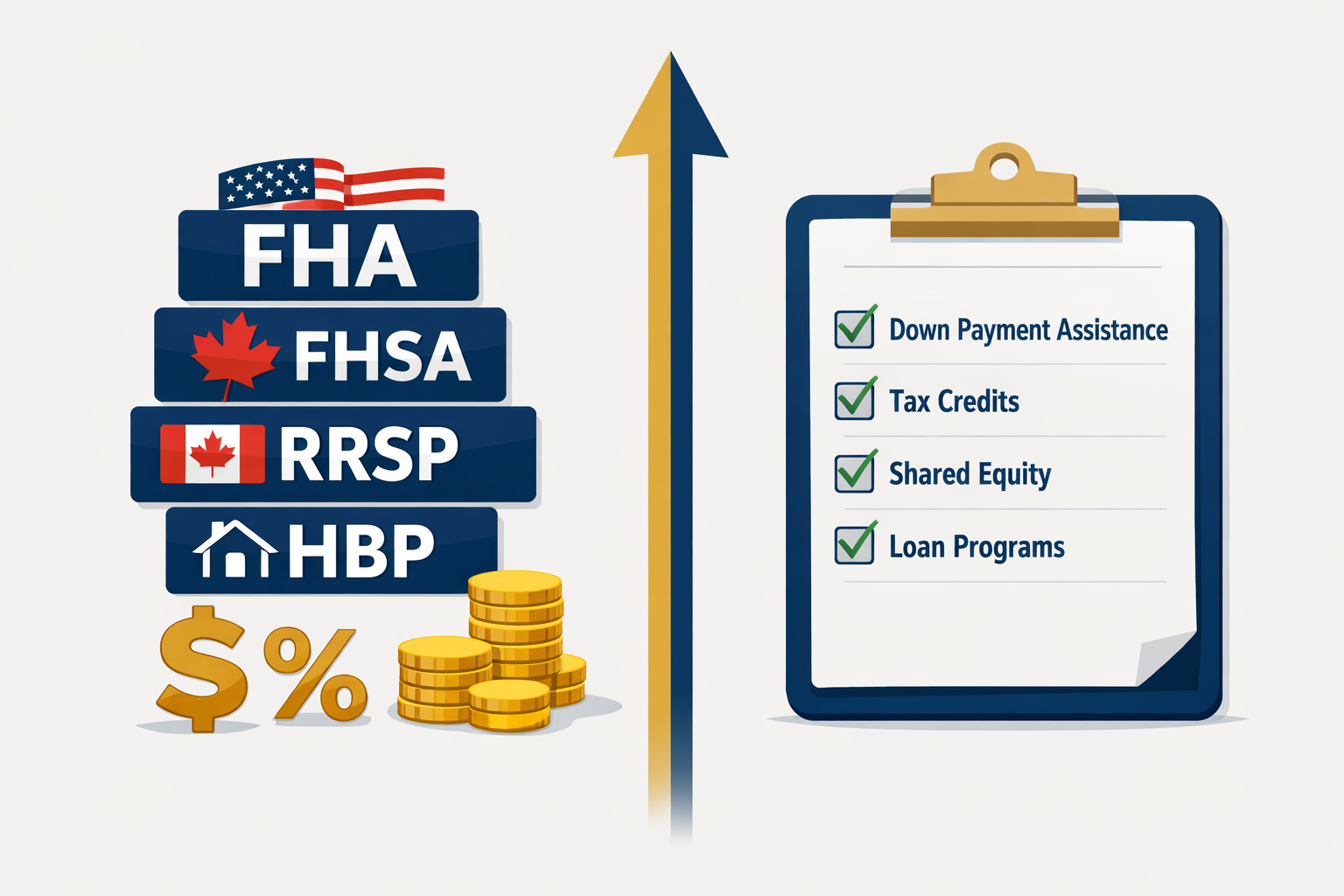
What Is a First-Time Home Buyer Incentive and Who Qualifies?
A first-time home buyer incentive is any program, benefit, or financial tool designed to lower the barrier to homeownership for people purchasing their first principal residence. These programs are offered by federal governments, provincial or state agencies, municipalities, and sometimes lenders themselves.
Who counts as a "first-time buyer"?
The definition is broader than most people expect. In Canada and the U.S., most programs define a first-time buyer as someone who has not owned a home used as a principal residence in the past three years. This means:
- Divorced individuals who haven't owned since the split may qualify.
- People who previously owned investment or rental properties (but not a primary home) may qualify.
- Anyone re-entering the market after three or more years of renting qualifies.
Common eligibility criteria across most programs:
| Criteria | Typical Requirement |
|---|---|
| Ownership history | No principal residence owned in past 3 years |
| Income limit | Usually 80%–120% of area median income |
| Credit score | 580+ for FHA; 620+ for USDA and most DPA programs [1] |
| Property type | Primary residence only (not investment or vacation) |
| Purchase price cap | Varies by program and region |
| Citizenship/residency | Must be a citizen or permanent resident |
Edge case: If one spouse owned a home previously but the other did not, some programs allow the non-owning spouse to qualify individually. Always check program-specific rules before assuming disqualification.
What First-Time Home Buyer Incentive Programs Are Available in Canada in 2026?
Canadian first-time buyers have access to several well-established federal programs that can be stacked together for maximum savings.
First Home Savings Account (FHSA)
The FHSA is one of the most powerful first-time home buyer incentive tools available in Canada. It combines the tax benefits of an RRSP with the tax-free withdrawal features of a TFSA, specifically for home purchases.
- Contribute up to $8,000 per year, with a lifetime limit of $40,000.
- Contributions are tax-deductible (like an RRSP).
- Qualifying withdrawals are completely tax-free (like a TFSA).
- Unused contribution room carries forward one year.
For a deeper breakdown of how the account works, see this introduction to the First Home Savings Account and how it can accelerate your path to ownership.
RRSP Home Buyers' Plan (HBP)
The Home Buyers' Plan lets first-time buyers withdraw up to $35,000 from their RRSP tax-free to use toward a down payment. Couples can withdraw up to $70,000 combined. The amount must be repaid over 15 years, or the annual repayment amount is added to taxable income.
Learn more about how the RRSP Home Buyers' Plan works and the repayment rules to avoid tax surprises.
First-Time Home Buyers' Tax Credit (HBTC)
This federal non-refundable tax credit allows eligible buyers to claim $10,000 on their tax return, resulting in up to $1,500 in tax savings. It applies to qualifying homes purchased after 2021. For a full walkthrough, see the First-Time Home Buyer Tax Credit guide.
GST/HST New Housing Rebate
Buyers of newly constructed homes may qualify for a partial rebate of the GST or HST paid, reducing the effective purchase price. The rebate phases out as the purchase price rises above certain thresholds.
Provincial Land Transfer Tax Rebates
Ontario, British Columbia, and Prince Edward Island offer first-time buyer rebates on land transfer tax. Ontario's rebate can be worth up to $4,000, effectively eliminating land transfer tax on homes priced up to approximately $368,000.
30-Year Amortization for Insured Mortgages
As of August 2024, the federal government extended 30-year amortization periods to first-time buyers purchasing new construction homes with insured mortgages. This reduces monthly payments and improves affordability. See how 30-year amortization affects first-time buyer mortgages for a full explanation.
What U.S. First-Time Home Buyer Incentive Programs Exist in 2026?
American first-time buyers can access federal loan programs, state-level grants, and lender-specific incentives. The landscape is more fragmented than Canada's, so location matters enormously.
Federal Loan Programs
FHA Loans
- Backed by the Federal Housing Administration.
- Minimum down payment of 3.5% with a credit score of 580+. [1]
- 2026 FHA loan limits increased in most counties, giving buyers $20,000–$40,000 more purchasing power compared to prior limits. [1]
- Requires mortgage insurance premium (MIP), which adds to monthly costs.
VA Loans
- Available to veterans, active-duty military, and surviving spouses.
- 0% down payment required with no official minimum credit score set by the VA (most lenders require around 620). [1]
- No private mortgage insurance (PMI) required, making this one of the strongest first-time home buyer incentive options available.
USDA Loans
- For buyers in eligible rural and suburban areas.
- 0% down payment with most lenders requiring a credit score around 620. [1]
- Income limits apply based on household size and location.
Conventional 97 / HomeReady / Home Possible
- Fannie Mae and Freddie Mac programs allowing as little as 3% down.
- Income limits apply for HomeReady and Home Possible.
- No upfront mortgage insurance premium (unlike FHA).
State-Level Down Payment Assistance Programs
State DPA programs are often the most impactful first-time home buyer incentive for buyers who don't qualify for VA or USDA loans. Funding is limited and often exhausted early in the year.
| State Program | Assistance Amount | Key Notes |
|---|---|---|
| Texas My First Texas Home | Up to 5% of loan amount | Winter 2026 extension offered $2,500 bonus credit through March 15, 2026 [1] |
| Florida Hometown Heroes | Up to $35,000 | For teachers, healthcare workers, law enforcement [1] |
| Georgia Dream DPA | Up to $10,000–$12,500 | 2026 cycle opened January 8; funding historically runs out by April [1] |
| Texas DPA (general) | $12,000–$25,000 | Varies by income and purchase price [1] |
Common mistake: Many buyers assume state DPA programs are always available. In reality, programs like Georgia Dream historically exhaust funding within weeks of opening. Apply as early in the calendar year as possible. [1]
The Proposed $25,000 Federal Grant
The Down Payment Toward Equity Act proposes up to $20,000 in assistance for first-generation buyers and up to $25,000 for socially or economically disadvantaged buyers, with eligibility extending to borrowers earning up to 120% of area median income. [3] However, this legislation was reintroduced in June 2025 and has not been signed into law as of 2026. [5] Do not plan your purchase around this grant until it passes.
How Do Builder and Lender Incentives Work for First-Time Buyers?
Beyond government programs, builders and lenders offer their own first-time home buyer incentives, particularly in slower markets.
Builder rate buydowns are one of the most tangible incentives available in 2026. Builders are offering:
- Temporary buydowns that reduce the mortgage rate for the first 1–3 years, saving buyers an estimated $250–$450 per month. [1]
- Permanent rate reductions of 0.25–0.75% as Q1 incentives on select communities. [1]
- Closing cost credits, appliance packages, and free upgrades.
Choose a builder buydown if: you plan to stay in the home for at least five years and the permanent rate reduction is meaningful relative to your loan size.
Lender-specific programs include reduced origination fees, first-time buyer rate discounts, and credit union programs with lower mortgage insurance requirements.
How Can First-Time Buyers Stack Multiple Incentives?
Stacking incentives is legal, encouraged, and often the difference between a comfortable purchase and a financially strained one.
Canadian stacking example:
- Open an FHSA and contribute the maximum ($8,000/year) for several years.
- Withdraw RRSP funds through the Home Buyers' Plan (up to $35,000 per person).
- Claim the First-Time Home Buyers' Tax Credit ($1,500 in tax savings).
- Apply for the provincial land transfer tax rebate (up to $4,000 in Ontario).
- If buying new construction, claim the GST/HST New Housing Rebate.
For a complete savings roadmap, see how to save and buy your first home.
U.S. stacking example:
- Use a state DPA grant for down payment funds.
- Finance with an FHA loan (3.5% down) or a Conventional 97 loan.
- Apply for a Mortgage Credit Certificate (MCC) if available in your state, which converts a portion of mortgage interest into a direct tax credit.
- Negotiate builder closing cost credits if purchasing new construction.
Important constraint: Some DPA programs prohibit stacking with other grants. Always confirm compatibility with your loan officer before applying to multiple programs simultaneously.
What Are the Biggest Mistakes First-Time Buyers Make With Incentive Programs?
Knowing what to avoid is just as valuable as knowing what programs exist. For a broader look at purchasing pitfalls, see this guide to first-time home buyer mistakes.
The most common errors:
- Waiting too long to apply. State DPA programs like Georgia Dream run out of funding within weeks of opening each year. [1] Applying in February beats applying in May.
- Assuming the $25,000 federal grant is available. It is not law as of 2026. [5] Buyers who plan around this grant risk delaying their purchase unnecessarily.
- Ignoring the mortgage stress test. In Canada, qualifying for a mortgage requires passing a stress test at a rate higher than the contract rate. Understanding this early shapes how much incentive money you actually need. See how the mortgage stress test works.
- Not using the FHSA before the RRSP HBP. Because FHSA withdrawals are tax-free and don't require repayment, they should generally be used before RRSP funds.
- Overlooking closing costs. Incentive programs cover down payments, not always closing costs. Budget 1.5%–4% of the purchase price for legal fees, title insurance, and land transfer taxes.
Step-by-Step: How to Apply for a First-Time Home Buyer Incentive
Step 1: Confirm eligibility. Check whether you meet the three-year ownership rule, income limits, and credit score requirements for your target programs.
Step 2: Open tax-advantaged accounts early (Canada). Start contributing to an FHSA as soon as possible. Contribution room accumulates annually, so earlier is better.
Step 3: Get pre-approved for a mortgage. A pre-approval tells you your maximum purchase price and which loan programs you qualify for. It also signals to sellers that you're a serious buyer.
Step 4: Research state/provincial programs. Contact your provincial housing authority or state housing finance agency directly. Program availability and funding levels change frequently.
Step 5: Work with a mortgage broker. Brokers have access to multiple lenders and often know which DPA programs are currently funded and compatible with specific loan types.
Step 6: Apply to programs before funding runs out. For state DPA programs, submit applications early in the calendar year. For Canadian programs, ensure your FHSA and RRSP contributions are in place before making an offer.
Step 7: Close and claim tax credits. After closing, claim applicable tax credits (HBTC in Canada, MCC in the U.S.) on your annual tax return.
FAQ: First-Time Home Buyer Incentive Questions Answered
Q: Can I use the FHSA and the RRSP Home Buyers' Plan together?
Yes. Canadian first-time buyers can use both the FHSA and the RRSP Home Buyers' Plan on the same purchase. The FHSA should generally be used first since withdrawals don't require repayment.
Q: Is the $25,000 first-time home buyer grant available in the U.S. in 2026?
No. The Down Payment Toward Equity Act was reintroduced in June 2025 but has not been passed into law as of 2026. [5] Do not plan your purchase around this grant.
Q: What credit score do I need for FHA loan approval?
FHA loans are available with a credit score of 580 for the 3.5% down payment option. Scores between 500–579 require a 10% down payment. [1]
Q: Do first-time buyer incentive programs apply to condos?
Generally yes, as long as the condo is used as a primary residence. Some programs exclude certain property types, so verify before applying. For Toronto-specific considerations, see what condo living means for first-time buyers.
Q: Can I qualify as a first-time buyer if I owned a home more than three years ago?
Yes. Most programs define first-time buyer as not having owned a principal residence in the past three years. If your last ownership was more than three years ago, you likely qualify.
Q: Are down payment assistance grants taxable income?
In most cases, DPA grants and forgivable loans are not considered taxable income. However, confirm this with a tax professional based on your specific program and jurisdiction.
Q: How long does it take to get approved for a state DPA program?
Approval timelines vary by state and program. Many DPA programs add 30–60 days to the standard mortgage approval process. Factor this into your purchase timeline.
Q: Can self-employed buyers access first-time buyer incentives?
Yes, self-employed buyers can access the same incentive programs as salaried employees. However, income documentation requirements are stricter. For more detail, see opportunities for first-time homebuyers among self-employed Canadians.
Q: What happens if I sell my home before the DPA repayment period ends?
Most forgivable DPA loans require full repayment if the home is sold before a set period (often 5–10 years). Grant-based programs typically have no repayment requirement.
Q: Is there a first-time buyer incentive for rural properties in Canada?
The FHSA, RRSP HBP, and HBTC all apply to rural properties as long as they serve as the principal residence. There is no equivalent to the U.S. USDA rural loan program in Canada, but standard insured mortgages apply.
Conclusion: Your Next Steps as a First-Time Buyer in 2026
The range of first-time home buyer incentive options available in 2026 is genuinely significant, but the programs reward those who plan ahead. Funding runs out, expiry dates arrive, and the best opportunities go to buyers who are prepared.
Actionable next steps:
- Open an FHSA immediately if you're a Canadian buyer who hasn't already. Every year without one is contribution room lost forever.
- Check your credit score and address any issues before applying for a mortgage or DPA program.
- Contact your state or provincial housing authority to confirm which DPA programs are currently funded and accepting applications.
- Get pre-approved so you know your budget and which programs you qualify for.
- Work with a mortgage broker who understands the full landscape of incentive programs and can help you stack benefits legally and strategically.
- Don't wait for the $25,000 federal grant in the U.S. It hasn't passed, and waiting could cost you more in rising prices than the grant would save.
The path to homeownership is clearer when the available tools are understood and used correctly. The incentives exist to help, but only buyers who act on them benefit.
References
[1] First Time Home Buyers Programme In The Us – https://www.realpha.com/blog/first-time-home-buyers-programme-in-the-us
[2] Whats New In First Time Home Buyer Programs For 2025 – https://www.makemymove.com/articles/whats-new-in-first-time-home-buyer-programs-for-2025
[3] First Time Home Buyer Grants – https://themortgagereports.com/97630/first-time-home-buyer-grants
[4] Firsttime Home Buyer Programs In Everything You Need To Know – https://www.amerisave.com/learn/firsttime-home-buyer-programs-in-everything-you-need-to-know
[5] Down Payment Toward Equity Act – https://www.fha.com/down-payment-toward-equity-act
Tags: first-time home buyer incentive, down payment assistance, FHSA, RRSP Home Buyers Plan, FHA loan, first-time buyer programs, home buyer grants, mortgage stress test, first-time buyer tax credit, state DPA programs, Canadian housing programs, homeownership incentives