Last updated: March 25, 2026
Quick Answer: A first time home buyer is someone purchasing a primary residence for the first time, typically qualifying for special mortgage programs, government incentives, and tax credits designed to lower the barrier to entry. In 2026, improving inventory, easing mortgage rates, and expanded savings tools make this one of the more accessible entry points in recent years — though affordability challenges remain real and preparation is everything.
Key Takeaways
- First-time buyers represented only 21% of all home purchases in 2025, a record low — but that also means less competition in many markets [1]
- The median first-time buyer puts down 10%, not 20% — and most lenders accept far less with the right mortgage program [1]
- Only 37% of Americans know a 20% down payment isn't required, creating a widespread and fixable misconception [5]
- Mortgage rates are projected to ease toward 6% in 2026, potentially opening the door for up to 1.6 million additional renters to afford a home [2]
- Down payment funds come from savings (59%), financial assets like 401(k)s (26%), and family gifts or loans (22%) [1]
- Canadian first-time buyers have access to powerful tools: the FHSA, RRSP Home Buyers' Plan, and the First-Time Home Buyer Tax Credit
- Getting pre-approved before house hunting is non-negotiable — it defines your real budget and strengthens offers
- Closing costs typically add 2–5% on top of the purchase price and catch many first-time buyers off guard
- More than 62% of homeowners say ownership cost more than expected — budgeting beyond the mortgage payment is critical [5]
- Working with a real estate agent remains the norm: 88% of buyers used one, and 91% said they'd recommend theirs [1]
Who Qualifies as a First Time Home Buyer?
A first time home buyer is generally defined as someone who has not owned a primary residence in the past three years. This definition applies to most government programs in both Canada and the United States, meaning someone who owned a home a decade ago may still qualify today.
Key eligibility nuances:
- In Canada, the Canada Revenue Agency (CRA) uses the "four calendar years" rule for RRSP Home Buyers' Plan eligibility — you must not have lived in a home you or your spouse owned in the current year or the preceding four years
- The First Home Savings Account (FHSA) requires that you have not lived in a qualifying home owned by you or your spouse at any point in the current year or the preceding four calendar years
- In the U.S., HUD defines a first-time buyer as someone who has not owned a principal residence in the past three years
- Divorced individuals who previously owned with a spouse may qualify again as first-time buyers under certain programs
Choose this status if: You haven't owned a home recently and want access to lower down payment requirements, tax credits, and government-backed incentives. Even if you owned property years ago, it's worth checking current program rules — you may still qualify.
What Does the First Time Home Buyer Landscape Look Like in 2026?
The market in 2026 is meaningfully different from the frenzied conditions of 2021–2022. First-time buyers are entering with more options, slightly more breathing room, and better-designed savings tools — but affordability remains the central challenge.
What the data shows:
- First-time buyers made up just 21% of all purchases in 2025, down from roughly 40% in 2007 — a historic low driven by high prices and elevated rates [1]
- NAR research suggests that if mortgage rates ease toward 6%, as many as 1.6 million more renters could afford to buy [2]
- Inventory is gradually rising, and list prices have softened slightly in many markets, giving buyers more negotiating room [5]
- The median age of first-time buyers was reported at 40 by NAR (based on July 2024–June 2025 transactions) [1], while Redfin's February 2026 data puts the median at 35 [3] — the difference reflects methodology, but both point to buyers waiting longer than previous generations
- In expensive metros like those in California, first-time buyer ages trend higher; in more affordable Midwestern and Southern cities, buyers are entering younger [6]
"More than three in five homeowners say owning a home has been much more expensive than they thought it would be." — NerdWallet Home Buyer Report [5]
This isn't a reason to avoid buying. It's a reason to plan carefully before you sign anything.
For a Toronto-specific view, 2026 is shaping up as a compelling entry point for first-time buyers in a cooling market.
How Much Do First Time Home Buyers Actually Need for a Down Payment?
Most first-time buyers do not need 20% down — and the data confirms it. The median first-time buyer put down 10% in 2025, matching the highest level recorded since 1989 [1]. Yet only 37% of Americans know a 20% down payment isn't required [5]. That gap in awareness is keeping qualified buyers on the sidelines.
Down payment minimums by loan/program type (Canada):
| Purchase Price | Minimum Down Payment |
|---|---|
| Up to $500,000 | 5% |
| $500,001 to $999,999 | 5% on first $500K + 10% on remainder |
| $1,000,000 and above | 20% |
Down payment minimums (U.S. — common programs):
| Program | Minimum Down |
|---|---|
| FHA Loan | 3.5% (credit score 580+) |
| Conventional (Fannie/Freddie) | 3% for first-time buyers |
| VA Loan (veterans) | 0% |
| USDA Loan (rural areas) | 0% |
Where first-time buyers get their down payment [1]:
- 59% from personal savings
- 26% from financial assets (401(k), stocks, other investments)
- 22% from gifts or loans from family and friends
Common mistake: Draining all savings for the down payment and arriving at closing without funds for closing costs, moving expenses, or immediate repairs. Keep a separate reserve of at least 1–3% of the purchase price.
In Canada, tools like the Tax-Free First Home Savings Account (FHSA) and the RRSP Home Buyers' Plan can significantly accelerate down payment savings with tax advantages built in.
What Are the Steps to Buying Your First Home?
Buying a first home follows a clear sequence. Skipping steps — especially early ones — is the most common source of costly surprises.
Step-by-step process:
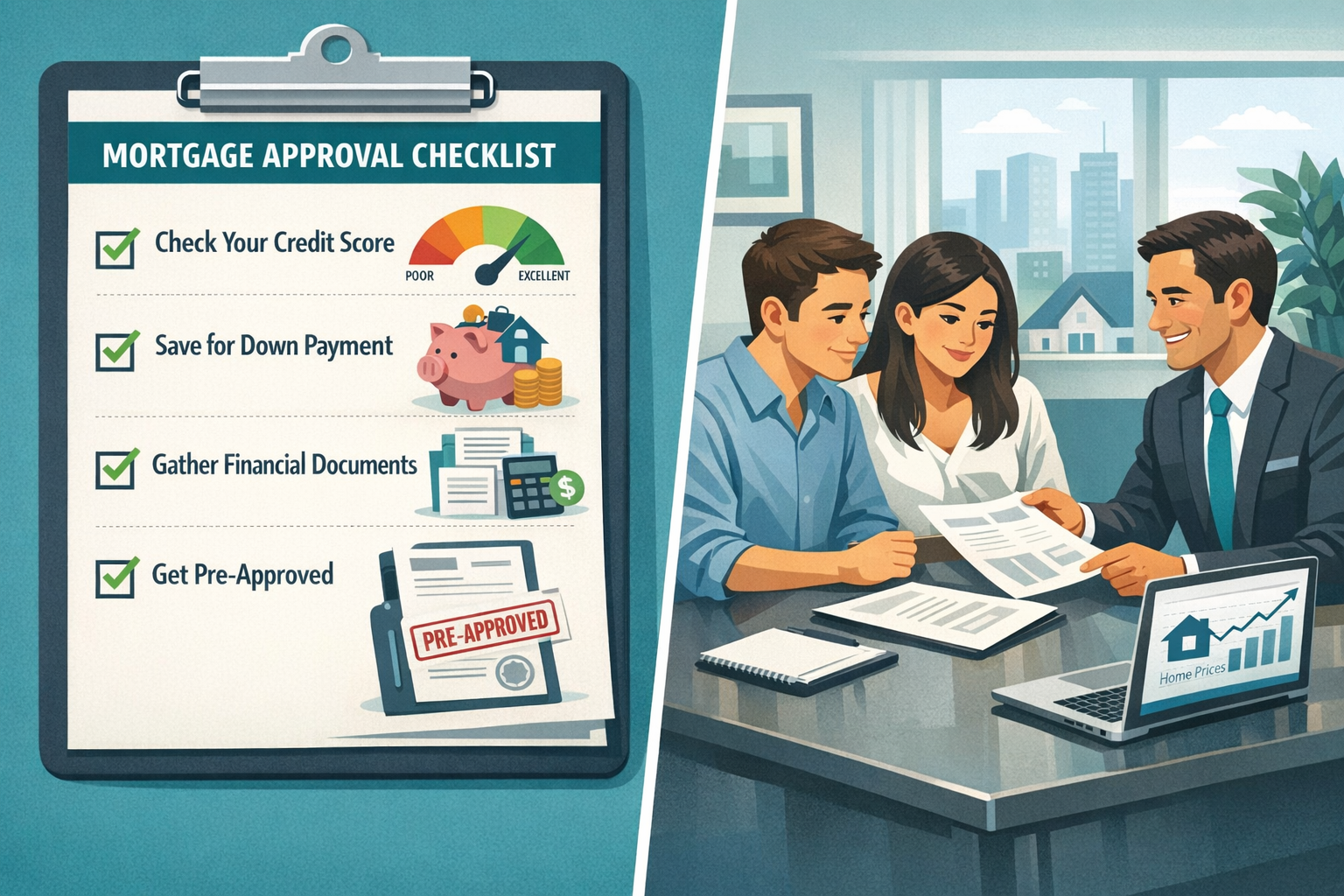
- Check your credit score. Lenders in Canada typically want 620+; 680+ gets better rates. In the U.S., FHA accepts 580+ for 3.5% down.
- Calculate your real budget. Factor in mortgage payments, property taxes, insurance, condo fees (if applicable), utilities, and maintenance. Use the 28/36 rule as a starting point: housing costs under 28% of gross income, total debt under 36%.
- Build your down payment and emergency fund. Use an FHSA, TFSA, or RRSP (Canada) or a high-yield savings account (U.S.) to grow savings tax-efficiently.
- Get pre-approved — not just pre-qualified. Pre-approval involves a full credit check and income verification. It tells sellers you're serious and tells you exactly how much you can borrow. Understanding the mortgage stress test is essential for Canadian buyers.
- Hire a real estate agent. 88% of buyers use one [1], and for good reason — they negotiate, identify red flags, and guide offers. Comparing working with an agent vs. going solo is worth doing before you decide.
- Search for homes within your pre-approved range. Stay disciplined. Falling in love with a home $80,000 over budget creates pressure to overextend.
- Make an offer and negotiate. Your agent will guide the offer price, conditions (financing, inspection), and deposit amount.
- Complete due diligence. Home inspection, title search, and review of any condo documents (if applicable).
- Secure your mortgage and lock your rate. Compare lenders — banks, credit unions, and mortgage brokers all offer different products. Understanding fixed vs. variable rate options matters here.
- Close the deal. Review closing costs, sign documents with a real estate lawyer, and get the keys.
For a detailed walkthrough tailored to Toronto's current market, see this step-by-step guide to buying your first home in Toronto's 2026 buyers' market.
What Government Programs Help First Time Home Buyers in Canada?
Canada offers several programs specifically designed to reduce the financial burden on first-time buyers. Using them in combination can make a meaningful difference.
Key Canadian programs in 2026:
1. First Home Savings Account (FHSA)
- Contribute up to $8,000/year (lifetime max $40,000)
- Contributions are tax-deductible; qualifying withdrawals are tax-free
- Combines benefits of RRSP and TFSA in one account
- Learn more: Introduction to the First Home Savings Account
2. RRSP Home Buyers' Plan (HBP)
- Withdraw up to $60,000 from your RRSP tax-free for a first home (increased from $35,000 in 2024)
- Must repay over 15 years or the amount is added to taxable income
- Can be combined with FHSA
3. First-Time Home Buyer Tax Credit
- A non-refundable federal tax credit worth up to $1,500 on your tax return
- Applies to qualifying homes purchased in the tax year
- Full details: First-Time Home Buyer Tax Credit in Canada
4. GST/HST New Housing Rebate
- Partial rebate on GST/HST paid on new construction homes
- Applies when the purchase price is under $450,000 (federal portion)
5. Land Transfer Tax Rebates
- Ontario and Toronto both offer rebates for first-time buyers on land transfer taxes
- Toronto buyers can receive up to $4,475 from the provincial rebate and up to $4,475 from the municipal rebate
Edge case: If one partner in a couple has previously owned a home, only the qualifying partner can claim first-time buyer benefits — the couple cannot claim the full amount together in most programs. Confirm eligibility with a mortgage professional before assuming.
What Are the True Costs of Buying a Home for the First Time?
Beyond the purchase price and down payment, first-time buyers consistently underestimate the full cost of buying and owning a home. This is the single biggest source of financial stress post-purchase: more than 62% of homeowners say it cost more than expected, and 34% consider themselves house poor [5].
One-time buying costs (estimate; varies by province/state and property):
| Cost | Typical Range |
|---|---|
| Home inspection | $400–$700 |
| Land transfer tax | 0.5%–2.5% of purchase price |
| Legal/lawyer fees | $1,500–$3,000 |
| Title insurance | $200–$400 |
| Mortgage default insurance (CMHC) | 2.8%–4% of mortgage (if <20% down) |
| Moving costs | $1,000–$5,000+ |
| Immediate repairs/upgrades | Highly variable |
Ongoing ownership costs to budget for:
- Property taxes (typically 0.5%–1.5% of assessed value annually)
- Home insurance ($1,000–$3,000/year depending on property)
- Utilities (hydro, gas, water)
- Maintenance (budget 1% of home value per year as a baseline)
- Condo/strata fees if applicable
For a detailed breakdown of what to expect at closing in the Toronto market, the closing cost calculator guide for Toronto homebuyers is a practical reference.
What Are the Most Common First Time Home Buyer Mistakes?
Most first-time buyer mistakes are avoidable with the right information. The ones below consistently appear across buyers who end up financially strained or stuck in the wrong property.
Top mistakes and how to avoid them:
- Skipping mortgage pre-approval. Shopping for homes without pre-approval wastes time and can lead to heartbreak when a dream home is actually out of reach.
- Underestimating closing costs. Budget 2–5% of the purchase price on top of your down payment for closing costs alone.
- Maxing out the pre-approved amount. Just because a lender approves you for $700,000 doesn't mean a $700,000 mortgage fits your life. Leave room for the unexpected.
- Waiving the home inspection. In competitive markets, buyers skip inspections to win. This is a significant financial risk — one hidden issue can cost tens of thousands.
- Ignoring the neighbourhood. A great house in the wrong location is a long-term problem. Visit at different times of day and research schools, transit, and future development plans.
- Not comparing mortgage products. The first rate a bank offers is rarely the best one. Brokers can access dozens of lenders.
- Forgetting about post-move costs. Furniture, appliances, landscaping, and repairs add up fast in the first year.
For a comprehensive breakdown, the first-time home buyer mistakes guide covers the most costly errors in detail.
Should a First Time Home Buyer Choose a Condo or a House?
The condo vs. house decision depends on budget, lifestyle, and location — and there's no universal right answer. In expensive urban markets like Toronto, condos are often the only realistic entry point for first-time buyers.
Condo advantages for first-time buyers:
- Lower purchase price in most markets
- Less maintenance responsibility (exterior, snow removal, landscaping handled by condo corp)
- Often better located near transit and urban amenities
- Easier to lock and leave for travel
Condo disadvantages:
- Monthly condo fees reduce borrowing power
- Less control over building decisions
- Special assessments can create unexpected costs
- Appreciation can be slower than freehold in some markets
House advantages:
- Full ownership of land and structure
- No condo fees
- More flexibility to renovate, add rental income suites
- Historically stronger long-term appreciation in many markets
House disadvantages:
- Higher purchase price in most urban markets
- Full maintenance responsibility
- Higher carrying costs (utilities, insurance, upkeep)
Choose a condo if: Budget is the primary constraint, you prefer urban living, or you want lower maintenance. Choose a house if: You want more space, plan to stay long-term, or want to add a rental unit for income.
For Toronto-specific context, the rise of condo living and what it means for first-time buyers is worth reading before deciding.
Conclusion: Your Next Steps as a First Time Home Buyer
Buying a first home is one of the most significant financial decisions most people make. The good news in 2026 is that conditions are more favorable than they've been in several years — inventory is rising, rates are easing, and Canadian buyers have more savings tools than ever before.
But preparation is what separates buyers who thrive from those who end up house poor. Here's where to start:
Actionable next steps:
- ✅ Check your credit score today — free through most banks and apps
- ✅ Open an FHSA if you're Canadian — every month without one is a missed contribution room
- ✅ Calculate your real budget — include taxes, insurance, maintenance, and condo fees
- ✅ Get pre-approved — contact a mortgage broker to compare rates across multiple lenders
- ✅ Research government programs — FHSA, RRSP HBP, and tax credits can save thousands
- ✅ Connect with a real estate agent — choose someone who specializes in first-time buyers in your target area
- ✅ Learn from others' mistakes — review the most common first-time buyer errors before making offers
The path to homeownership is rarely perfectly straight. But with the right preparation, the right team, and realistic expectations, becoming a homeowner is achievable — even in today's market.
Frequently Asked Questions
Q: What credit score does a first-time home buyer need?
In Canada, most lenders want a minimum score of 620, though 680 or higher qualifies for better rates and more product options. In the U.S., FHA loans accept 580+ for 3.5% down; conventional loans typically require 620+.
Q: Can a first-time buyer purchase with less than 5% down in Canada?
No. The minimum down payment in Canada is 5% for homes under $500,000. There is no zero-down conventional mortgage option in Canada, though the FHSA and RRSP Home Buyers' Plan can help reach that threshold faster.
Q: What is the median age of a first-time home buyer in 2026?
NAR reported a median age of 40 for first-time buyers based on July 2024–June 2025 data [1], while Redfin's February 2026 report puts the figure at 35 [3]. The difference reflects methodology. Both indicate buyers are entering homeownership later than previous generations.
Q: How long does the home buying process take?
From starting a serious search to closing, most buyers take 3–6 months. The mortgage closing period alone typically takes 30–60 days after an accepted offer.
Q: Is it better to rent or buy as a first-time buyer in 2026?
It depends on local market conditions, how long you plan to stay, and your financial readiness. In many GTA markets, the rent vs. buy analysis for 2026 shows ownership building equity faster than high rents — but the math varies by neighbourhood.
Q: What is mortgage default insurance (CMHC insurance)?
In Canada, any buyer putting down less than 20% must purchase mortgage default insurance through CMHC, Sagen, or Canada Guaranty. The premium ranges from 2.8% to 4% of the mortgage amount and is added to the mortgage balance. It protects the lender, not the buyer — but it enables lower down payments.
Q: Can first-time buyers use both the FHSA and RRSP Home Buyers' Plan?
Yes. A Canadian first-time buyer can withdraw from both an FHSA (tax-free, no repayment required) and an RRSP through the Home Buyers' Plan (up to $60,000, repayable over 15 years) for the same purchase.
Q: Do first-time buyers need a home inspection?
It's strongly recommended. A home inspection typically costs $400–$700 and can identify structural, mechanical, or safety issues that could cost tens of thousands to fix. Waiving it to win a bidding war is a significant financial risk.
Q: What is the First-Time Home Buyer Tax Credit in Canada?
It's a federal non-refundable tax credit that provides up to $1,500 back on your tax return for qualifying home purchases. It applies to the year of purchase and requires that neither you nor your spouse owned a qualifying home in the preceding four calendar years.
Q: How does the mortgage stress test affect first-time buyers in Canada?
The stress test requires buyers to qualify at the higher of the contract rate plus 2%, or 5.25%. This reduces the maximum mortgage amount a buyer qualifies for. For example, if rates are at 5%, buyers must qualify at 7%. Understanding this before house hunting prevents targeting homes that won't pass lender approval.
Q: What are closing costs and how much should a first-time buyer budget?
Closing costs are expenses paid at the time of purchase beyond the down payment. They include land transfer taxes, legal fees, title insurance, and home inspection fees. Budget 2–5% of the purchase price to cover them comfortably.
Q: Should a first-time buyer use a mortgage broker or go directly to a bank?
A mortgage broker accesses multiple lenders and can often find better rates or more flexible terms than a single bank. Banks offer convenience and relationship discounts. Many first-time buyers benefit from consulting a broker first to understand the full range of options available.
References
[1] First Time Home Buyer Share Falls To Historic Low Of 21 Median Age Rises To 40 – https://www.nar.realtor/newsroom/first-time-home-buyer-share-falls-to-historic-low-of-21-median-age-rises-to-40
[2] Could More First Time Buyers Make The Math Work In 2026 – https://www.nar.realtor/magazine/real-estate-news/could-more-first-time-buyers-make-the-math-work-in-2026
[3] Redfin Reports The Typical First Time Homebuyer Is 35 Years Old – https://www.redfin.com/news/press-releases/redfin-reports-the-typical-first-time-homebuyer-is-35-years-old/
[5] Home Buyer Report – https://www.nerdwallet.com/mortgages/studies/home-buyer-report
[6] First Time Homebuyer Age Metro – https://www.axios.com/2026/03/23/first-time-homebuyer-age-metro
Tags: first time home buyer, home buying guide, mortgage pre-approval, FHSA Canada, down payment tips, CMHC mortgage insurance, first home savings account, home buyer programs Canada, real estate agent tips, closing costs, mortgage stress test, condo vs house