31 Mar
If you’ve ever looked at a mole on your skin and wondered whether removing it would cost you anything — or whether OHIP would pick up the tab — you’re not alone. Is mole removal covered by OHIP in Ontario? is one of the most common questions patients ask before booking an appointment. The answer isn’t a simple yes or no. It depends on why the mole needs to come off. Understanding the difference between a medically necessary removal and a cosmetic one can save you hundreds of dollars — or help you get the care you need without delay.
In this guide, we’ll walk you through exactly how OHIP mole removal coverage works in Ontario, what qualifies as medically necessary, what you’ll pay out of pocket for cosmetic removal, and how The Minor Surgery Center can help you navigate your options.
Key Takeaways 📋
- ✅ OHIP covers mole removal in Ontario only when it is medically necessary — not for cosmetic or aesthetic reasons.
- 🔍 Suspicious moles showing signs of cancer, causing pain, bleeding, or interfering with daily function may qualify for OHIP coverage.
- 💸 Cosmetic mole removal costs in Ontario typically range from $150 to $1,500 per mole, with most standard procedures falling between $400 and $650.
- 📋 The ABCDE criteria (Asymmetry, Border, Color, Diameter, Evolution) are used to evaluate whether a mole warrants medical removal.
- 🏥 The Minor Surgery Center offers free consultations at clinics in Toronto, Vaughan, Oakville, and Mississauga to help you determine your best path forward.
Understanding OHIP: What It Covers and What It Doesn’t
Before diving into mole removal specifically, it helps to understand how OHIP (Ontario Health Insurance Plan) decides what to cover. OHIP is Ontario’s publicly funded health insurance program. It covers services that are medically necessary — meaning treatments that a licensed physician determines are required to diagnose or treat a health condition.
OHIP does not cover procedures that are done purely for appearance or personal preference. This is a firm line in Ontario’s health policy, and it applies directly to mole removal.
Here’s a quick overview of what OHIP does and doesn’t cover in dermatology:
| Covered by OHIP | NOT Covered by OHIP |
|---|---|
| Suspicious mole removal (cancer risk) | Cosmetic mole removal |
| Skin cancer treatment | Botox injections |
| Severe acne treatment | Lipoma removal |
| Eczema and psoriasis treatment | Skin cyst removal |
| Skin infections | Dermatofibromas |
| Precancerous lesion removal | Xanthelasmas |
| Moles causing functional interference | Pyogenic granulomas |
💬 “OHIP draws a clear line: if a mole poses a health risk or causes a functional problem, removal may be covered. If you simply don’t like how it looks, you’ll pay out of pocket.”
Is Mole Removal Covered by OHIP in Ontario? The Medical Necessity Rule
So, is mole removal covered by OHIP in Ontario? The short answer is: yes, but only under specific medical conditions.
OHIP will cover the examination and removal of a mole at no cost to the patient when a physician determines the procedure is medically necessary. The key word here is medically necessary. This isn’t a judgment call you make yourself — it’s a clinical determination made by your family doctor or dermatologist based on documented criteria.
When Does OHIP Cover Mole Removal?
OHIP mole removal coverage applies in the following situations:
1. The mole is suspicious for skin cancer If your mole shows signs that it could be cancerous or precancerous, your doctor can refer you for removal and biopsy under OHIP. This is the most common reason for covered removal.
2. The mole has been diagnosed as cancerous or precancerous Any confirmed or suspected malignant melanoma or other skin cancer will be treated as a medical emergency and fully covered.
3. The mole is causing physical symptoms Moles that are actively causing pain, itching, or bleeding are considered symptomatic. These symptoms indicate a possible medical problem, and OHIP may cover their removal.
4. The mole interferes with daily function If a mole is located in a spot that makes everyday activities difficult — such as shaving, applying makeup, or wearing clothing — it may qualify as functionally interfering. Your physician must document this clearly.
The ABCDE Criteria: How Doctors Evaluate Suspicious Moles
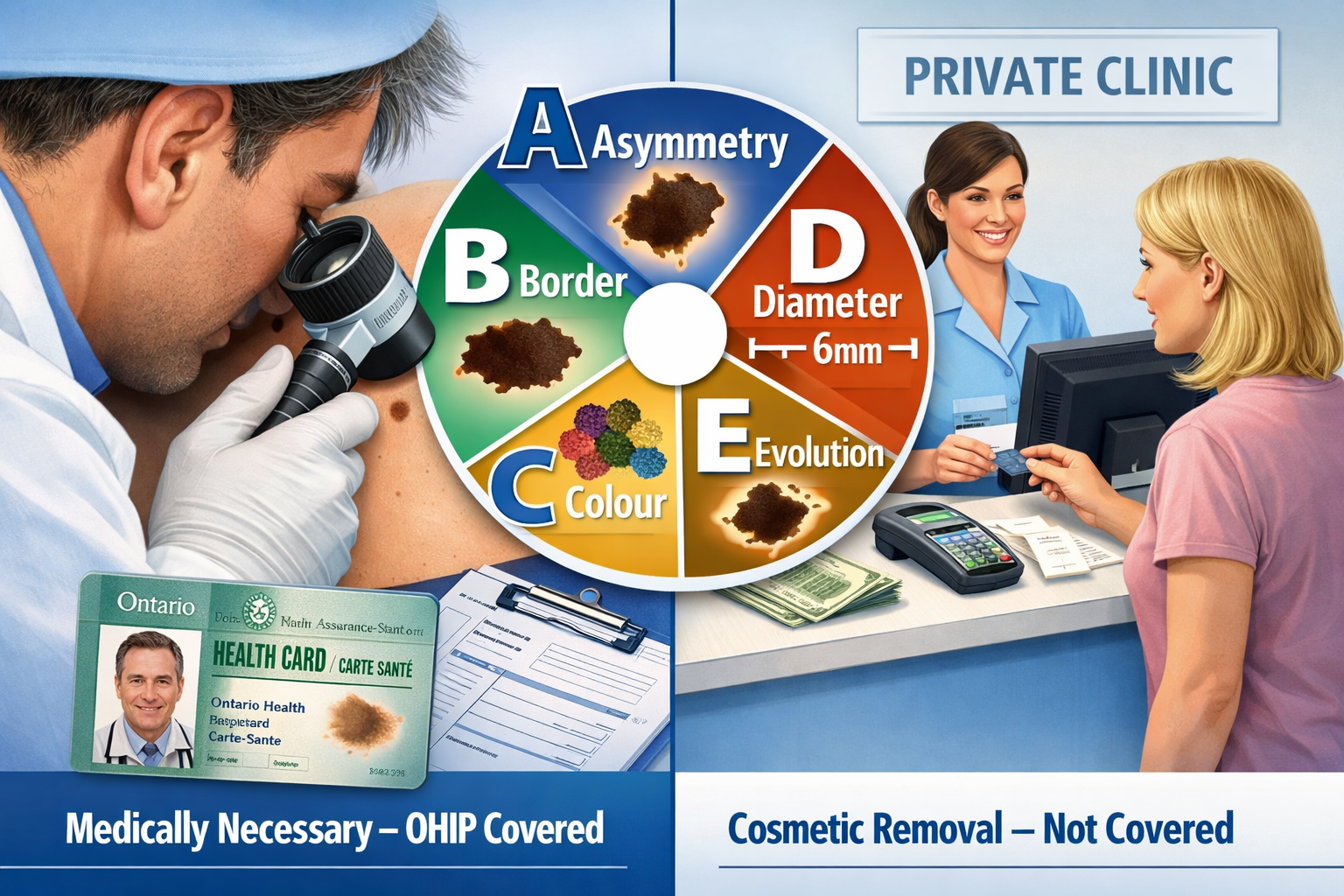
Ontario physicians use the internationally recognized ABCDE criteria to assess whether a mole is suspicious enough to warrant medical evaluation and potential OHIP-covered removal:
| Letter | What It Stands For | What to Look For |
|---|---|---|
| A | Asymmetry | One half doesn’t match the other |
| B | Border | Ragged, notched, or blurred edges |
| C | Color | Multiple shades of brown, black, red, or white |
| D | Diameter | Larger than 6mm (about the size of a pencil eraser) |
| E | Evolution | Any change in size, shape, color, or new symptoms |
⚠️ If your mole shows any of these signs, see your family doctor right away. Early detection of skin cancer dramatically improves outcomes — and your removal may be fully covered by OHIP.
Enhanced Assessment Factors in 2026
Ontario’s OHIP assessment process has become more thorough in recent years. Physicians now consider a broader range of factors when documenting medical necessity, including:
- Symptomatology and functional impact — Is the mole causing physical problems?
- Patient risk factors — Family history of skin cancer, significant sun exposure history, or immunosuppression
- ABCDE criteria evaluation — Documented clinical findings
- Detailed physician documentation — More comprehensive records are now required to support coverage decisions
The focus remains firmly on function and cancer risk, not cosmetic concerns. Borderline cases may require pre-approval, so it’s important to work closely with your physician to ensure proper documentation.
What About Getting a Referral?
To access OHIP-covered mole removal, you’ll typically need to start with your family doctor. They will assess the mole, document their findings, and refer you to a dermatologist or surgeon if removal is warranted. The referral process ensures that OHIP resources are directed toward genuinely medical cases.
For cosmetic removal at a private clinic, no referral is needed — you simply book directly and pay out of pocket.
When Is Mole Removal NOT Covered by OHIP in Ontario?
This is where many patients are surprised. If you want a mole removed simply because you don’t like how it looks, OHIP will not cover it. This applies even if the mole is large, visible, or has always bothered you.
Cosmetic Mole Removal: What OHIP Won’t Pay For
As of 2026, there has been no legislative change to expand OHIP coverage to include aesthetic mole removal. Cosmetic procedures remain explicitly excluded. Here are common scenarios where you’ll pay out of pocket:
- 🚫 Removing a mole because it’s on a visible part of your face
- 🚫 Removing a mole for personal or aesthetic preference
- 🚫 Removing a mole that is flat, uniform in color, and shows no ABCDE warning signs
- 🚫 Removing skin tags, lipomas, cysts, dermatofibromas, or xanthelasmas
- 🚫 Removing pyogenic granulomas or other non-suspicious benign lesions
💬 “Just because a mole is bothersome or visible doesn’t automatically make it medically necessary. OHIP requires documented clinical evidence of risk or functional impact.”
It’s worth noting that many benign skin conditions — including lipomas, skin cysts, and non-suspicious moles — are not covered by OHIP regardless of their size or how much they bother you. If you’re unsure whether your specific condition qualifies, a consultation with a physician is always the right first step.
How Much Does Private Mole Removal Cost in Ontario? 💰
If your mole doesn’t qualify for OHIP coverage — or if you simply prefer to have it removed quickly without waiting for a referral — private mole removal is widely available in Ontario. Here’s what you can expect to pay.
Private Mole Removal Cost Breakdown
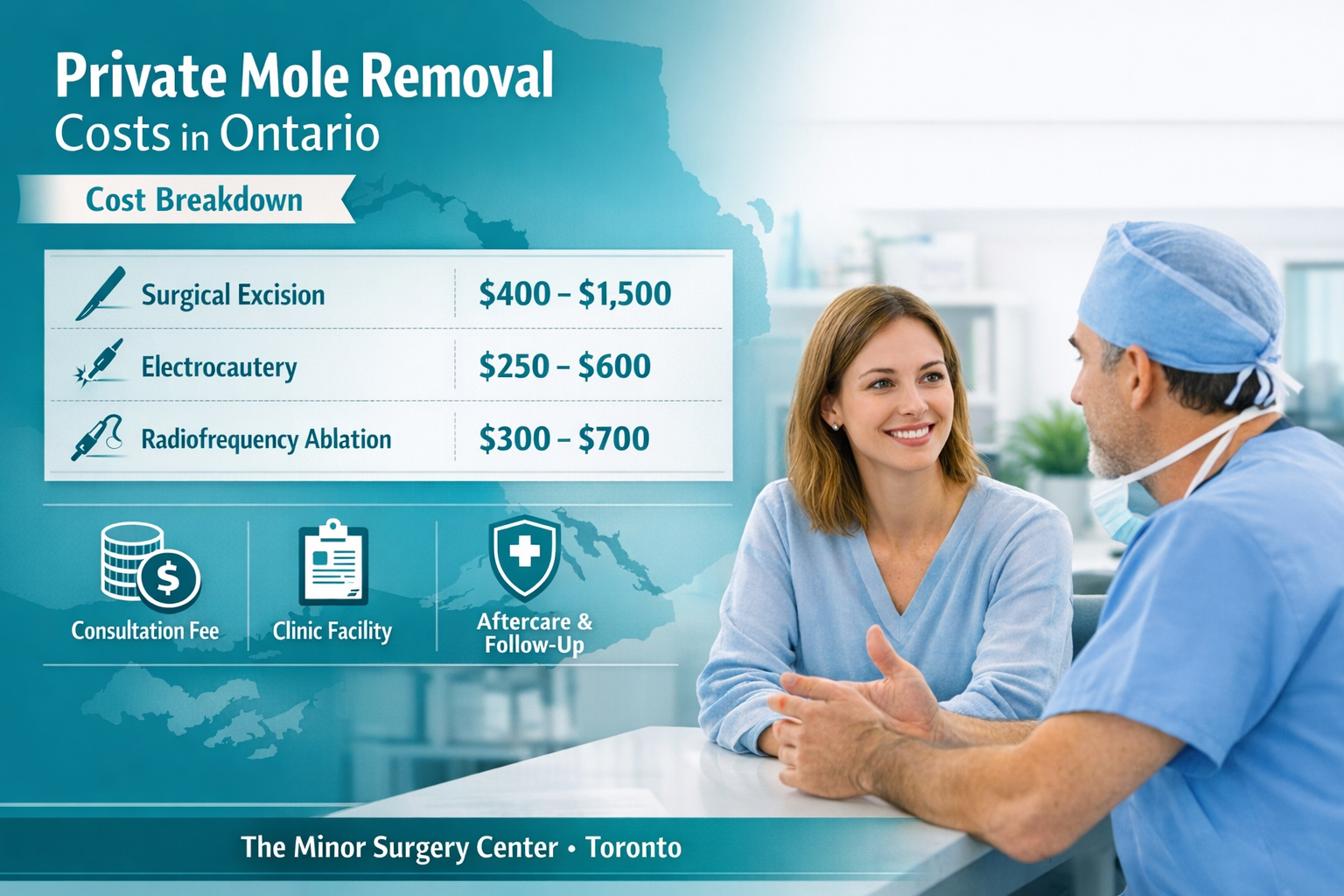
Costs for cosmetic mole removal in Ontario vary based on the size of the mole, the method used, the clinic’s location, and the physician’s experience. Here’s a general breakdown:
| Cost Component | Estimated Range |
|---|---|
| Initial consultation fee | $50 – $200 |
| Surgical excision (per mole) | $150 – $1,500 |
| Electrocautery (per mole) | $200 – $500 |
| Radiofrequency ablation (per mole) | $200 – $600 |
| Follow-up visit | $50 – $150 |
| Typical total for standard removal | $400 – $650 |
For most patients seeking removal of a single, standard-sized mole, the total out-of-pocket cost typically falls between $400 and $650, including consultation and follow-up.
Private Removal Methods Explained
🔪 Surgical Excision The mole is cut out using a scalpel and the wound is closed with sutures. This is the most thorough method and is often used for larger or deeper moles. It provides a tissue sample for pathology if needed. Cost: $150–$1,500 depending on size and complexity.
⚡ Electrocautery An electrical current is used to burn away the mole tissue. This method is effective for raised or superficial moles and typically leaves minimal scarring. Cost: $200–$500 per mole.
📡 Radiofrequency Ablation A radiofrequency device precisely removes mole tissue with minimal damage to surrounding skin. This method is popular for its low complication rates and minimal scarring. Cost: $200–$600 per mole.
Does Private Health Insurance Cover Cosmetic Mole Removal?
Some private or employer-sponsored health insurance plans in Ontario may cover a portion of mole removal costs, particularly if there is a medical component. It’s worth checking your policy or speaking with your insurer before your appointment. However, purely cosmetic removal is generally not covered by private insurance either.
Is Mole Removal Covered by OHIP in Ontario? How to Find Out If Your Mole Qualifies
If you’re unsure whether your mole might qualify for OHIP coverage, here’s a practical step-by-step approach:
Step 1: Do a Self-Check Using the ABCDE Criteria
Look at your mole carefully. Does it show asymmetry, irregular borders, multiple colors, a diameter larger than 6mm, or any recent changes? If yes, this is a reason to see a doctor promptly.
Step 2: Book an Appointment With Your Family Doctor
Your family doctor is your first point of contact for OHIP-covered care. Describe your mole, its history, and any symptoms. Your doctor will examine it and document their findings.
Step 3: Ask for a Referral if Warranted
If your family doctor believes the mole warrants further evaluation, they will refer you to a dermatologist or surgeon. This referral is key to accessing OHIP-covered removal.
Step 4: Get a Professional Assessment at a Private Clinic
If your mole doesn’t meet OHIP criteria but you still want it removed, or if you’d prefer faster access to care, a private clinic like The Minor Surgery Center offers free consultations to help you understand your options and costs upfront.
Quick Self-Assessment Checklist ✅
Use this checklist to help decide whether to seek medical evaluation:
- Has the mole changed in size, shape, or color recently?
- Does the mole bleed, itch, or cause pain?
- Is the mole larger than 6mm?
- Does the mole have uneven or ragged borders?
- Does the mole have more than one color?
- Is the mole in a location that interferes with shaving, clothing, or daily activities?
- Do you have a family history of skin cancer or melanoma?
If you checked even one box, book an appointment with your doctor. Don’t wait.
Navigating the OHIP System: Practical Tips for Ontario Patients
Getting OHIP to cover mole removal requires clear communication and proper documentation. Here are some practical tips to help you navigate the process:
🗂️ Keep a Record of Changes
If your mole has been changing, take dated photos over time. This documentation can support your physician’s assessment and strengthen the case for medical necessity.
📝 Be Specific About Symptoms
When speaking with your doctor, be specific. Don’t just say “it bothers me.” Describe exactly what you’re experiencing: “It bleeds when I shave,” “It itches constantly,” or “It has changed color over the past three months.” Specific, clinical language helps your doctor document medical necessity accurately.
🏥 Ask About Pre-Approval for Borderline Cases
For moles that fall into a gray area, your physician may need to seek pre-approval from OHIP. Ask your doctor whether this step is needed and follow up to ensure the paperwork is submitted.
⏱️ Don’t Delay if You’re Concerned
If you believe your mole is suspicious, don’t wait for a convenient time. Skin cancer — particularly melanoma — can progress quickly. Early removal and biopsy can be life-saving.
💡 Consider a Private Consultation First
Even if you’re planning to go through OHIP, a private consultation at a clinic like The Minor Surgery Center can give you a clear, expert assessment of your mole’s characteristics and help you understand whether it’s likely to qualify for coverage — before you start the referral process.
Why Choose The Minor Surgery Center for Mole Removal in Ontario?
Whether your mole removal is covered by OHIP or you’re paying privately, choosing the right clinic matters. The Minor Surgery Center is a trusted provider of minor surgical procedures with locations across the Greater Toronto Area, including Toronto, Vaughan, Oakville, and Mississauga.
Here’s why patients across Ontario choose The Minor Surgery Center:
- 🏥 Experienced surgeons with specialized expertise in skin lesion removal
- 📍 Convenient locations across the GTA — close to where you live or work
- 🆓 Free initial consultations — no surprise fees upfront
- ⚡ Fast access to care — no long waits compared to the public system
- 🔬 Pathology available — tissue samples sent for analysis when clinically appropriate
- 💬 Transparent pricing — you’ll know exactly what you’re paying before any procedure
- 🩺 Multiple removal methods — surgical excision, electrocautery, and radiofrequency ablation available
Whether you need a suspicious mole evaluated, want a cosmetic mole removed, or simply want expert advice on your options, The Minor Surgery Center is here to help.
Frequently Asked Questions About OHIP Mole Removal Coverage
Can I self-refer for OHIP-covered mole removal?
No. To access OHIP-covered mole removal, you need a referral from your family doctor or another OHIP-registered physician. Your doctor must document the medical necessity.
How long does it take to get OHIP-covered mole removal in Ontario?
Wait times vary depending on your location and the urgency of the case. Suspicious moles with cancer risk are typically prioritized. For non-urgent cases, waits can range from weeks to several months.
Will OHIP cover removal of multiple moles at once?
OHIP may cover removal of multiple moles if each one independently meets the medical necessity criteria. Each mole is assessed individually based on clinical findings.
Is a biopsy covered by OHIP?
Yes. If your physician removes a mole under OHIP coverage, the associated pathology (biopsy analysis) is also covered.
What if my mole comes back after removal?
If a mole recurs and shows suspicious characteristics, it can be re-evaluated for OHIP-covered removal. Recurrence of a previously treated lesion is a clinical concern that warrants medical attention.
Can children get OHIP-covered mole removal in Ontario?
Yes. Children with OHIP coverage are subject to the same medical necessity criteria. If a child’s mole is suspicious or symptomatic, it can be assessed and removed under OHIP.
Conclusion: Know Your Options and Take Action 🎯
So, is mole removal covered by OHIP in Ontario? The answer comes down to one essential question: is the removal medically necessary? If your mole is suspicious for cancer, causing physical symptoms, or interfering with your daily life, OHIP may cover the full cost of removal. If you simply want a mole removed for cosmetic reasons, you’ll pay out of pocket — but private removal is accessible, affordable, and available quickly.
Here’s what you should do next:
- Check your mole using the ABCDE criteria. Any warning signs? See your family doctor immediately.
- Talk to your family doctor about whether your mole qualifies for OHIP coverage. Ask for a referral if warranted.
- If you’re paying privately — or want faster access to expert care — book a free consultation at The Minor Surgery Center.
- Don’t ignore a changing mole. When it comes to skin cancer, early action saves lives.
📅 Book Your Free Consultation at The Minor Surgery Center
You don’t have to figure this out alone. Whether you’re trying to understand your OHIP mole removal coverage in Ontario, or you’re ready to move forward with private removal, The Minor Surgery Center is here to help.
Our experienced surgical team offers free consultations at our clinics in Toronto, Vaughan, Oakville, and Mississauga. We’ll assess your mole, explain your options clearly, and give you transparent pricing — with no pressure and no surprises.
👉 Book your free consultation today at theminorsurgerycenter.com — and take the first step toward clearer, healthier skin.