25 Mar
Last updated: March 25, 2026
Quick Answer: A skin tag removal dr (doctor) is the safest and most effective option for removing skin tags, especially those in sensitive areas, on the face, or that are large or irritated. A qualified physician uses proven techniques like snip excision, cryotherapy, or electrocautery to remove tags cleanly, with minimal discomfort and a very low risk of complications. Most appointments take under 30 minutes.
Key Takeaways
- Skin tags are benign (non-cancerous) soft tissue growths, but professional removal by a doctor is the safest route, especially near eyes, groin, or armpits.
- Doctors use three main removal methods: snip excision, cryotherapy (freezing), and electrocautery (heat). The right method depends on the tag’s size, location, and your skin type.
- DIY removal at home carries real risks: infection, scarring, and incomplete removal. A doctor visit eliminates most of these concerns.
- Skin tag removal is typically considered cosmetic and may not be covered by OHIP or private insurance unless the tag is causing medical symptoms.
- Most professional removals are quick, virtually painless with local anaesthetic, and require minimal downtime.
- New devices, including silicone band ligation tools, are currently in clinical trials as an alternative to freezing or burning [1].
- AI-assisted diagnostic tools are emerging in dermatology to help distinguish skin tags from other lesions, including early skin cancers [3].
- Choosing an experienced surgical team at a dedicated outpatient clinic means faster appointments, clearer communication, and better outcomes than waiting for a hospital referral.

What Is a Skin Tag, and Why Do People See a Doctor for Removal?
Skin tags (medically called acrochordons) are small, soft, flesh-coloured growths that hang off the skin by a thin stalk. They’re extremely common, completely benign, and typically appear in areas where skin rubs against skin or clothing — like the neck, armpits, eyelids, groin, and under the breasts.
Most people visit a skin tag removal dr for one of three reasons:
- Irritation or pain — The tag catches on clothing, jewellery, or a seatbelt.
- Appearance — Especially when tags appear on the face or neck.
- Uncertainty — They’re not 100% sure the growth is a skin tag and want a professional opinion.
That last point matters more than people realize. Not every small skin growth is a harmless tag. Some lesions that look like skin tags can be warts, moles, or — rarely — early-stage skin cancers. A doctor can confirm the diagnosis before removal, which is something no at-home kit can do. For a broader look at different skin lesion types, see this complete guide to 25+ types of skin lesions.
Common mistake: Assuming any small growth is a skin tag and treating it at home. When in doubt, get it checked.
When Should You See a Skin Tag Removal Dr?
See a doctor for skin tag removal if any of the following apply to you:
- The tag is on or near your eyelid, genitals, or anus (high-risk areas for DIY removal).
- The growth has changed colour, shape, or size recently.
- It bleeds, itches persistently, or feels hard to the touch.
- You have multiple tags appearing at once (this can sometimes signal an underlying metabolic condition like insulin resistance).
- You’ve tried an at-home method and it didn’t work or caused irritation.
- You simply want it done cleanly, quickly, and with confidence.
Choose a doctor if: You’re unsure what the growth is. A physician will examine it, confirm it’s benign, and remove it in the same visit if appropriate.
Edge case: Tags near the eyelid (periocular area) require extra precision. Removal in this area typically involves micro-cautery or a careful snip technique and should only be performed by an experienced clinician [2].
For patients in the Greater Toronto Area, skin tag removal in Toronto is available at The Minor Surgery Center, with locations across the region.
What Methods Does a Skin Tag Removal Dr Use?
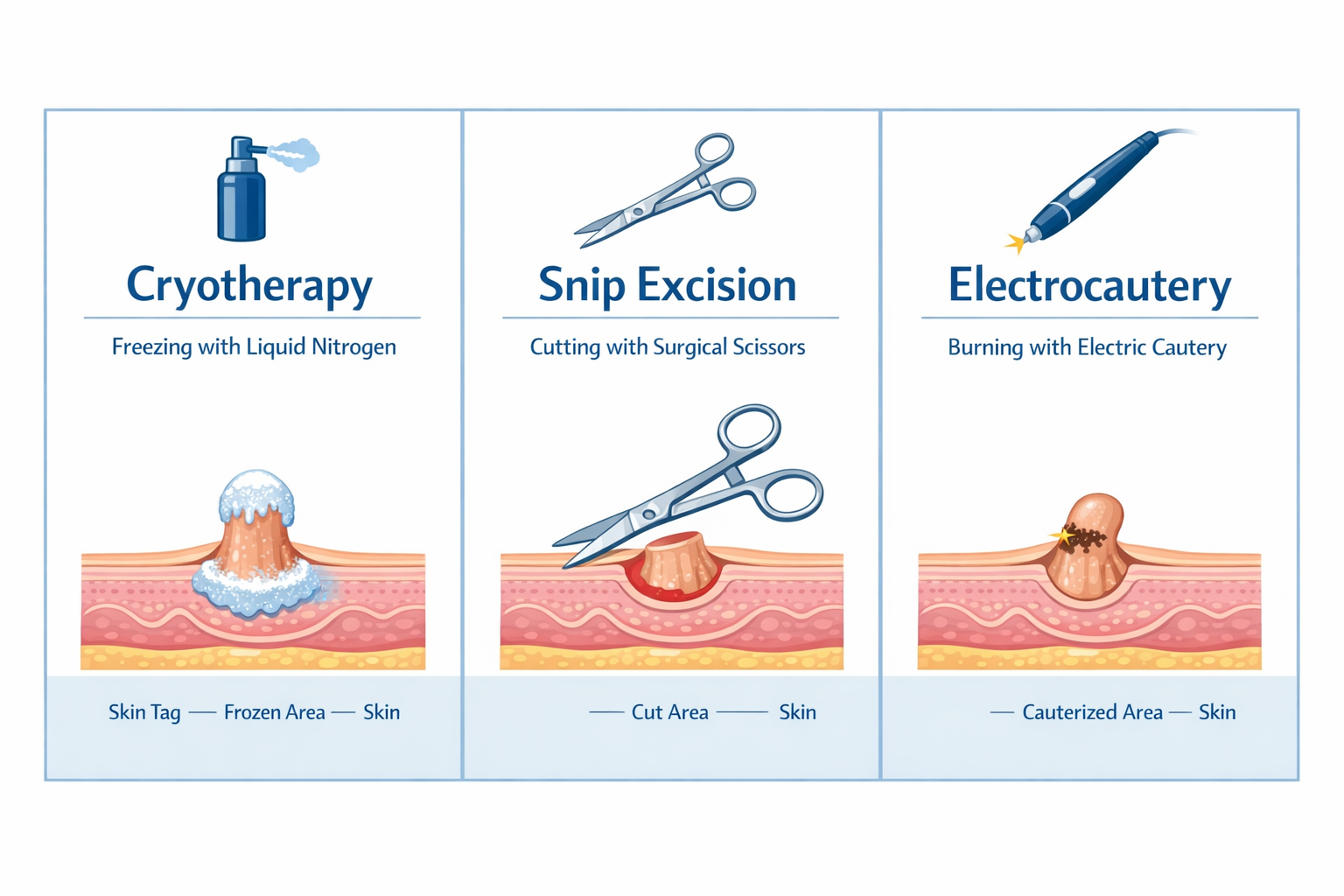
Doctors have three well-established, safe methods for removing skin tags. Each one is chosen based on the tag’s size, location, and the patient’s preferences [5].
1. Snip Excision
The most direct method. The doctor numbs the area with a small injection of local anaesthetic, then uses sterile surgical scissors or a scalpel to cut the tag off at its base. It’s fast, precise, and leaves a very small wound that heals quickly.
Best for: Tags with a well-defined stalk, larger tags, or tags in areas where precision matters.
2. Cryotherapy (Freezing)
Liquid nitrogen is applied to the tag for a few seconds, freezing the tissue. The tag dies and falls off within 1–2 weeks. Cryotherapy is efficient for small, flat tags and requires minimal equipment [5].
Best for: Small tags, patients who prefer to avoid cutting, clusters of tiny tags.
3. Electrocautery (Heat)
A small electrical current is used to burn through the stalk of the tag. This method also cauterizes the area as it removes the tag, which helps control any minor bleeding.
Best for: Tags in areas where bleeding control is important, or where very clean edges are needed.
Here’s a quick comparison:
| Method | How It Works | Healing Time | Best For |
|---|---|---|---|
| Snip Excision | Cut with scissors/scalpel | 5–10 days | Larger or stalked tags |
| Cryotherapy | Liquid nitrogen freezes tag | 1–2 weeks | Small or flat tags |
| Electrocautery | Electrical current burns tag | 5–10 days | Tags needing cauterization |
Emerging option: A new silicone band ligation device (the STR device) is currently in clinical trials. It works by restricting blood supply to the base of the tag without freezing or burning. The study aims to enroll up to 200 subjects, with a target of successfully removing 60% of treated tags. The device comes in two sizes, including a micro version for tags measuring 4–6mm at the base [1].
How to Find the Right Skin Tag Removal Dr Near You
Finding a qualified doctor for skin tag removal doesn’t need to be complicated. Here’s what to look for:
Credentials matter. Look for a physician, general surgeon, or dermatologist with specific experience in minor skin procedures. Board-certified surgeons with a track record in outpatient skin lesion removal are ideal.
Dedicated outpatient clinics are often better than walk-in options. A clinic that specializes in minor surgery will have the right tools, proper sterile technique, and experienced staff — without the long wait times of a hospital or the unpredictability of a walk-in.
Ask these questions before booking:
- What removal method do you recommend for my tag, and why?
- Will the tissue be sent for pathology if there’s any doubt?
- What does aftercare look like?
- Is there a consultation fee, or is it bundled with the procedure?
The Minor Surgery Center offers expert outpatient care across multiple GTA locations. Whether you’re in Mississauga, Scarborough, Brampton, Ajax, or Newmarket, there’s a clinic nearby with an experienced surgical team ready to help.
What Does Skin Tag Removal by a Doctor Actually Cost?
Cost is one of the most common questions patients ask before booking. Here’s what you need to know.
In Canada (Ontario specifically): Skin tag removal is almost always considered a cosmetic procedure and is not covered by OHIP. Some private insurance plans may cover removal if the tag is causing documented medical symptoms (like repeated bleeding or interference with daily function) — but this varies by plan.
Pricing factors include:
- Number of tags being removed
- Size and location of the tags (periocular/eyelid tags cost more due to the precision required)
- The method used (snip excision, cryotherapy, electrocautery)
- Whether a consultation fee applies separately
For reference, UK pricing data from 2026 shows single tag removal typically runs £80–£150, with tags near the eyelid ranging from £160–£270 due to the precision involved [2]. Canadian pricing follows a similar structure, though exact fees vary by clinic.
Practical tip: Many clinics (including The Minor Surgery Center) remove multiple tags in a single visit, which is more cost-effective than separate appointments. Use a minor surgery cost estimator to get a ballpark figure before booking.
Common mistake: Choosing the cheapest option without checking credentials. Skin tag removal near the eye or in sensitive areas requires a skilled hand. Saving $50 isn’t worth a scar or an infection.
Is DIY Skin Tag Removal Safe, or Should You Always See a Doctor?
The honest answer: it depends on the situation, but a doctor is almost always the better choice.
When DIY carries real risk:
- Removing tags near the eyes, genitals, or face without proper technique can cause scarring, infection, or incomplete removal.
- At-home freezing kits are far less controlled than clinical cryotherapy. Applying too much or too little can damage surrounding healthy skin.
- Tying off a tag with thread (ligation) at home can cause pain, infection, and necrosis if done incorrectly.
- You can’t diagnose what you’re removing. If it’s not actually a skin tag, you could delay treatment for something that needs proper attention.
For a detailed breakdown of the risks, see this article on DIY skin tag removal.
When at-home options might be acceptable: Very small, clearly identified tags on low-risk areas of the body (like the trunk) in adults who have previously had a doctor confirm similar growths are benign. Even then, proceed carefully and stop if there’s any pain, bleeding, or skin reaction.
“A skin tag that looks simple can sit right next to a nerve, a vessel, or a lesion that needs a second look. A five-minute appointment with a doctor is worth far more than a week of uncertainty after a DIY attempt.”
The safest, cleanest path is always professional removal. It’s quick, it’s effective, and it lets you get back to your life without second-guessing the outcome.
What Happens During a Skin Tag Removal Appointment?
Knowing what to expect makes the whole experience much easier. Here’s a typical appointment at a dedicated outpatient clinic:
Step 1: Consultation and assessment
The doctor examines the growth, confirms it’s a skin tag (not a mole, wart, or other lesion), and discusses removal options with you. This is also when you ask your questions.
Step 2: Informed consent
You’ll review and sign a consent form outlining the procedure, expected outcomes, and potential risks (which are minimal for routine tag removal).
Step 3: Local anaesthetic
A small injection numbs the area. Most patients say this is the only part they feel, and it passes in seconds.
Step 4: Removal
Depending on the method chosen, the tag is removed in under a minute. The area is cleaned and dressed.
Step 5: Aftercare instructions
You’ll receive clear guidance on wound care, what to watch for (signs of infection), and when to follow up if needed.
Total time: Most appointments are 15–30 minutes from start to finish. There’s no hospital admission, no general anaesthetic, and no extended recovery. A comfort-first approach means most patients leave feeling relieved they didn’t put it off longer.
What’s New in Skin Tag Removal in 2026?
The field of minor dermatological procedures is moving quickly. A few developments worth knowing about:
AI-assisted diagnostics: Dermatology clinics are increasingly using AI screening tools to help distinguish benign lesions (like skin tags) from early-stage skin cancers before removal. This adds a valuable safety layer, especially for patients with multiple or atypical growths [3].
New device trials: The silicone band ligation STR device mentioned earlier is being studied as a non-thermal, non-cryogenic option for tag removal. If approved, it could offer an additional minimally invasive solution for patients who prefer to avoid cutting or freezing [1].
Combination protocols: Leading dermatology centres are moving toward integrated treatment approaches that address multiple skin concerns in a single visit, rather than treating each issue separately [3].
FDA-cleared at-home devices: Devices like the Claritag Advanced Skin Tag Remover have received FDA clearance, combining a dual-action grip and freeze system. These are designed for consumer use, though they still carry the same limitations as other at-home methods — no diagnostic capability and reduced precision compared to clinical tools.
For patients concerned about whether a growth might be more than a skin tag, the skin cancer conditions page at The Minor Surgery Center provides useful context on what to watch for.
FAQ: Skin Tag Removal by a Doctor

Q: Can a family doctor remove skin tags?
A: Some family doctors do remove skin tags, but many refer patients to a dermatologist or a minor surgery clinic for this. A dedicated outpatient surgical clinic typically has better equipment and more experience with skin lesion removal.
Q: Does skin tag removal by a doctor hurt?
A: With local anaesthetic, the removal itself is painless. You may feel a brief sting from the numbing injection, but most patients describe the procedure as much easier than they expected.
Q: How long does it take for the skin to heal after professional removal?
A: Most sites heal within 5–14 days, depending on the method used. Snip excision and electrocautery typically heal in about a week. Cryotherapy sites may take up to two weeks as the frozen tissue naturally falls away.
Q: Will there be a scar?
A: Professional removal by an experienced doctor minimizes scarring significantly. Small tags on most body areas heal with little to no visible mark. Larger tags or those in certain locations may leave a faint mark that fades over time.
Q: Can skin tags grow back after removal?
A: The removed tag itself won’t grow back. However, new tags can develop in the same area over time, especially if the underlying cause (friction, skin folds, metabolic factors) hasn’t changed.
Q: Is it safe to remove multiple skin tags in one visit?
A: Yes. Removing several tags in a single appointment is common, efficient, and often more cost-effective. The doctor will assess how many can be safely treated in one session based on their size and location.
Q: What should I do if a skin tag bleeds or changes colour?
A: See a doctor promptly. Bleeding, rapid growth, or colour changes can indicate the growth is not a simple skin tag and may need further evaluation.
Q: How do I know if my skin tag removal is covered by insurance?
A: In Ontario, OHIP does not cover cosmetic skin tag removal. If the tag is causing documented medical symptoms, some private plans may contribute. Contact your insurer before your appointment to confirm your coverage.
Q: Are there skin tag removal doctors near me in the GTA?
A: Yes. The Minor Surgery Center has clinics across the Greater Toronto Area, including locations in Oakville, North York, Markham, and more.
Q: What’s the difference between a skin tag and a mole?
A: Skin tags hang off the skin on a thin stalk and are soft to the touch. Moles are flat or slightly raised, firmly attached, and can vary in colour. A doctor can confirm which is which during a quick examination.
Q: Can skin tags be a sign of something more serious?
A: In most cases, no. But multiple skin tags appearing suddenly can sometimes be associated with insulin resistance or hormonal changes. If you’re noticing many new tags, it’s worth mentioning to your doctor.
Q: How do I prepare for a skin tag removal appointment?
A: No special preparation is needed for most removals. Wear comfortable clothing that allows easy access to the area. Avoid applying creams or lotions to the site on the day of your appointment.
Conclusion
Seeing a skin tag removal dr is the clearest, safest path to getting rid of a growth that’s bothering you — whether it’s catching on your collar, affecting your confidence, or simply something you want confirmed and dealt with.
Professional removal is fast, virtually painless with local anaesthetic, and carries far fewer risks than at-home alternatives. A qualified doctor also gives you something no kit can: a proper diagnosis before anything is removed.
Your next steps:
- Book a consultation at a dedicated minor surgery clinic near you. Don’t wait for a hospital referral if you don’t need one.
- Bring a list of questions — how many tags, which method, what aftercare looks like.
- Check your insurance ahead of time so there are no billing surprises.
- Don’t self-treat if the tag is near your eye, has changed appearance, or you’re not certain what it is.
The Minor Surgery Center’s experienced surgical team provides personalised treatment plans across the GTA, with a comfort-first approach and clear communication from start to finish. Whether you have one tag or several, you can get it handled efficiently and get back to your life.
Explore skin tag removal options at The Minor Surgery Center or find the clinic closest to you.
References
[1] NCT06463613 – ClinicalTrials.gov – https://clinicaltrials.gov/study/NCT06463613
[2] Price of Skin Tag Removal in 2026: Cost Guide – In-Derm Skin Clinic – https://www.in-dermskinclinic.com/blogs/price-of-skin-tag-removal-in-2026-cost-guide/
[3] Top Advances in Dermatology 2026 – London Dermatology Centre – https://www.london-dermatology-centre.co.uk/blog/top-advances-dermatology-2026/
[5] Skin Tags Explained in 2026: Causes, Safe Removal Options and At-Home Solutions That Actually Work – Ocuralife – https://ocuralife.com/blogs/news/skin-tags-explained-in-2026-causes-safe-removal-options-and-at-home-solutions-that-actually-work
Tags: skin tag removal, skin tag removal dr, skin tag doctor, professional skin tag removal, cryotherapy skin tags, snip excision, outpatient minor surgery, skin tag removal Toronto, skin lesion removal, dermatology 2026, minor surgery GTA, skin tag treatment options