25 Mar
Last updated: March 25, 2026
Quick Answer: A skin tag removal kit is an over-the-counter product designed to remove small, benign skin growths at home, typically using cryotherapy (freezing), ligation (cutting off blood supply), or topical solutions. These kits can work for small, clearly identified skin tags in low-risk areas, but they carry real limitations — including infection risk, incomplete removal, and the danger of treating a lesion that isn’t actually a skin tag.
Key Takeaways
- Skin tag removal kits use three main methods: freezing (cryotherapy), ligation (band/thread), and topical solutions.
- FDA-cleared cryotherapy kits (such as Dr. Scholl’s Freeze Away and Claritag) are among the most studied OTC options available in 2026. [2][4]
- Most OTC kits are designed for small skin tags (under 5mm) in accessible, low-friction areas like the neck, underarms, or torso.
- Skin tags on the eyelids, genitals, or face should never be treated with an at-home kit.
- Incorrect use can cause scarring, infection, or incomplete removal — leaving a regrowth-prone stump.
- If a growth bleeds, changes colour, grows quickly, or you’re unsure what it is, see a medical professional before trying any removal method.
- Professional removal by an experienced surgical team is faster, more precise, and typically leaves less scarring than DIY methods.
- The Minor Surgery Center offers skin tag removal in Toronto and at multiple GTA locations with same-visit results.
What Is a Skin Tag Removal Kit?
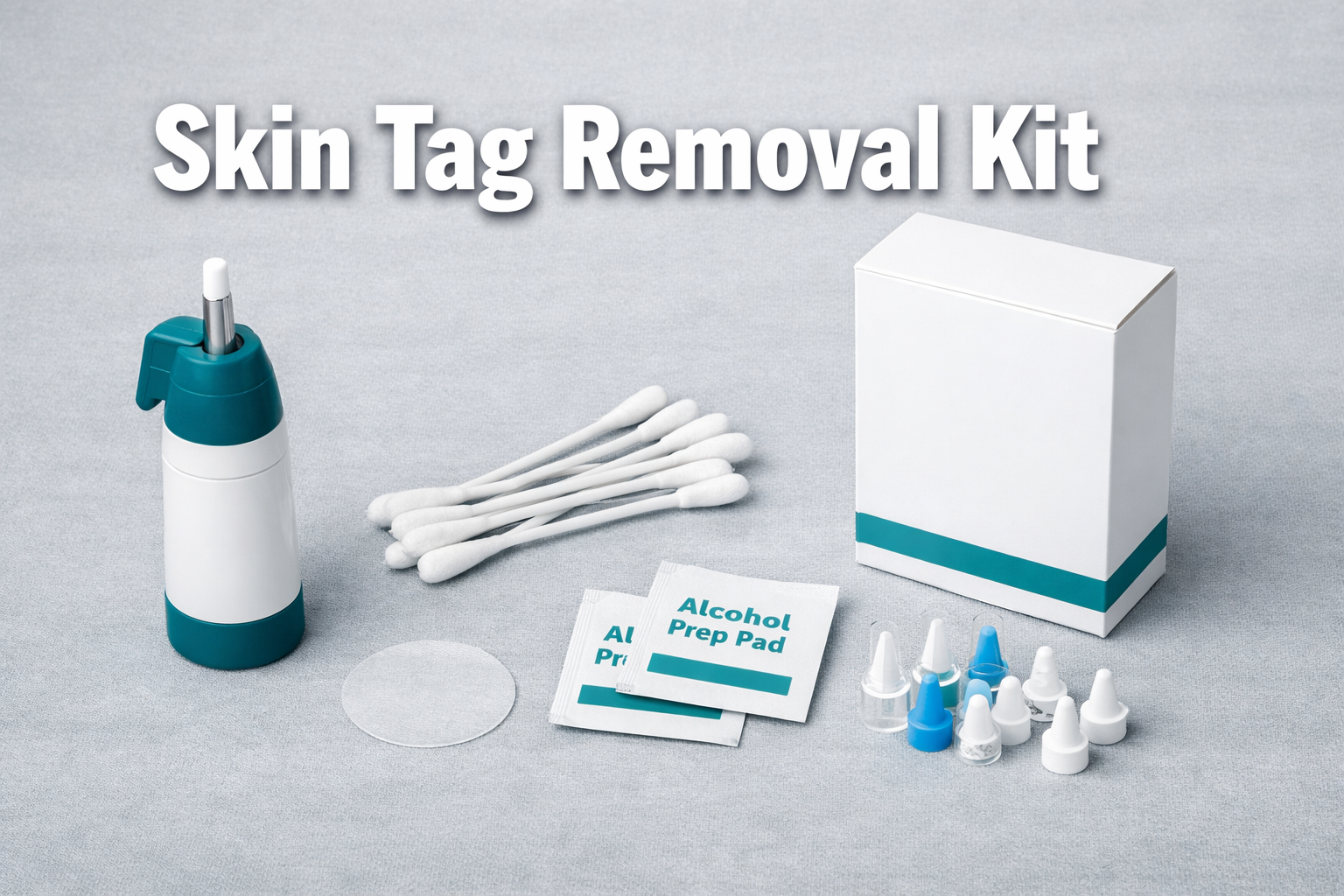
A skin tag removal kit is a consumer product that lets you treat small, benign skin tags at home without a clinical appointment. Most kits target the same goal: destroy or cut off the skin tag so it falls off within days to two weeks.
Skin tags (medically called acrochordons) are soft, flesh-coloured growths that hang off the skin by a thin stalk. They’re harmless, but they can catch on clothing, jewellery, or razors — which is why so many people want them gone.
To understand why skin tags form in the first place, see this helpful overview: why do skin tags form.
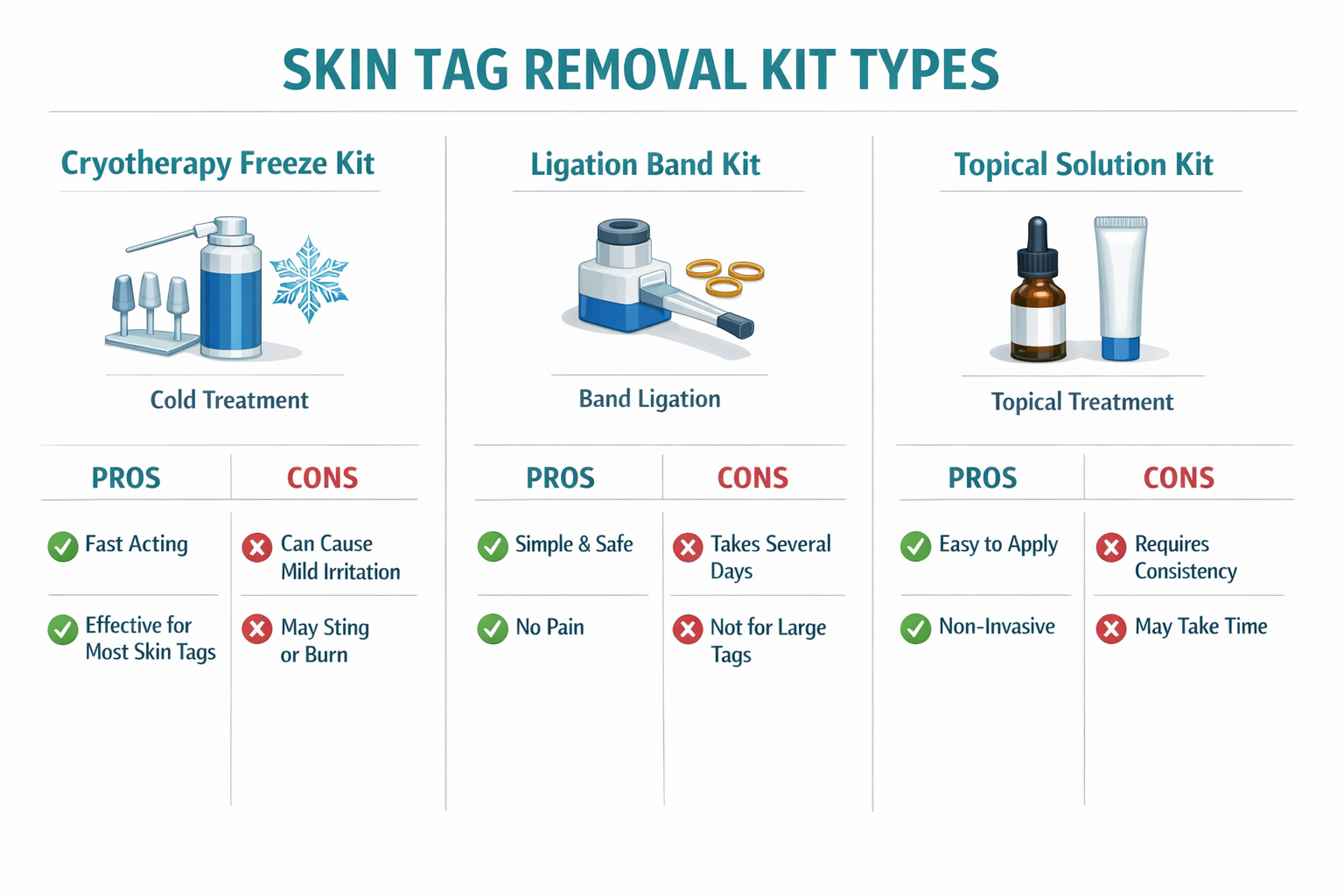
The three main kit types:
| Kit Type | How It Works | Typical Result Time |
|---|---|---|
| Cryotherapy (freeze) | Liquid nitrogen or dimethyl ether propane freezes the tag, destroying tissue | 7–14 days |
| Ligation (band/thread) | A tiny band cuts off blood supply to the stalk | 7–10 days |
| Topical solution | Acidic or herbal compounds applied repeatedly to break down tissue | 2–4 weeks (variable) |
Each method has a different risk profile, success rate, and appropriate use case. Choosing the right one matters more than most people realise.
What Types of Skin Tag Removal Kits Are Available in 2026?
Three broad categories of at-home skin tag removal kits are currently on the market, ranging from FDA-cleared devices to less-regulated topical products.
Cryotherapy Kits
These are the most widely used and best-studied category. They work by applying extreme cold directly to the skin tag, causing the cells to die and the tag to fall off.
Examples include:
- Dr. Scholl’s Freeze Away — FDA-cleared, uses the same freezing principle as professional dermatology. Most tags fall off within two weeks. [4]
- Claritag Advanced — FDA-cleared, uses patented “Squeeze & Freeze” technology. Priced around $24.99 (USD), each kit treats up to 8–12 lesions, and the process takes under 60 seconds per tag. [2]
- Alcane Precision Freeze and Skin Clinic Freeze and Clear — also FDA-cleared freeze-based options. [3]
These kits are the closest OTC equivalent to in-office cryotherapy, though the temperatures achieved at home are typically less extreme than clinical-grade liquid nitrogen.
Ligation Kits
Ligation kits use a micro-band (usually silicone or rubber) placed tightly around the base of the skin tag stalk. This cuts off blood supply, causing the tag to shrink and fall off.
A novel mechanical ligation device is currently in a pivotal clinical trial enrolling up to 200 subjects, comparing manual and automatic versions, with a target success rate of 60% removal. [1] This research suggests ligation remains a legitimate and potentially less invasive option than freezing or burning — but it’s still being refined.
Common mistake: Ligation bands placed incorrectly (too loose, too high on the stalk, or on the wrong type of growth) often fail or cause pain without achieving removal.
Topical Solutions
These products apply an acidic or botanical compound to the skin tag repeatedly over days or weeks. Evidence supporting their effectiveness is limited, and they carry the highest risk of skin irritation or chemical burns if misapplied.
Choose topical kits only if: The skin tag is very small, in a non-sensitive area, and you’re comfortable with a slow, multi-week process that may not fully work.
How Do You Use a Skin Tag Removal Kit Safely?
Safe use depends on correctly identifying the growth, preparing the skin, and following the kit’s instructions precisely. Skipping any step increases the risk of scarring or infection.
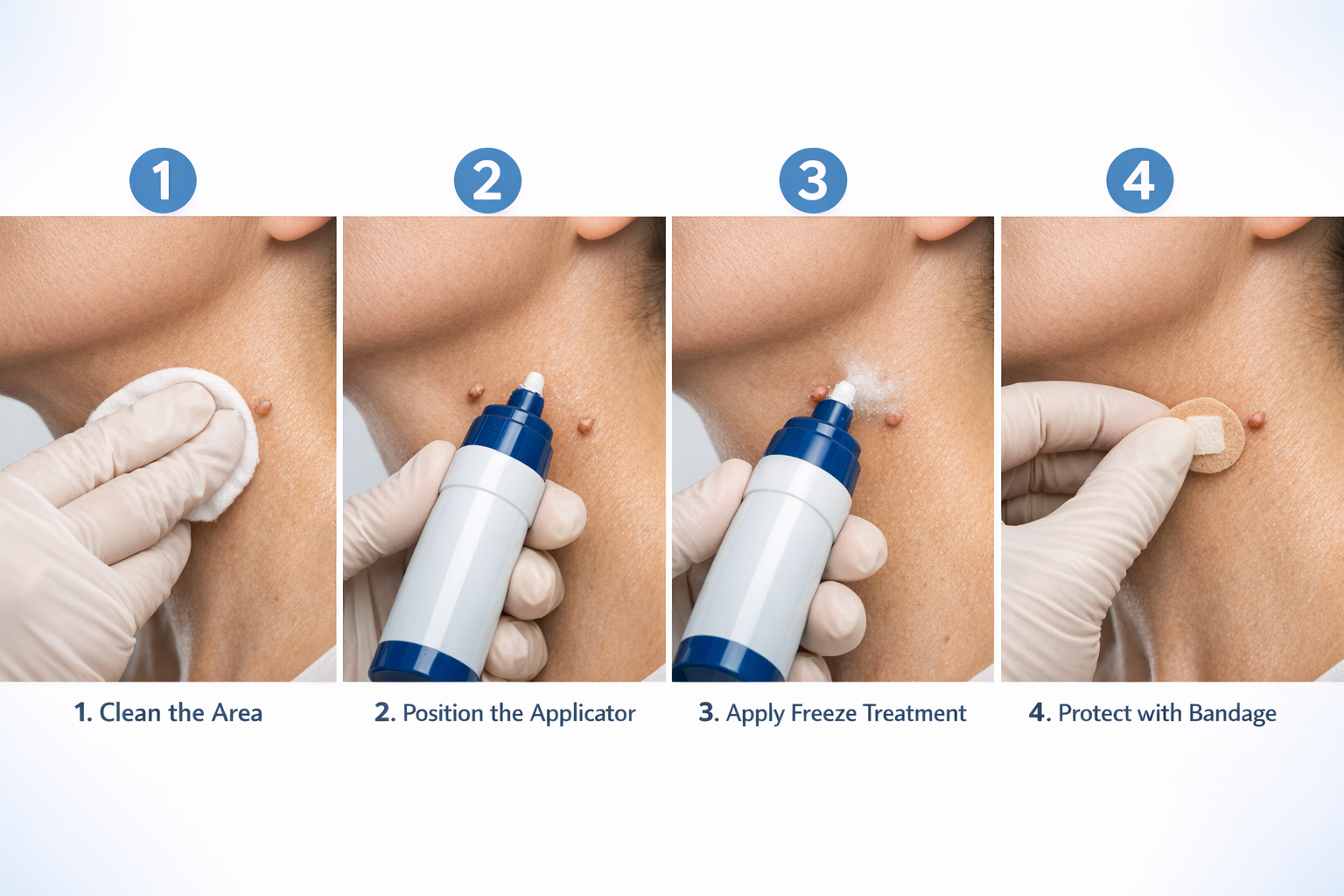
Step-by-Step: Using a Cryotherapy Kit
- Confirm it’s a skin tag. The growth should be soft, flesh-coloured, attached by a thin stalk, and non-painful. If it’s hard, dark, bleeding, or growing fast — stop and see a doctor.
- Clean the area. Wash with mild soap and water. Pat dry completely.
- Protect surrounding skin. Apply petroleum jelly around (not on) the tag to shield healthy tissue from the cold.
- Apply the applicator. Hold the device against the tag for the time specified (usually 20–40 seconds). Do not press harder than instructed.
- Wait and monitor. The tag should blister, darken, and fall off within 7–14 days. Do not pull or cut it.
- Keep the area clean. Apply a gentle antiseptic and cover loosely if needed.
- Repeat only if directed. Some tags need a second treatment after 2 weeks. More than two applications without results means the kit isn’t working for this particular tag.
When to stop and seek care: Increasing redness, swelling, oozing, or fever after treatment are signs of infection. See a healthcare provider promptly.
For a broader look at all available removal options, the comparison of skin tag removal methods covers clinical and at-home approaches side by side.
Which Skin Tags Should Never Be Treated With an At-Home Kit?
Some skin tags are simply not appropriate for DIY removal, regardless of which kit you choose. This is one of the most important distinctions to understand.
Avoid at-home kits for skin tags that are:
- On or near the eyelids — The risk of chemical or cold injury to the eye is serious.
- On the genitals or perianal area — Sensitive tissue, higher infection risk.
- On the face (especially near the nose or lips) — Scarring is more visible and harder to treat.
- Larger than 5mm — OTC kits are not designed for bigger lesions and often fail, leaving a partial stump.
- Bleeding, changing colour, or growing rapidly — These features may indicate something other than a benign skin tag. A growth that bleeds easily or has irregular edges should be evaluated by a medical professional. See our guide on skin lesion types to understand the differences.
- On skin with poor circulation (such as in patients with diabetes) — Healing is slower and infection risk is higher.
- In children — Paediatric skin is more sensitive, and children are less likely to stay still during application.
“If you’re not 100% sure what you’re looking at, don’t treat it at home. A skin tag and an early skin cancer can look similar to an untrained eye.”
This is not an exaggeration. Some early skin cancer lesions can resemble benign tags or moles. Getting a professional opinion before removal is always the safer choice.
What Are the Risks of Using a Skin Tag Removal Kit?
At-home skin tag removal kits are generally low-risk when used correctly on appropriate lesions. But “generally low-risk” still leaves room for real problems.
The most common risks include:
- Incomplete removal — The tag falls off partially, leaving a stump that can regrow or become irritated.
- Scarring — Cryotherapy applied too long or topical acids misapplied can damage surrounding skin.
- Infection — Any open wound, including a post-treatment blister, can become infected.
- Skin discolouration — Freezing can cause temporary or permanent hypopigmentation (lightening) or hyperpigmentation (darkening), particularly on darker skin tones.
- Treating the wrong lesion — Applying a kit to a mole, wart, or early skin lesion that isn’t a skin tag can delay proper diagnosis.
Edge case to know: Some people develop a keloid scar response after skin trauma, including minor procedures. If you’ve had keloid scarring before, at-home removal carries a higher risk of a raised, uncomfortable scar.
How Does a Skin Tag Removal Kit Compare to Professional Removal?
For small, straightforward skin tags in accessible locations, an OTC kit can work. For everything else — or when you want a guaranteed, clean result — professional removal is the better option.
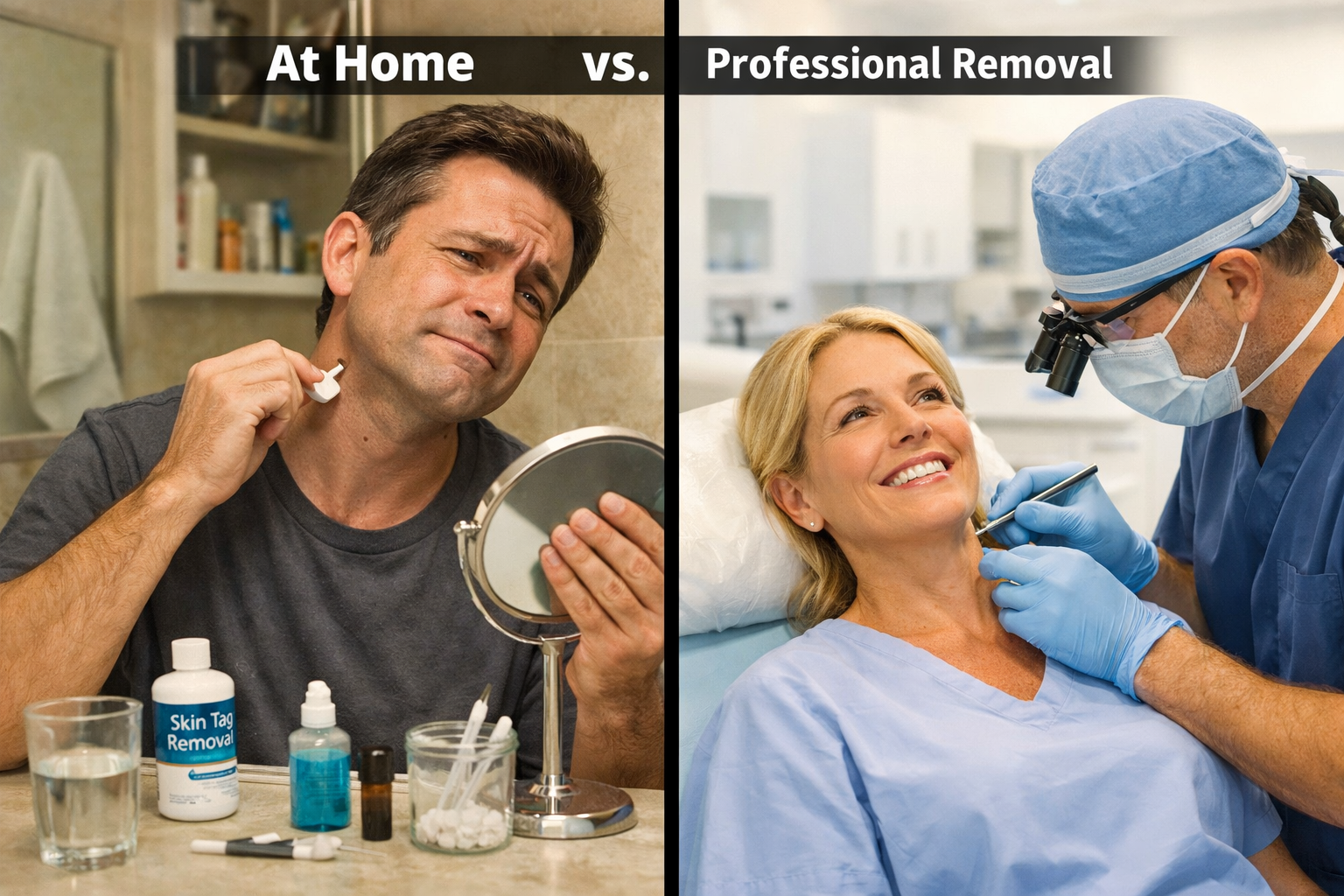
Side-by-Side Comparison
| Factor | OTC Skin Tag Removal Kit | Professional Removal |
|---|---|---|
| Cost | $15–$40 per kit | Varies; see pricing guide |
| Speed | 7–14 days for tag to fall off | Same-visit removal in minutes |
| Precision | Moderate (user-dependent) | High (trained clinician) |
| Pain | Mild to moderate | Minimal (local anaesthetic used) |
| Scarring risk | Moderate if misapplied | Low with experienced surgeon |
| Suitable for all locations? | No | Yes |
| Diagnosis included? | No | Yes |
| Multiple tags at once? | Limited (8–12 per kit) | Yes, multiple lesions per visit |
Professional removal at a clinic like The Minor Surgery Center uses a minimally invasive approach with local anaesthetic. The experienced surgical team removes the tag cleanly at the base, which significantly reduces the chance of regrowth.
If you’re in the GTA, same-day or next-available appointments are offered at locations including Mississauga, Scarborough, Brampton, Oakville, and Newmarket.
What Should You Look for When Buying a Skin Tag Removal Kit?
Not all kits are equal. Some are FDA-cleared medical devices; others are cosmetic products with minimal clinical backing. Knowing the difference protects both your skin and your money.
Key things to check before buying:
- ✅ FDA clearance — Look for “FDA-cleared” on the packaging. This means the device has been reviewed for safety and effectiveness. Claritag, Dr. Scholl’s Freeze Away, and Alcane Precision Freeze all carry this designation. [2][4][3]
- ✅ Clear instructions — The kit should specify exactly how long to apply, how many treatments are safe, and what side effects to watch for.
- ✅ Applicator count — Most cryotherapy kits include 8–12 applicators per box. [3] If you have multiple tags, check whether one kit will cover them.
- ✅ Skin type guidance — Some kits claim suitability for all skin types and tones. [2] Verify this claim and check for specific cautions about darker skin tones and pigmentation risk.
- ❌ Avoid kits with vague “natural” or “herbal” claims — without clinical evidence, these products are unlikely to work and may irritate skin.
- ❌ Avoid any kit that claims to treat skin tags on the eyelids — this is not safe for at-home use.
Frequently Asked Questions
Q: Do skin tag removal kits actually work?
FDA-cleared cryotherapy kits (like Dr. Scholl’s Freeze Away and Claritag) can successfully remove small skin tags in 7–14 days when used correctly. [2][4] Results vary depending on tag size, location, and how precisely the kit is applied. Larger or awkwardly placed tags often don’t respond well to OTC kits.
Q: How long does it take for a skin tag to fall off after using a removal kit?
Most cryotherapy-based kits produce results within 7–14 days. [4] Ligation kits typically work in 7–10 days. Topical solutions can take 2–4 weeks, with less predictable outcomes.
Q: Can I use a skin tag removal kit on my face?
Generally, no. Facial skin is more sensitive, and the risk of scarring or pigmentation changes is higher. Skin tags near the eyes should never be treated at home. A professional removal is the safer choice for any facial skin tag.
Q: Is it safe to use a skin tag removal kit on dark skin?
Cryotherapy carries a risk of hypopigmentation (lightening) on darker skin tones. Some kits claim suitability for all skin types [2], but if you have medium to dark skin, consult a clinician before using a freeze-based kit to discuss your specific risk.
Q: What happens if the skin tag doesn’t fall off after using the kit?
If the tag hasn’t responded after two applications (following the kit’s instructions), the kit is unlikely to work for that particular lesion. See a medical professional rather than continuing to apply treatments — repeated applications increase the risk of skin damage.
Q: Can skin tags grow back after removal?
A skin tag removed cleanly at the base (stalk) typically does not regrow. However, new skin tags can form in the same area over time, especially if friction or other contributing factors are still present. Incomplete removal — common with OTC kits — can leave a stump that regrows.
Q: Are skin tag removal kits safe for children?
Most OTC kits are not recommended for children. Paediatric skin is more sensitive, and children may not stay still during application, increasing the risk of burns or misapplication. Consult a paediatrician or dermatologist for children’s skin tags.
Q: How do I know if a growth is a skin tag and not something else?
A skin tag is typically soft, flesh-coloured, attached by a thin stalk, and non-painful. If the growth is hard, dark, has irregular edges, bleeds easily, or is growing quickly — do not treat it at home. These features warrant a professional evaluation to rule out other conditions, including skin cancer.
Q: Can I use a skin tag removal kit if I have diabetes?
People with diabetes should avoid DIY skin tag removal. Reduced circulation and slower wound healing increase the risk of infection from any open skin wound. Seek professional removal with a clinician who is aware of your medical history.
Q: Is professional skin tag removal covered by insurance in Canada?
Skin tag removal is typically considered cosmetic and is not covered by provincial health plans in Ontario. The Minor Surgery Center offers transparent pricing — use the cost estimator tool to get a clear picture before booking.
Conclusion: Know When the Kit Is Enough — and When It Isn’t
A skin tag removal kit can be a reasonable first option for small, clearly identified skin tags in low-risk locations. FDA-cleared cryotherapy products from brands like Dr. Scholl’s and Claritag offer a legitimate at-home solution when used carefully and correctly. [2][4]
But the kit has real limits. It can’t diagnose what it’s treating. It can’t reach awkward spots safely. It can’t guarantee a clean removal without scarring. And it absolutely cannot tell you whether that growth is a benign skin tag or something that needs medical attention.
The practical rule: If you’re confident it’s a small skin tag in an easy-to-reach spot, an OTC kit is a reasonable starting point. If there’s any doubt — about the diagnosis, the location, or the size — skip the kit and book a professional consultation instead.
The Minor Surgery Center’s experienced surgical team offers expert outpatient care for skin tag removal across the GTA, with a comfort-first approach and same-visit results. Whether you’re in Toronto, Mississauga, Brampton, or Oakville, a personalised treatment plan and clean, precise removal is just one appointment away.
Ready to get back to your life without the discomfort? Book a consultation or use the cost estimator to understand your options today.
References
[1] Nct06463613 – https://clinicaltrials.gov/study/NCT06463613
[2] Claritag – https://www.claritag.com
[3] Watch – https://www.youtube.com/watch?v=VhFf04EhlZM
[4] Skin Tag Remover Freeze Away – https://www.drscholls.com/products/skin-tag-remover-freeze-away
Tags: skin tag removal kit, skin tag removal, cryotherapy skin tag, at-home skin tag removal, OTC skin tag treatment, ligation skin tag removal, skin tag removal Toronto, minor surgery, skin lesion removal, FDA-cleared skin tag kit, skin tag vs mole, outpatient skin tag removal