25 Mar
Last updated: March 25, 2026
Quick Answer: Skin tag removal is a straightforward procedure that can be performed using several methods, including surgical excision, cryotherapy, cauterization, or ligation. Most skin tags are harmless, but professional removal by a trained surgeon is the safest, most reliable option, especially for tags in sensitive areas or those causing discomfort. At-home treatments carry real risks and are rarely as effective as clinical care.
Key Takeaways
- Skin tags (medically called acrochordons) are benign, soft growths that hang from the skin by a thin stalk.
- They’re extremely common and typically appear in areas where skin rubs together: the neck, armpits, groin, and eyelids.
- Professional removal methods include excision, cryotherapy, cauterization, and ligation — each suited to different tag sizes and locations.
- At-home removal carries risks including infection, scarring, and incomplete removal; healthcare experts recommend professional care. [6]
- The global skin tag remover market is growing rapidly, driven partly by demand for at-home solutions, but clinical results remain superior. [2]
- Skin tags are not cancerous, but any growth that changes in size, color, or shape should be evaluated by a medical professional.
- Most professional skin tag removal procedures take under 30 minutes and require little to no downtime.
- Cost varies by method, number of tags, and clinic — but many patients find professional care more cost-effective long-term than repeated at-home attempts.
What Is a Skin Tag, Exactly?
A skin tag is a small, soft, benign growth that hangs off the skin by a narrow stalk (called a peduncle). They’re not dangerous, not contagious, and not a sign of anything serious — but they can be annoying, uncomfortable, or simply something you’d rather not have.
Medically, they’re called acrochordons. They’re made of collagen fibers and blood vessels surrounded by skin, and they tend to develop in areas where skin rubs against skin or clothing. Common locations include:
- The neck
- Armpits
- Under the breasts
- The groin and inner thighs
- Eyelids
- Around the back
They’re more common in adults over 40, people who are overweight, pregnant women, and those with type 2 diabetes — though anyone can develop them. For a broader look at different skin lesion types, the complete guide to skin lesions covers acrochordons alongside other common growths.
What Are the Most Effective Skin Tag Removal Methods?
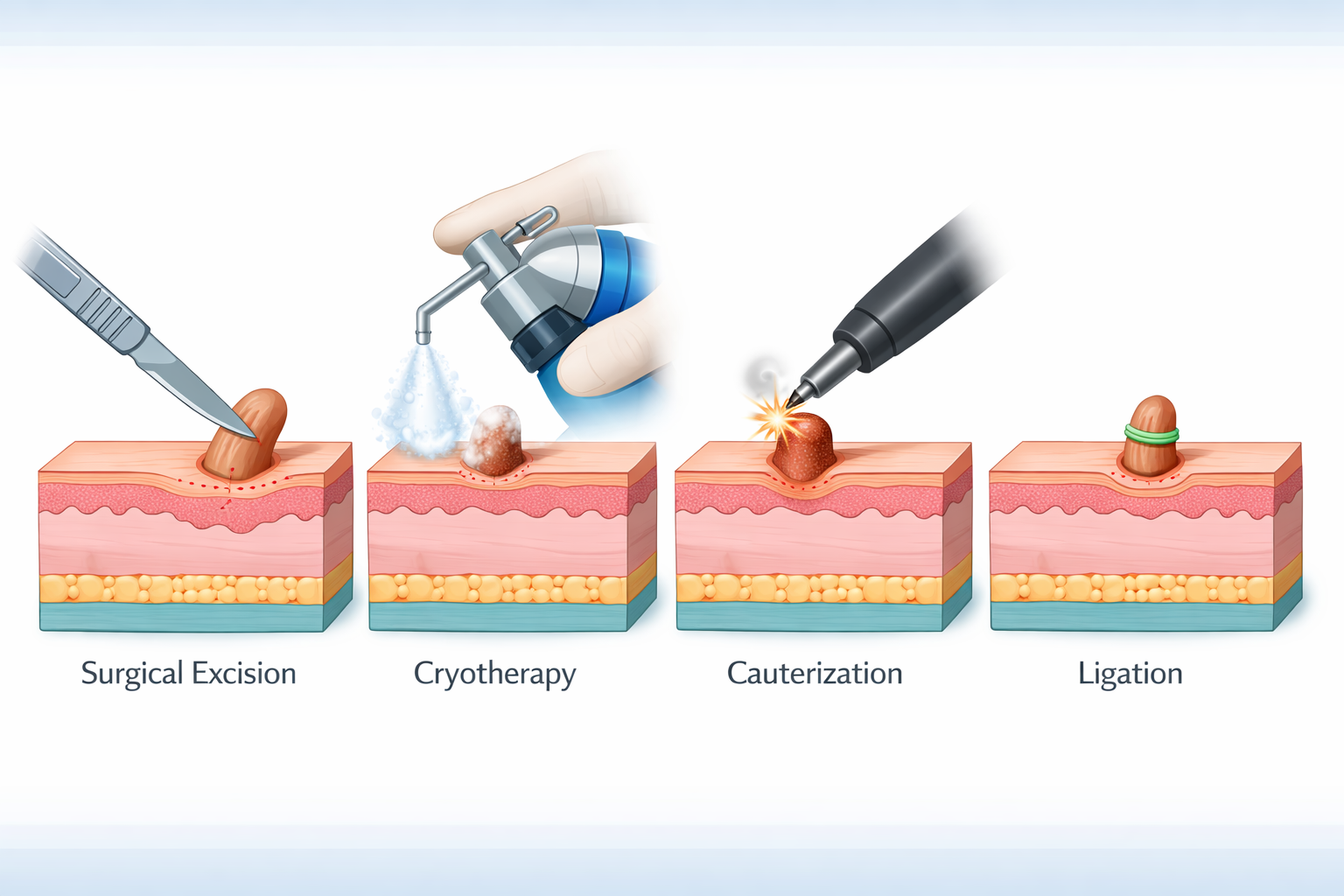
Professional skin tag removal is safe, quick, and highly effective when performed by an experienced surgical team. The right method depends on the tag’s size, location, and your skin type.
Here’s a breakdown of the main options:
| Method | How It Works | Best For | Typical Recovery |
|---|---|---|---|
| Surgical Excision | Tag is cut off with sterile scissors or a scalpel | Any size or location | 1–3 days |
| Cryotherapy | Liquid nitrogen freezes the tag, causing it to fall off | Small to medium tags | 1–2 weeks (tag falls off) |
| Cauterization | Electrical current burns the tag at its base | Tags with a clear stalk | 1–3 days |
| Ligation | A band cuts off blood supply to the tag | Medium-sized tags | 1–2 weeks (tag falls off) |
Surgical excision is the most immediate option — the tag is removed in a single visit with no waiting period. Cryotherapy and ligation involve a waiting period of days to weeks as the tag naturally falls off after treatment.
A novel silicone band ligation device is currently being evaluated in a clinical trial (NCT06463613), with the goal of achieving 60% successful removal rates. The device is designed to be less invasive than freezing or burning methods because it restricts blood supply without causing direct tissue damage. [1]
For a detailed comparison of all available options, see the skin tag removal methods comparison guide.
Choose excision if: you want immediate results or the tag is large.
Choose cryotherapy if: you prefer no cutting and have a small to medium tag.
Choose ligation if: you want a minimally invasive approach and can wait for the tag to fall away naturally.
Is At-Home Skin Tag Removal Safe?
At-home skin tag removal is widely available but carries meaningful risks that most people underestimate. Healthcare experts at UCLA Health explicitly recommend against home removal, noting that professional methods like excision, cauterization, or cryotherapy minimize pain and scarring risks. [6]
The appeal of DIY is understandable. The global skin tag remover market is projected to reach USD 681 million by 2025, with a compound annual growth rate of 5.1% from 2020 to 2034, driven in large part by demand for convenient at-home solutions. [2] Gel and cream formulations currently dominate the market due to ease of use, and natural ingredients like tea tree oil and thuja occidentalis are growing in popularity. [2]
But popularity doesn’t equal safety.
Common at-home risks include:
- Infection — breaking the skin without sterile conditions invites bacteria.
- Scarring — improper technique or incomplete removal can leave permanent marks.
- Bleeding — skin tags have a blood supply; cutting them without proper tools can cause more bleeding than expected.
- Incomplete removal — the tag may grow back if the base isn’t fully treated.
- Misidentification — not every growth is a skin tag. Removing something that’s actually a mole, wart, or suspicious lesion at home is dangerous.
Over-the-counter cryotherapy devices have received FDA clearance for home use [1], but “cleared” doesn’t mean “risk-free.” They’re generally less precise than clinical-grade equipment and may require multiple applications.
The bottom line: if you’re unsure what the growth is, or if it’s in a sensitive location (near the eyes, on the eyelids, in the groin), always consult a professional. For more on the risks of DIY approaches, read the detailed breakdown of DIY skin tag removal.
When Should You See a Doctor for Skin Tag Removal?
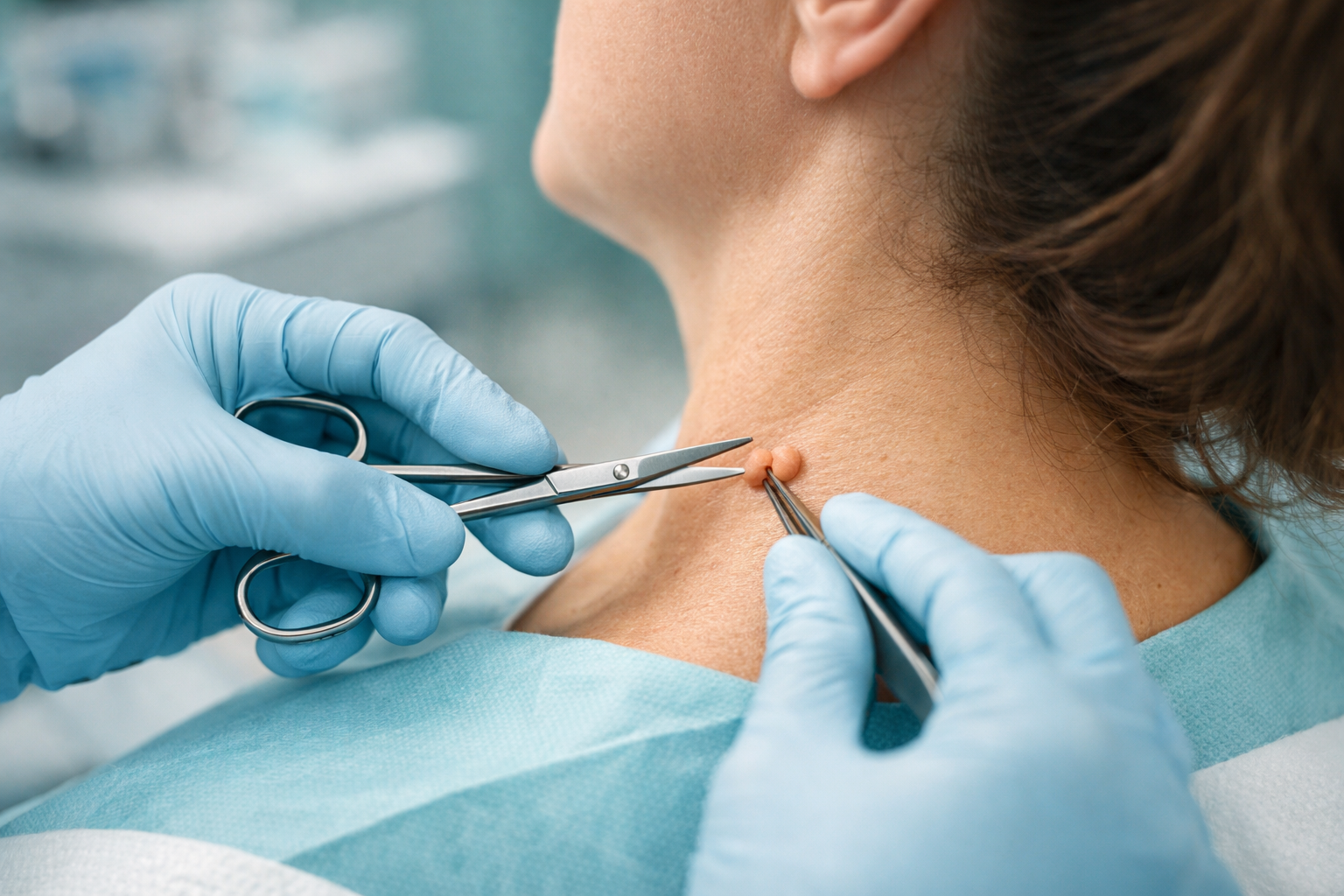
Most skin tags don’t require urgent medical attention — but there are clear situations where professional evaluation is the right call.
See a doctor if the growth:
- Bleeds, itches, or causes persistent pain
- Changes in size, shape, or color over time
- Has an irregular border or uneven coloring
- Is located near your eye, eyelid, or in the groin area
- You’re not 100% certain it’s a skin tag
Any growth that changes should be assessed to rule out skin cancer or other conditions. If you have concerns about a suspicious lesion, the skin cancer conditions page explains what to look for and when to act.
Also consider professional removal if:
- The tag is large (over 5mm at the base)
- It’s in an area that’s frequently irritated by clothing or jewelry
- You’ve tried at-home methods without success
- You want a clean, scar-minimized result
A trained surgeon can also remove multiple tags in a single visit, which is both efficient and cost-effective. The skin tag removal service page outlines what a professional consultation looks like.
What Happens During a Professional Skin Tag Removal Procedure?
Professional skin tag removal is quick, straightforward, and performed under local anesthetic. Most patients are in and out in under 30 minutes.
Here’s what to expect, step by step:
- Consultation: The surgeon examines the tag, confirms it’s benign, and recommends the most appropriate removal method.
- Preparation: The area is cleaned and sterilized. A local anesthetic is applied or injected to numb the site.
- Removal: Depending on the method chosen, the tag is excised, frozen, cauterized, or ligated.
- Post-procedure care: A small bandage may be applied. The surgeon provides aftercare instructions.
- Follow-up (if needed): For ligation or cryotherapy, a follow-up may be scheduled to confirm the tag has fully resolved.
The comfort-first approach at The Minor Surgery Center means patients receive clear explanations at every step, and the experienced surgical team is focused on making the process as smooth as possible.
Common mistake to avoid: Assuming all skin tags are identical. Tags vary in size, stalk thickness, and location — and the best removal method isn’t always the same. A personalised treatment plan from a qualified surgeon accounts for all of these factors.
How Much Does Skin Tag Removal Cost in Toronto?
Cost depends on the number of tags, the removal method, and the clinic. In Canada, skin tag removal is generally considered a cosmetic procedure and is not covered by OHIP unless the tag is causing a documented medical problem (such as repeated bleeding or interference with vision).
Typical cost factors include:
- Number of skin tags being removed
- Size and location of each tag
- Method used (excision, cryo, cauterization)
- Clinic fees and surgeon experience
To get a clearer picture of what your specific procedure might cost, use The Minor Surgery Center’s minor surgery cost estimator — it’s a free tool that gives you a realistic range based on your situation.
Patients in the Greater Toronto Area can access expert outpatient care at multiple clinic locations, including:
Can Skin Tags Come Back After Removal?
Once a skin tag is fully removed, it won’t grow back in the same spot. However, new skin tags can develop elsewhere — especially if the underlying factors (friction, weight, hormonal changes) haven’t changed.
What determines whether new tags appear:
- Body weight: excess weight increases skin-on-skin friction
- Hormonal changes: pregnancy and insulin resistance are linked to new tag formation
- Genetics: some people are simply more prone to developing them
- Age: skin tag formation becomes more common after 40
Removing existing tags doesn’t prevent future ones, but it does permanently resolve the ones treated. If you’re prone to developing multiple tags, a conversation with your surgeon about monitoring and periodic treatment is worthwhile.
At-Home vs. Professional Skin Tag Removal: A Clear Comparison

Choosing between at-home and professional skin tag removal comes down to safety, reliability, and what you’re comfortable with.
| Factor | At-Home | Professional |
|---|---|---|
| Cost (upfront) | Lower | Higher |
| Safety | Variable | High (sterile, supervised) |
| Effectiveness | Inconsistent | Reliable |
| Speed of results | Slow (days to weeks) | Immediate to 2 weeks |
| Scarring risk | Higher | Lower |
| Suitable for all locations | No | Yes |
| Requires multiple attempts | Often | Rarely |
| Medical oversight | None | Full |
The market for at-home skin tag removers is expanding rapidly, and consumers increasingly expect visible results within just a few applications. [2] But the reality is that professional removal consistently outperforms DIY methods on every metric that matters: safety, reliability, and long-term results.
Think of it this way: you could try to fix a leaky pipe yourself, or you could call a plumber and have it done right the first time. Professional skin tag removal is the equivalent of calling the plumber — efficient, clean, and no repeat visits for the same problem.
Frequently Asked Questions About Skin Tag Removal
Q: Are skin tags dangerous?
Skin tags are benign (non-cancerous) growths. They pose no health risk on their own. However, any growth that bleeds, changes shape, or looks unusual should be evaluated by a doctor to rule out other conditions.
Q: Does skin tag removal hurt?
Professional removal is performed under local anesthetic, so the procedure itself is not painful. You may feel mild discomfort after the anesthetic wears off, but this typically resolves within a day or two.
Q: How long does the procedure take?
Most skin tag removal appointments at an outpatient clinic take 15 to 30 minutes, including preparation and aftercare instructions.
Q: Can I remove multiple skin tags in one visit?
Yes. A qualified surgeon can remove multiple tags in a single appointment, which is both time-efficient and cost-effective.
Q: Will my skin tag grow back after removal?
A fully removed skin tag will not return to the same spot. New tags may develop elsewhere over time, depending on individual factors like friction, weight, and genetics.
Q: Is skin tag removal covered by OHIP in Ontario?
In most cases, no. Skin tag removal is classified as cosmetic unless the tag is causing a documented medical issue. Your clinic can advise on what’s covered based on your specific situation.
Q: What’s the difference between a skin tag and a mole?
Skin tags are soft, flesh-colored, and hang off the skin by a stalk. Moles are flat or slightly raised, usually darker in color, and sit flush with or just above the skin surface. If you’re unsure which you have, a surgeon can assess it during a consultation.
Q: Are at-home freezing kits safe to use?
Some OTC cryotherapy kits have received FDA clearance [1], but they’re less precise than clinical equipment and may require multiple applications. They’re generally not recommended for tags near the eyes, eyelids, or groin.
Q: What should I do after skin tag removal?
Keep the area clean and dry. Avoid picking at any scab that forms. Your surgeon will provide specific aftercare instructions based on the method used.
Q: Can skin tags be a sign of diabetes?
There is an association between skin tag development and insulin resistance or type 2 diabetes. If you’re developing multiple skin tags rapidly, it’s worth mentioning to your family doctor.
Q: How do I know if a growth is a skin tag or something more serious?
If a growth is soft, flesh-colored, and hangs by a stalk, it’s likely a skin tag. If it’s dark, irregular, firm, or growing quickly, see a doctor. When in doubt, always get it checked.
Q: Where can I get skin tag removal near me in Toronto?
The Minor Surgery Center has clinics across the Greater Toronto Area, including locations in Mississauga, Scarborough, Brampton, North York, and Markham.
Conclusion
Skin tag removal is one of the most common and straightforward minor surgical procedures available. Whether a tag is bothering you physically or simply something you’d rather not have, you have real options — and the safest, most reliable path is professional care.
At-home treatments have their place for very small, uncomplicated tags, but they come with genuine risks: infection, scarring, incomplete removal, and the danger of misidentifying a growth. A qualified surgeon removes the guesswork entirely.
Here’s what to do next:
- Identify your tags. Note their size, location, and whether any have changed recently.
- Check for warning signs. Bleeding, color changes, or irregular borders warrant a medical assessment before any removal attempt.
- Book a consultation. A brief appointment with an experienced surgical team is all it takes to get a personalised treatment plan and a clear cost estimate.
- Get back to your life. Most procedures take under 30 minutes, with minimal downtime.
The Minor Surgery Center offers safe and efficient surgery for skin tags across the Greater Toronto Area, with a comfort-first approach and expert outpatient care at every step. If you’re ready to get those tags taken care of, explore skin tag removal options near you or use the cost estimator tool to understand your investment before you book.
References
[1] Nct06463613 – https://clinicaltrials.gov/study/NCT06463613
[2] Skin Tag Remover 227709 – https://www.archivemarketresearch.com/reports/skin-tag-remover-227709
[6] Skin Tags While Usually Harmless Should Not Be Removed Home – https://www.uclahealth.org/news/article/skin-tags-while-usually-harmless-should-not-be-removed-home
Tags: skin tag removal, acrochordons, skin tag treatment, cryotherapy, surgical excision, minor surgery Toronto, at-home skin tag removal, skin lesions, outpatient surgery, skin tag cost, cauterization, ligation