25 Mar
Last updated: March 25, 2026
Quick Answer
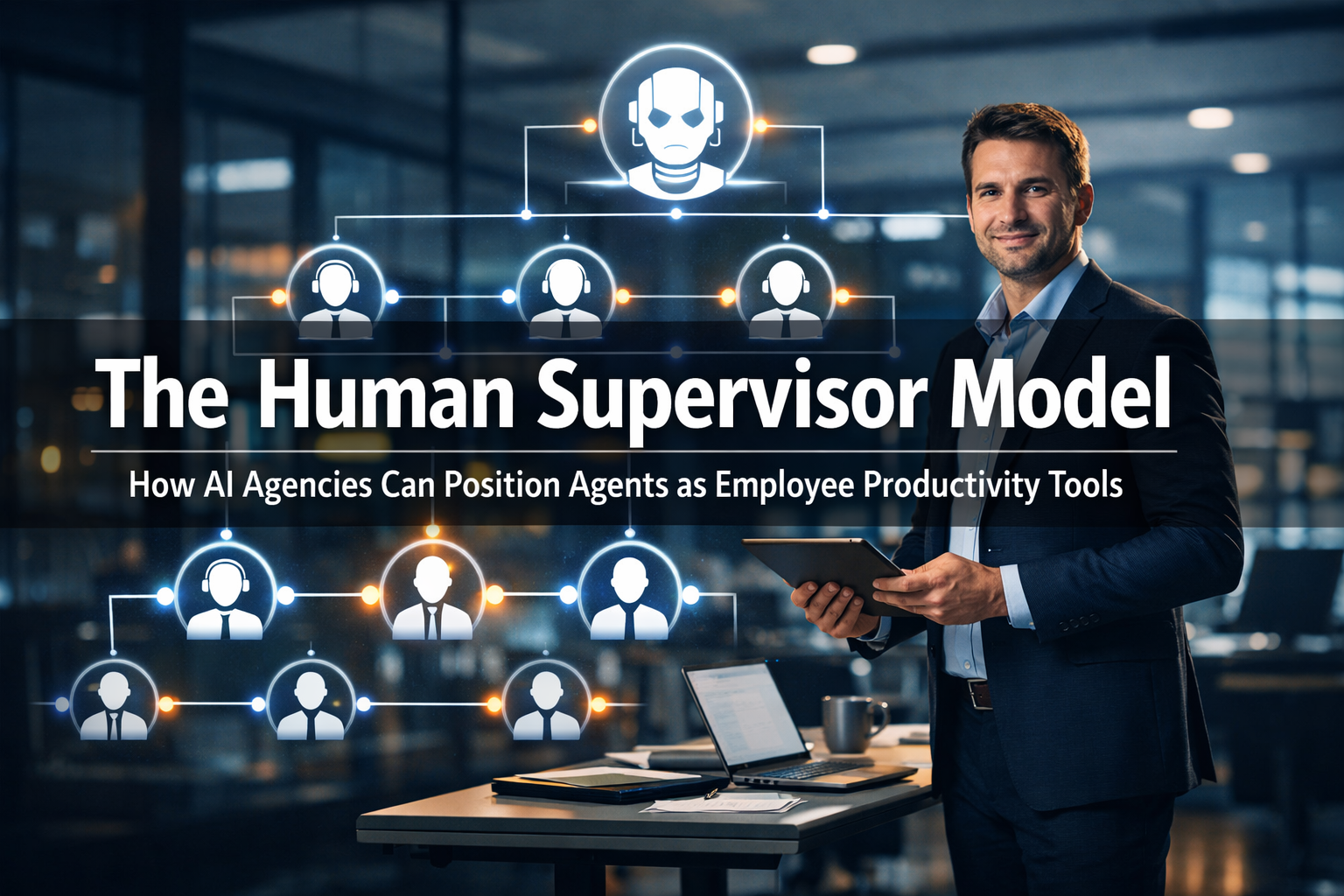
The Human Supervisor Model reframes AI agents not as job replacements, but as specialized digital workers that human employees direct and oversee. For AI agencies, this creates a distinct service category: helping corporate clients build, deploy, and manage teams of AI agents that amplify what each employee can accomplish. The differentiator is positioning the human as the manager, not the machine.
Key Takeaways
- The Human Supervisor Model positions every employee as a manager of AI agents, shifting their role from task executor to strategic overseer.
- AI agencies can build a new service category around “agent team management,” selling ongoing support rather than one-time software deployments.
- A 41-percentage-point gap exists between executive comfort with AI (92%) and employee comfort (51%), creating a clear training and change management opportunity for agencies. [2]
- Gartner predicts 20% of organizations will use AI to flatten structures and eliminate more than half of current middle management roles through 2026. [3]
- Real-world deployments show measurable results: Suzano achieved a 95% reduction in query time across 50,000 employees using a single AI agent. [4]
- Performance management systems must be redesigned to evaluate human-plus-AI collaboration, not just individual human output. [2]
- Critical thinking, judgment, and oversight skills are becoming the most valuable human competencies as AI handles analytical and repetitive work. [3]
- Agencies that lead with workforce integration—not just technology—win longer, stickier client relationships.
What Is the Human Supervisor Model and Why Does It Matter in 2026?
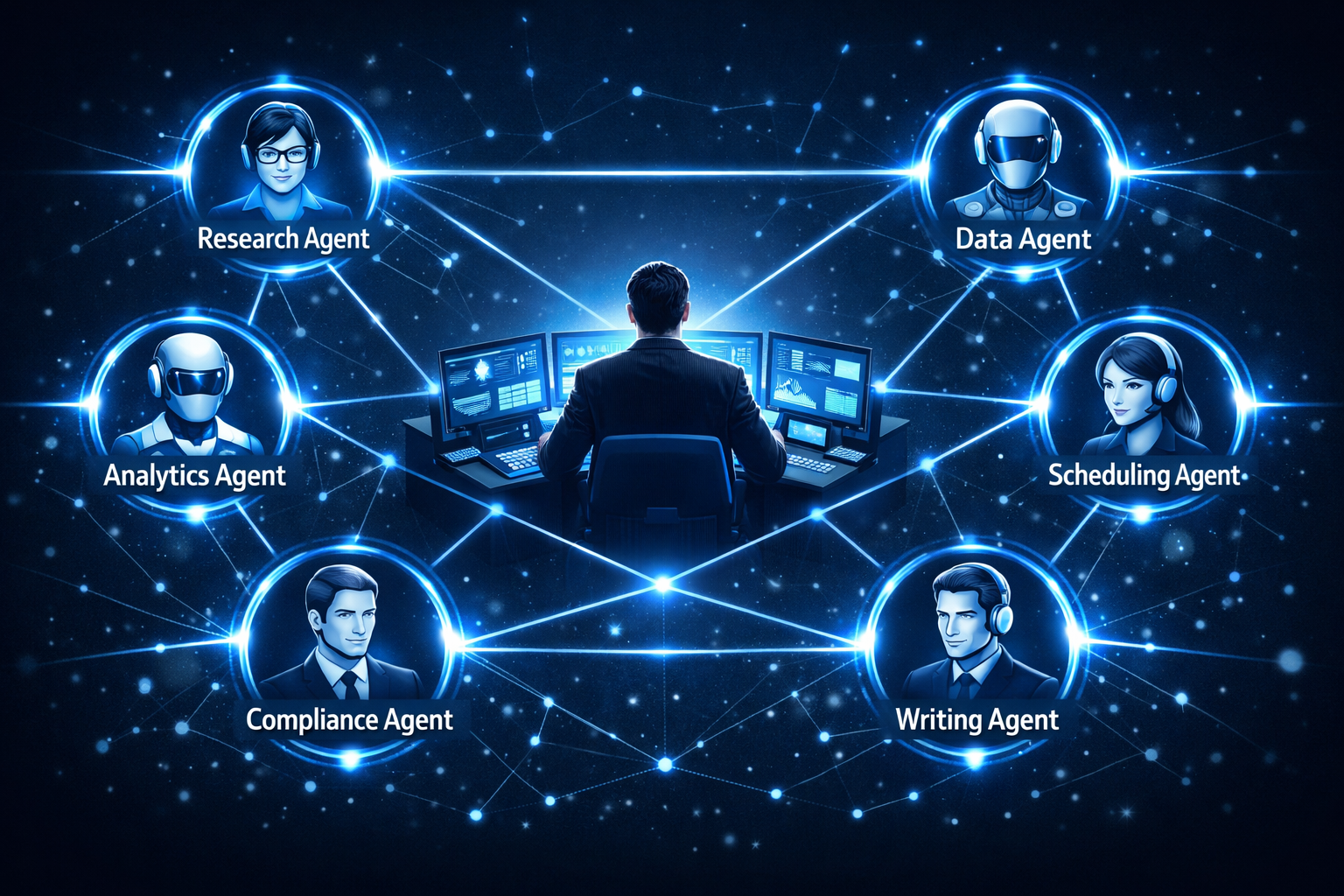
The Human Supervisor Model is a workforce framework where employees act as supervisors of AI agents, delegating specific tasks to specialized tools while retaining responsibility for strategy, judgment, and quality control. It matters because it solves the most common reason AI deployments fail: employees don’t know where they fit once the technology arrives.
Most organizations in 2026 are not short on AI tools. They’re short on a clear story about what humans are supposed to do alongside those tools. The Human Supervisor Model provides that story.
Why this framing works:
- It preserves employee identity and authority rather than threatening it.
- It creates a clear division of labor: AI handles volume and speed, humans handle judgment and accountability.
- It gives managers a concrete vocabulary for discussing AI adoption with their teams.
According to research from BetterWorks, employees currently view AI as a leadership priority rather than an integrated tool, because they haven’t been shown how it supports their specific roles. [2] The supervisor model directly addresses that gap by making the employee’s role explicit.
“Every employee is becoming a manager—not of people, but of AI agents. Most workers have never been trained for that.” [1]
For AI agencies, this is the opening. Clients don’t just need agents deployed. They need a model for how their people work alongside those agents every day.
How Does the Human Supervisor Model Create a New Service Category for AI Agencies?
The Human Supervisor Model gives AI agencies a way to sell ongoing relationships instead of one-time implementations. The service category is “agent team management for corporate clients”—a combination of agent configuration, employee training, workflow integration, and performance review.
This is a meaningful shift from the typical agency pitch, which centers on technology. The new pitch centers on productivity outcomes for specific employee roles.
Three layers of the service category:
- Agent team design — Identifying which tasks within a role are best delegated to AI agents, then selecting or building the right agents for each function.
- Supervisor training — Teaching employees how to direct, evaluate, and correct AI agents, including prompt design, output review, and escalation protocols.
- Performance monitoring — Tracking agent output quality over time and iterating on configurations to maintain alignment with organizational goals.
This last layer is where the distinction between observability and supervision becomes critical. Observability tells you what happened. Supervision asks should it have happened, and then drives improvement. [1] Agencies that build supervision frameworks—not just dashboards—provide far more durable value.
Who this service is for:
- Mid-to-large enterprises deploying AI agents across multiple departments.
- HR and operations teams redesigning workflows around human-AI collaboration.
- Organizations that have purchased AI tools but haven’t seen productivity gains yet.
Who it’s not for:
- Small businesses with fewer than 10 employees, where the overhead of agent management may outweigh the gains.
- Organizations still in early AI awareness stages who need foundational literacy work first.
What Does the “10x Employee” Framework Mean for Corporate Clients?
The “10x employee” concept describes workers who, rather than doing tasks themselves, orchestrate teams of AI agents to achieve goals at a scale no individual could match alone. [4] For corporate clients, this is the productivity argument that justifies investment in the Human Supervisor Model.
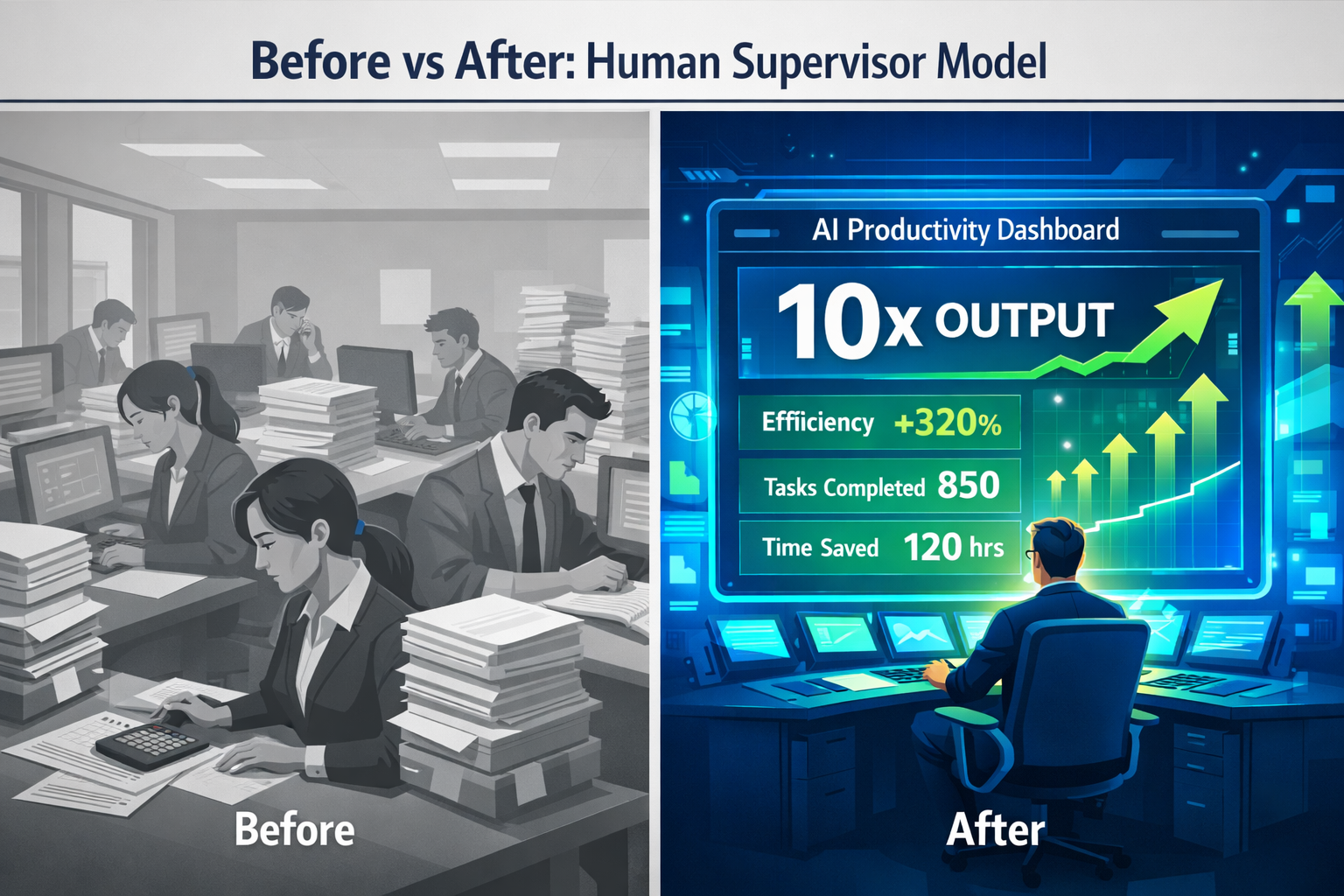
The math is straightforward. An employee who spends four hours daily on research, data formatting, and report drafting can redirect that time to strategy and client relationships if AI agents handle those tasks. The employee’s output doesn’t just improve—it multiplies.
A concrete example: Suzano, a global paper and pulp company, deployed an AI agent that translates natural language questions into SQL queries for materials data. The result was a 95% reduction in query time across 50,000 employees. [4] The employees didn’t disappear. They became supervisors of a tool that made each of them dramatically more capable.
How agencies should frame this for clients:
| Traditional Model | Human Supervisor Model |
|---|---|
| Employee completes task | Employee directs agent, reviews output |
| Productivity limited by individual capacity | Productivity scales with agent configuration |
| Training focuses on task skills | Training focuses on oversight and judgment |
| Performance measured individually | Performance measured as human + agent output |
| Middle manager coordinates workflow | AI agent handles coordination tasks |
The 10x framing also helps agencies avoid the replacement narrative that creates employee resistance. The message is augmentation: the employee gets more capable, not redundant.
By 2027, half of companies using generative AI are expected to launch agentic AI applications capable of complex work with limited human oversight. [3] Agencies that help clients build supervisor competency now are positioning those clients to manage that transition without disruption.
What Is the Executive-Employee Confidence Gap and How Should Agencies Address It?
The confidence gap is one of the most practical implementation challenges agencies face. Research from BetterWorks found that 92% of executives feel comfortable using AI to get work done, compared to only 51% of employees—a 41-percentage-point disparity. [2]
This gap doesn’t mean employees are resistant to AI. It means they haven’t been shown how it applies to their actual work. Executives see AI as a strategic asset. Employees see it as something happening to them.
The agency’s role in closing this gap:
- Role-specific use cases: Don’t show employees a general AI demo. Show a customer service rep how an agent handles ticket triage. Show a financial analyst how an agent formats data for review. Specificity builds confidence.
- Supervisor framing from day one: Introduce AI agents as tools the employee controls, not systems that evaluate them. Language matters enormously here.
- Quick wins early: Deploy agents on genuinely tedious tasks first. When an employee sees an agent save two hours of formatting work in the first week, adoption accelerates.
A common mistake agencies make is launching with the most technically impressive agent rather than the most immediately useful one. Start with the task employees find most frustrating, not the one that showcases the technology best.
How Should Agencies Redesign Performance Management Around the Supervisor Model?
Performance management systems built for individual human output don’t capture value in a human-plus-AI model. BetterWorks data shows that six times more executives than employees believe performance reviews have kept pace with AI-driven work. [2] That gap creates confusion about what good performance looks like.
Agencies advising corporate clients on the Human Supervisor Model should recommend explicit changes to how performance is defined and measured.
What to change:
- Redefine output metrics to include the combined productivity of the employee and their agent team, not just individual task completion.
- Add supervision quality as a competency — how well does the employee direct agents, catch errors, and iterate on configurations?
- Separate AI-assisted and AI-free assessments where appropriate. Gartner warns that critical-thinking skill atrophy from GenAI use will push 50% of organizations to require AI-free skills assessments by 2026. [3] Agencies should help clients build both evaluation types.
- Recognize escalation judgment — the ability to identify when an AI agent’s output requires human intervention is a skill worth measuring.
“The performance review of 2026 needs to answer one question: how well does this person work with their agent team, not just how much did they produce alone.” [2]
A practical checklist for clients redesigning performance systems:
- Audit current KPIs for tasks now handled by AI agents
- Define new competencies around agent supervision and quality review
- Update job descriptions to reflect human-plus-agent role expectations
- Train managers to evaluate AI-assisted work fairly
- Build in AI-free assessment components for core judgment skills
How Do Agencies Build the Supervision Framework That Clients Actually Need?
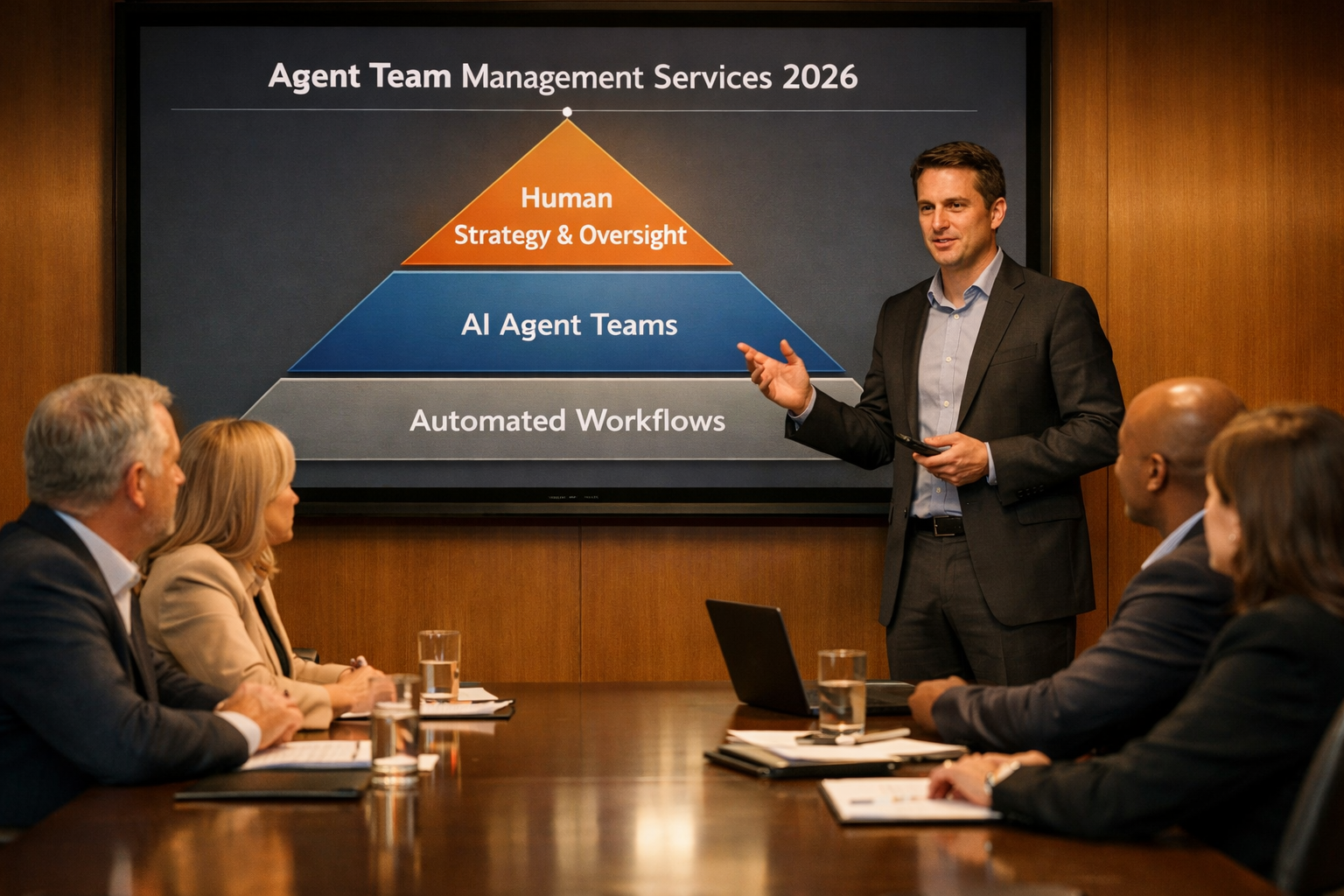
A supervision framework answers the question organizations most often skip: not “what can the agent do?” but “how do we know it did it right?” Moving from observability to genuine supervision is what separates agencies that deliver lasting results from those that deliver impressive demos. [1]
The four components of a working supervision framework:
- Task scope definition — Clear documentation of what each agent is authorized to do, what it should escalate, and what it should never attempt.
- Output review protocols — Structured processes for employees to check agent outputs before they enter a workflow. This includes checklists, sampling rates, and red-flag criteria.
- Feedback loops — Mechanisms for employees to flag agent errors and feed corrections back into configuration or prompt design.
- Escalation paths — Defined routes for when an agent output requires human judgment, legal review, or client approval.
Human judgment remains essential for strategy, nuanced decisions, and serving as the final checkpoint for quality, accuracy, tone, and organizational alignment. [4] The supervision framework makes that checkpoint systematic rather than ad hoc.
Edge case to watch: In organizations where middle management is being reduced (Gartner predicts AI will eliminate more than half of current middle management positions in 20% of organizations through 2026 [3]), the supervision framework must account for who owns agent oversight when the traditional supervisor role no longer exists. Agencies should help clients assign agent ownership explicitly during restructuring, not after.
What Are the Ethical Oversight Requirements Agencies Must Build Into the Model?
Ethical oversight is not a compliance checkbox. It’s a trust-building mechanism that affects both employee confidence and client reputation. Questions about bias, transparency, and accountability have moved from theoretical to urgent business concerns, and organizations that handle them well earn both employee and customer loyalty. [3]
Minimum ethical oversight requirements for any agent deployment:
- Bias auditing: Agents trained on historical data can replicate historical biases. Build regular audits into the service agreement, not just the initial setup.
- Transparency documentation: Employees should know which decisions in their workflow involve AI agent output. Hidden AI involvement erodes trust when discovered.
- Accountability assignment: For every agent action, there must be a named human responsible for reviewing and standing behind the output. “The AI did it” is not an acceptable answer in client-facing or regulated contexts.
- Data handling protocols: Agents often process sensitive employee or customer data. Agencies must ensure configurations comply with applicable privacy regulations.
For agencies, building ethical oversight into the standard service package—rather than offering it as an add-on—signals maturity and reduces client risk. It’s also a competitive differentiator, because many agencies still treat ethics as optional.
How Can AI Agencies Package and Sell the Human Supervisor Model to Corporate Clients?
The Human Supervisor Model is most effectively sold as a transformation engagement with three phases, each with its own deliverables and renewal opportunity.
Phase 1: Workforce Readiness Assessment (4–6 weeks)
- Audit current workflows to identify high-value agent delegation opportunities
- Measure the executive-employee confidence gap within the organization
- Map existing tools and identify integration requirements
- Deliverable: Agent deployment roadmap with ROI projections by role
Phase 2: Agent Team Deployment and Supervisor Training (8–16 weeks)
- Configure and deploy initial agent team for priority use cases
- Run supervisor training for target employee groups
- Build supervision framework with output review protocols
- Deliverable: Live agent team with trained supervisors and documented workflows
Phase 3: Ongoing Agent Team Management (retainer)
- Monitor agent performance and iterate on configurations
- Expand agent scope as employee supervisor competency grows
- Redesign performance management systems to reflect human-plus-agent output
- Deliverable: Quarterly performance reports and continuous improvement roadmap
Pricing logic: Phase 1 and 2 are project fees. Phase 3 is a monthly retainer. The retainer is justified by the ongoing supervision and iteration work that clients cannot easily do themselves—especially as agent capabilities and organizational needs evolve.
The stickiest part of this model is Phase 3. Clients who have built agent teams and trained their employees to supervise them don’t easily switch agencies, because the institutional knowledge embedded in the supervision framework is genuinely hard to transfer.
FAQ
What is the Human Supervisor Model in simple terms? It’s a framework where employees act as managers of AI agents, directing them on tasks and reviewing their outputs, rather than doing those tasks themselves or being replaced by automation.
Why should AI agencies use this model instead of selling AI tools directly? Selling tools creates one-time transactions. Selling the Human Supervisor Model creates ongoing relationships built around workforce integration, training, and performance management—services that are harder to commoditize.
How is supervision different from observability in AI agent management? Observability tracks what an agent did. Supervision evaluates whether it should have done it and drives improvement. Agencies that build supervision frameworks deliver lasting value; those that only build dashboards don’t. [1]
What roles benefit most from the Human Supervisor Model? Knowledge workers with high volumes of repetitive analytical, research, or communication tasks see the fastest gains. Examples include financial analysts, customer service managers, HR coordinators, and operations leads.
How do you handle employees who are afraid AI agents will replace them? Lead with the supervisor framing from the start. Show employees they are gaining a team of tools they control, not losing their job to automation. Role-specific quick wins in the first two weeks are the most effective trust-builders.
What happens to middle managers under this model? Their role shifts from coordinating routine workflows (which agents handle) to developing people’s supervision skills, managing agent team performance, and focusing on strategic activities. Some middle management positions will be eliminated, but the remaining roles become higher-value. [3]
How long does it take to see productivity results? Quick wins on well-scoped tasks can appear within the first two to four weeks of deployment. Broader productivity gains typically emerge over three to six months as employees develop supervisor competency and agent configurations are refined.
Do employees need technical skills to supervise AI agents? No. The supervisor model is designed for non-technical employees. The agency handles configuration. Employees need clear protocols, good judgment, and the ability to evaluate outputs against quality standards.
How should performance reviews change under this model? Reviews should measure the combined output of the employee and their agent team, add supervision quality as an explicit competency, and include AI-free assessments for core judgment skills. [2]
What’s the biggest mistake agencies make when implementing this model? Deploying the most technically impressive agent first rather than the most immediately useful one. Start with the task employees find most frustrating, not the one that best showcases the technology.
Is the Human Supervisor Model suitable for small businesses? It’s most effective for mid-to-large organizations where the overhead of agent management is justified by scale. Small businesses with fewer than 10 employees may find simpler AI tool adoption more practical.
What ethical obligations come with deploying AI agents in a workforce? Agencies must build in bias auditing, transparency about which decisions involve AI output, clear accountability assignment, and data privacy compliance. These are not optional—they’re foundational to employee trust and client risk management. [3]
Conclusion: Actionable Next Steps for AI Agencies in 2026
The Human Supervisor Model is the clearest competitive differentiator available to AI agencies right now. The market is crowded with tool vendors. It is not crowded with agencies that help organizations answer the harder question: how do our people work alongside these tools, every day, in ways that actually improve output?
Immediate actions for agencies:
Reframe your pitch deck. Lead with employee productivity outcomes and the supervisor framework, not technical capabilities. Show clients what their employees will do differently, not just what the agent can do.
Build a workforce readiness assessment product. The executive-employee confidence gap is measurable and addressable. An assessment that quantifies it gives clients a baseline and gives your agency a clear starting point.
Develop role-specific supervisor training. Generic AI training doesn’t move the needle. Build training modules for specific roles—analyst, coordinator, manager—that show exactly how supervision works in that person’s daily workflow.
Package Phase 3 as a retainer from the start. Don’t let clients think the engagement ends at deployment. The ongoing supervision, iteration, and performance management work is where the real value lives—and where your agency becomes genuinely hard to replace.
Add ethical oversight to your standard service agreement. Bias auditing, transparency documentation, and accountability protocols should be included by default. It reduces client risk and signals that your agency operates at a higher standard.
The organizations that win the next five years won’t be the ones with the most AI tools. They’ll be the ones where every employee knows exactly how to work with those tools—and where an agency helped them build that capability systematically.
References
[1] Humans Of Ai Matan Paul Shetrit – https://writer.com/blog/humans-of-ai-matan-paul-shetrit/ [2] Performance Report 2026 – https://www.betterworks.com/performance-report-2026 [3] Ai Workforce Trends – https://gloat.com/blog/ai-workforce-trends/ [4] Blog 10x Employee – https://www.katonic.ai/blog-10x-employee